

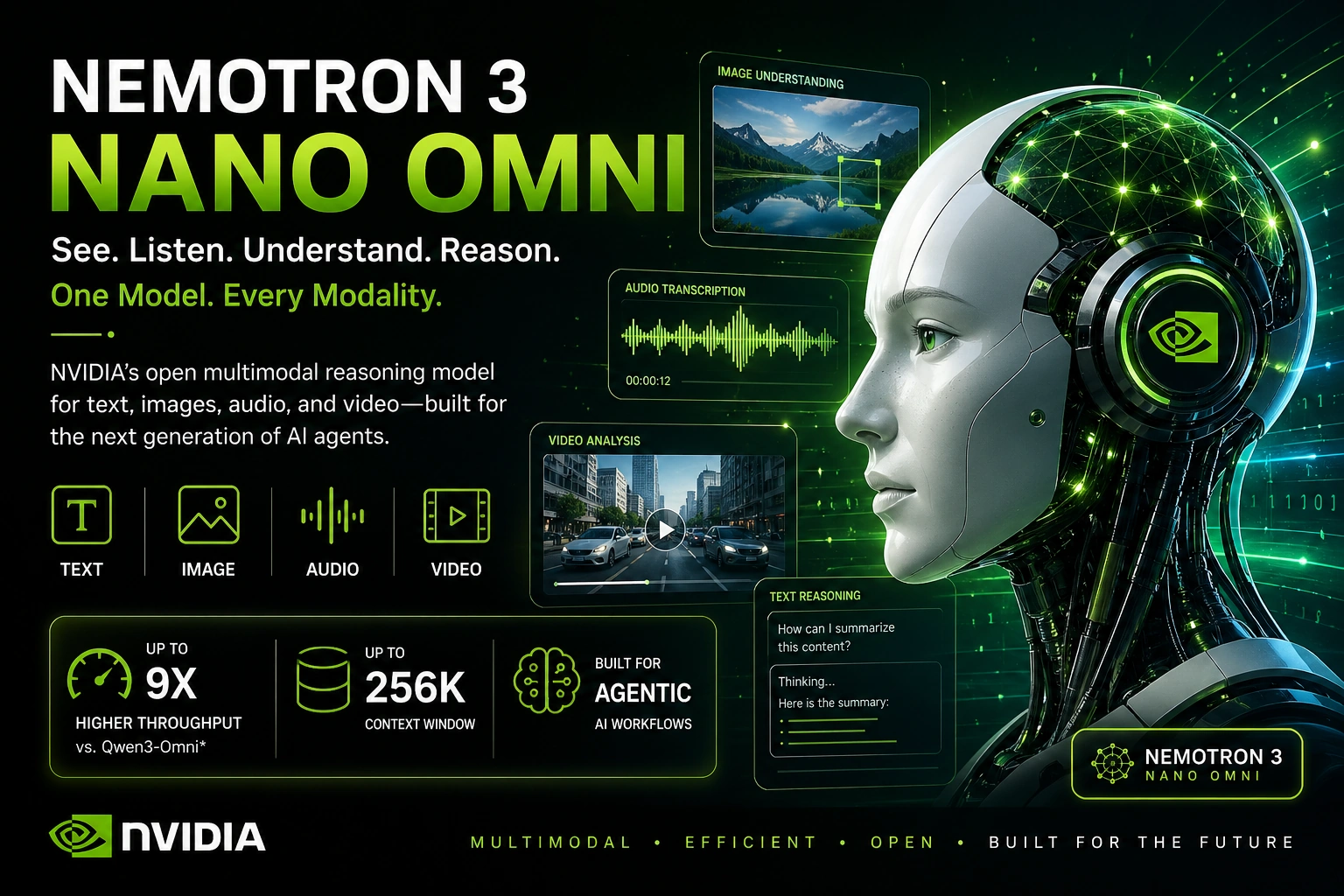
Nemotron 3 Nano Omni is NVIDIA’s open multimodal reasoning model for text, images, video, and audio. It is built to act as a fast perception model inside agent systems, so one model can read documents, watch screens, listen to speech, and return text answers. NVIDIA says the model launched on April 28, 2026, with BF16, FP8, and NVFP4 releases for commercial use under the NVIDIA Open Model Agreement.
Abstract / Overview
As of April 29, 2026, NVIDIA’s official material describes Nemotron 3 Nano Omni as a 30B-A3B hybrid Mixture of Experts, or MoE, model. MoE means the model uses only the parts it needs for each job, which helps speed and cost. NVIDIA also says it supports up to 256K context, takes video, audio, image, and text as input, and returns text output with support for JSON, tool calling, and word-level timestamps for transcription.
This model matters because it tries to replace a stacked setup of separate speech, vision, and language models with one reasoning loop. NVIDIA positions it for document intelligence, computer use agents, and audio-video understanding. In NVIDIA’s reported B200 tests, it delivered up to 9x higher output throughput than Qwen3-Omni at the same interactivity target on long-video workloads, and the quantized versions showed a median accuracy drop of less than 1% versus BF16 across 25 benchmarks.
Conceptual Background
Nemotron 3 Nano Omni is best understood as a perception-first model. NVIDIA says it works like the “eyes and ears” of an agent system. A bigger planning model can still be useful, but this model handles the seeing, reading, and listening layer in one place.
Three simple terms help explain it.
Multimodal means one model can work with more than one input type, such as text, images, audio, and video. Nemotron 3 Nano Omni supports all four.
Context window means how much information the model can hold in one request. NVIDIA lists this model at up to 256K tokens.
Quantization means shrinking the math format so the model uses less memory and can run faster. NVIDIA released BF16, FP8, and NVFP4 variants.
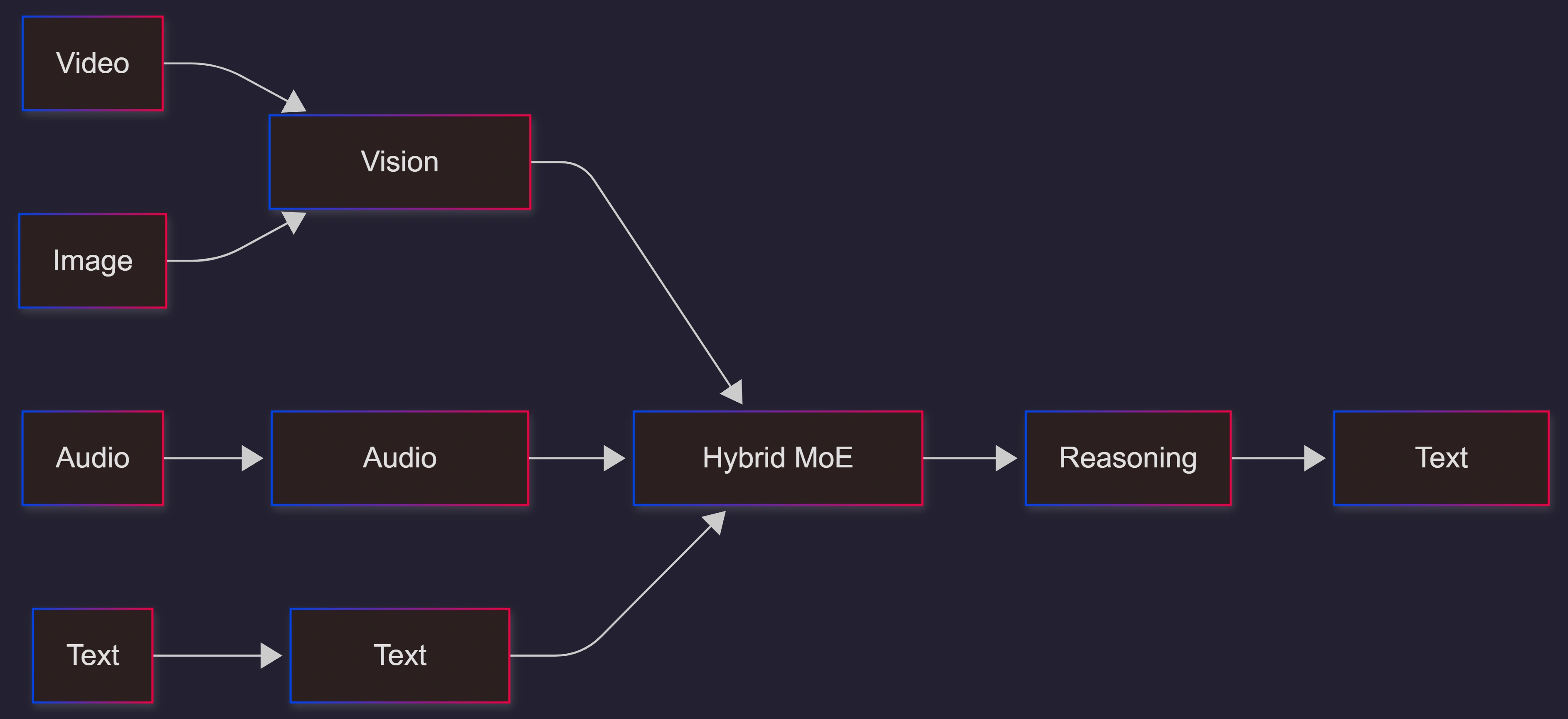
The core design combines a Nemotron 3 Nano 30B-A3B language backbone with a C-RADIOv4-H vision encoder and a Parakeet speech encoder. NVIDIA also says the model adds native audio support, dynamic image resolution, Conv3D-based temporal video compression, and a longer 256K context window compared with its earlier Nemotron Nano V2 VL release.
One expert quote in the launch material stands out. H Company CEO Gautier Cloix said, “This isn’t just a speed boost.” That is a good way to read this launch. The point is not only speed. The point is simpler agent design with less handoff between separate models.
Step-by-Step Walkthrough
Start with the job, not the model name
If your workflow needs one model to read a document, inspect a screen, listen to speech, or track what happens across a short video, this model fits well. NVIDIA’s own examples focus on computer use agents, document intelligence, customer service, media analysis, and mixed audio-video tasks.
Prepare the inputs the way NVIDIA recommends
The official model card says video input is MP4 up to 2 minutes. For 1080p video, NVIDIA suggests up to 1 FPS and 128 frames. For lower-resolution video like 720p, it says 2 FPS and 256 frames may be used. The same card says audio can be WAV or MP3 up to 1 hour, images can be JPEG or PNG, and language support is English only.
Pick the right deployment path
NVIDIA says the model is available through Hugging Face, build.nvidia.com, and NGC. The official model card also lists vLLM, NeMo, Megatron, NeMo-RL, TensorRT-LLM, llama.cpp, Ollama, and SGLang in the software stack, with Linux support and GPU support across Ampere, Hopper, Lovelace, and Blackwell platforms.
Choose the precision that matches your goal
BF16 is the full-size baseline. FP8 and NVFP4 are the smaller, faster options. NVIDIA’s report says BF16 is 61.5 GB, FP8 is 32.8 GB, and NVFP4 is 20.9 GB in its tested setup. The same report says the median accuracy drop for FP8 and NVFP4 stayed below 1% versus BF16 across 25 benchmarks, which makes quantized deployment look practical for many real workloads.
Use it as part of an agent stack when needed
NVIDIA does not present Nemotron 3 Nano Omni as the only model you will ever need. The launch material says it can work beside larger planner or execution models, including Nemotron 3 Super and Ultra, to serve as the perception sub-agent. That is a smart pattern for teams building real systems. Let this model see and summarize the world. Then let a stronger planner decide what to do next.
A simple rule helps. Keep the multimodal work here. Keep the long-term planning elsewhere. Then measure both latency and answer quality before you scale.
Use Cases / Scenarios
Document intelligence
This is one of the clearest fits. NVIDIA says the model is built for contracts, financial files, scientific documents, charts, tables, screenshots, and mixed-media inputs. If your team needs one model that can read the page layout, extract meaning, and answer questions in plain text, Nemotron 3 Nano Omni is a strong candidate.
Computer use agents
NVIDIA says the model can power the perception loop for agents that navigate graphical user interfaces. That means reading screens, tracking interface state, and understanding what changed over time. The official Hugging Face model card also reports a jump on OSWorld from 11.1 to 47.4 versus Nemotron Nano VL V2.
Audio and video understanding
The model can take speech and video together, which makes it useful for support calls, training recordings, meeting review, media search, and monitoring workflows. NVIDIA’s product page says it is a single model for video, audio, image, and text understanding, which is the main reason it can simplify an agent workflow.
Enterprise copilots and sub-agents
If you are building a business assistant, this model can sit at the front of the pipeline. It can turn messy multimodal inputs into clean text, JSON, timestamps, or tool calls for the next part of the system. NVIDIA’s model card says it supports JSON output, reasoning output, tool calling, and word-level timestamps for transcription.
If you want to move from a demo to a working pilot, this is the right point to bring in C# Corner Consulting. A good pilot needs more than model access. It needs prompt design, guardrails, test data, evaluation, cost controls, and a rollout plan.
Fixes
If latency is too high, try a smaller precision
NVIDIA’s own data shows large speed gains from quantized formats, especially NVFP4. Start with BF16 for validation, then test FP8 or NVFP4 against your own quality bar.
If video jobs feel noisy, reduce frame waste
The official report says Nemotron 3 Nano Omni uses efficient video sampling and Conv3D-based temporal compression. In plain language, it tries to keep useful motion and drop repeated frames. Follow NVIDIA’s sampling guidance instead of sending every possible frame.
If GUI results are inconsistent, keep screenshots sharp and tasks narrow
NVIDIA highlights high-resolution screen use and dynamic image resolution. That means the model benefits from clear interface images and focused prompts. Ask one task at a time, such as reading a dialog box, checking a table, or spotting a state change.
If your rollout is regulated, keep the deployment local or controlled
NVIDIA says the model is open, customizable, and deployable across local, edge, and data center environments. That matters for teams with data locality, sovereignty, or compliance needs. Still, the model card also says teams should do use-case-specific testing before deployment.
If you publish a product or case study around this model, publish it in more than one format. Use docs, short demo videos, PDFs, and technical notes. Then track Share of Answer, impressions, coverage, and sentiment so you can see whether AI search systems are picking up your work.
FAQs
1. What is Nemotron 3 Nano Omni in one line?
It is NVIDIA’s open multimodal reasoning model for text, images, video, and audio, built to act as a fast perception model for agent systems.
2. Is it open source?
The safer answer is that it is an open model with released weights and commercial use terms, governed by the NVIDIA Open Model Agreement. Check that agreement before production use.
3. Does it output audio, images, or video?
No. The official model card says the output type is text. It can still support things like JSON output, tool calling, and word-level timestamps for transcription.
4. How large is the model?
NVIDIA lists it as about 31B parameters in a 30B-A3B class design. In the official weight sizes, BF16 is 61.5 GB, FP8 is 32.8 GB, and NVFP4 is 20.9 GB in the evaluation setup reported by NVIDIA.
5. How much context does it support?
NVIDIA says the maximum context length is up to 256K tokens.
6. What inputs can it handle?
The official model card lists video, audio, image, and text. It says video can be MP4 up to 2 minutes, audio can be WAV or MP3 up to 1 hour, and images can be JPEG or PNG.
7. Which hardware does NVIDIA list?
The official model card lists support across NVIDIA Ampere, Hopper, Lovelace, and Blackwell GPU families, with Linux as the supported operating system.
8. What is the biggest reason to care about this model?
It can replace a fragmented multimodal stack with one model loop. That can lower cost, reduce latency, and keep context together across screen, document, audio, and video inputs. NVIDIA’s own launch and report materials frame this as the main value.
References
NVIDIA Developer. “Nemotron AI Models.” Official product page for the Nemotron family and Nemotron 3 Nano Omni. (NVIDIA Developer)
NVIDIA Blog. “NVIDIA Launches Nemotron 3 Nano Omni Model, Unifying Vision, Audio and Language for up to 9x More Efficient AI Agents.” April 28, 2026. (NVIDIA Blog)
NVIDIA Technical Blog. “NVIDIA Nemotron 3 Nano Omni Powers Multimodal Agent Reasoning in a Single Efficient Open Model.” April 29, 2026. (NVIDIA Developer)
NVIDIA Research. “Nemotron 3 Nano Omni: Efficient and Open Multimodal Intelligence.” Technical report, dated April 27, 2026.
NVIDIA on Hugging Face. “Nemotron-3-Nano-Omni-30B-A3B-Reasoning-BF16” model card. Release details, inputs, outputs, deployment, and quick-start notes. (Hugging Face)
Conclusion
Nemotron 3 Nano Omni looks like a serious step forward for practical multimodal agents. It is not just another big model with a new name. NVIDIA’s official material shows a clear design goal: one open model that can read, watch, listen, and reason fast enough to serve as a production sub-agent. If your team works on document intelligence, computer use, or audio-video workflows, this is one of the most important multimodal models to evaluate right now.
If you build with it, keep the rollout simple. Start with one narrow workflow. Measure quality, cost, latency, and failure cases. Publish your learnings in more than one format. Then track Share of Answer, impressions, coverage, and sentiment so your product earns visibility in both search and AI answers.
Join the conversation! Your thoughts help the community grow.