

Introduction
This is the content list of this article:
- Indroduction
- A - What is PowerShell
- Command-line Shell
- Scripting language
- Automation platform
- Configuration management
- B - The Windows PowerShell ISE
- Key Features
- Elements
- C - Cmdlets
- D - Scripting
- How To Run A PowerShell Script
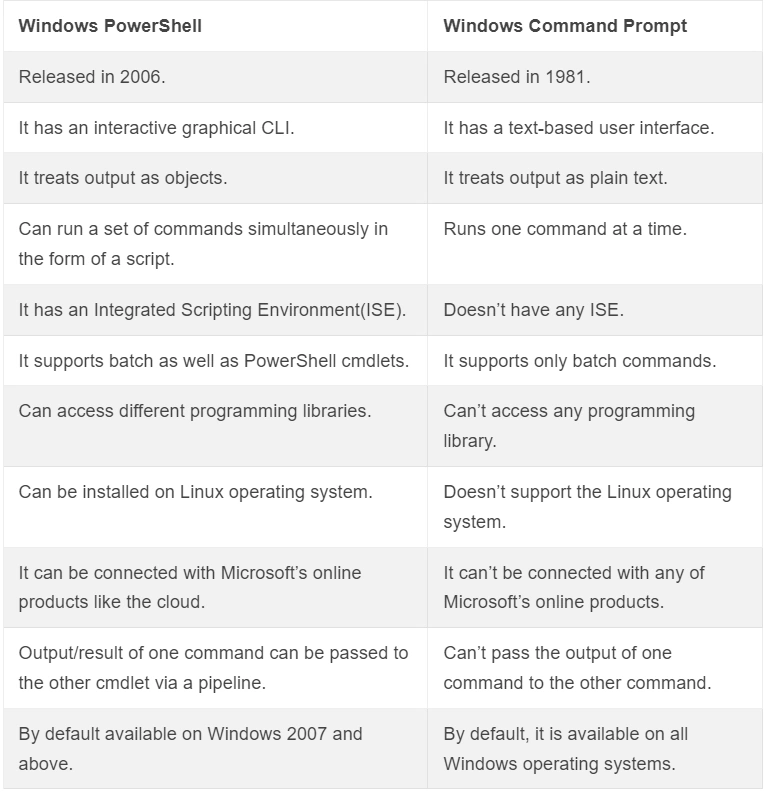
- E - Difference Between Command prompt and PowerShell
A - What is PowerShell? [ref]
PowerShell is a cross-platform task automation solution made up of
- a command-line shell,
- a scripting language, and
- a configuration management framework.
PowerShell runs on Windows, Linux, and macOS.
-
Command-line Shell
- PowerShell is a modern command shell that includes the best features of other popular shells. Unlike most shells that only accept and return text, PowerShell accepts and returns .NET objects. The shell includes the following features:
- Robust command-line history
- Tab completion and command prediction (See about_PSReadLine)
- Supports command and parameter aliases
- Pipeline for chaining commands
- In-console help system, similar to Unix
manpages
-
Scripting language
- As a scripting language, PowerShell is commonly used for automating the management of systems. It is also used to build, test, and deploy solutions, often in CI/CD environments. PowerShell is built on the .NET Common Language Runtime (CLR). All inputs and outputs are .NET objects. No need to parse text output to extract information from output. The PowerShell scripting language includes the following features:
- Extensible through functions, classes, scripts, and modules
- Extensible formatting system for easy output
- Extensible type system for creating dynamic types
- Built-in support for common data formats like CSV, JSON, and XML
-
Automation platform
- The extensible nature of PowerShell has enabled an ecosystem of PowerShell modules to deploy and manage almost any technology you work with. For example:
-
Configuration management
- PowerShell Desired State Configuration (DSC) is a management framework in PowerShell that enables you to manage your enterprise infrastructure with configuration as code. With DSC, you can:
- Create declarative configurations and custom scripts for repeatable deployments
- Enforce configuration settings and report on configuration drift
- Deploy configuration using push or pull models
B - The Windows PowerShell ISE
Windows PowerShell ISE (Integrated Scripting Environment) is a GUI tool for building and debugging PowerShell scripts, functions, and modules.
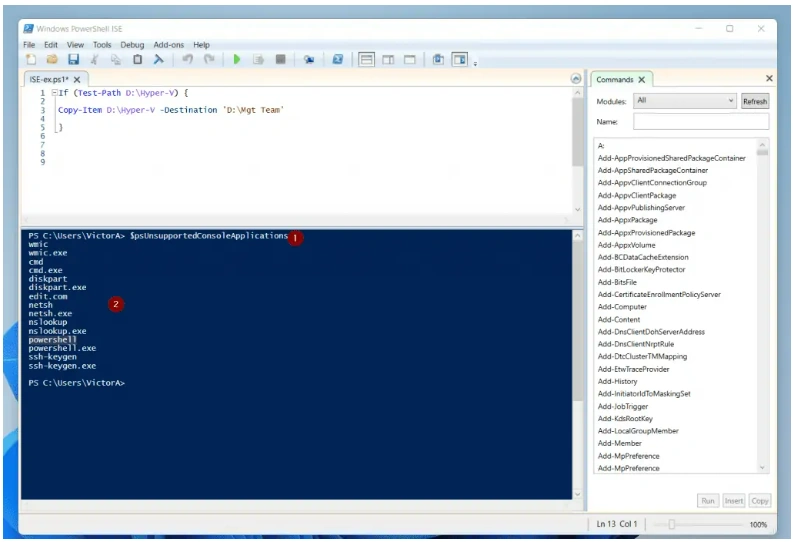
Key Features
- Multiline editing: To insert a blank line under the current line in the Command pane, press SHIFT+ENTER.
- Selective execution: To run part of a script, select the text you want to run, and then click the Run Script button. Or, press F5.
- Context-sensitive help: Type
Invoke-Item, and then press F1. The Help file opens to the article for theInvoke-Itemcmdlet.
The Windows PowerShell ISE lets you customize some aspects of its appearance. It also has its own Windows PowerShell profile script.
Elements
- Menu bar
- Toolbar
- PowerShell tabs
- Script tabs
- Console pane
- Script pane
- Status bar
- Text-size slider
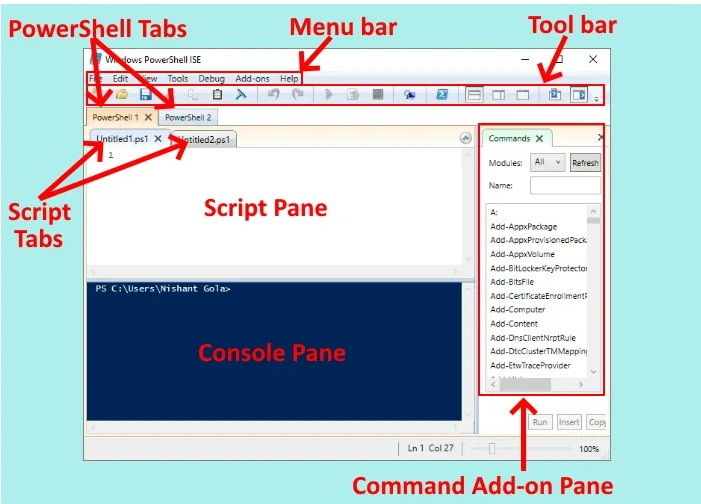
from How to use Windows PowerShell ISE - Beginners Tutorial (thewindowsclub.com)
These elements make it easy for a user to run, edit, and execute the commands and scripts.
C - Cmdlets
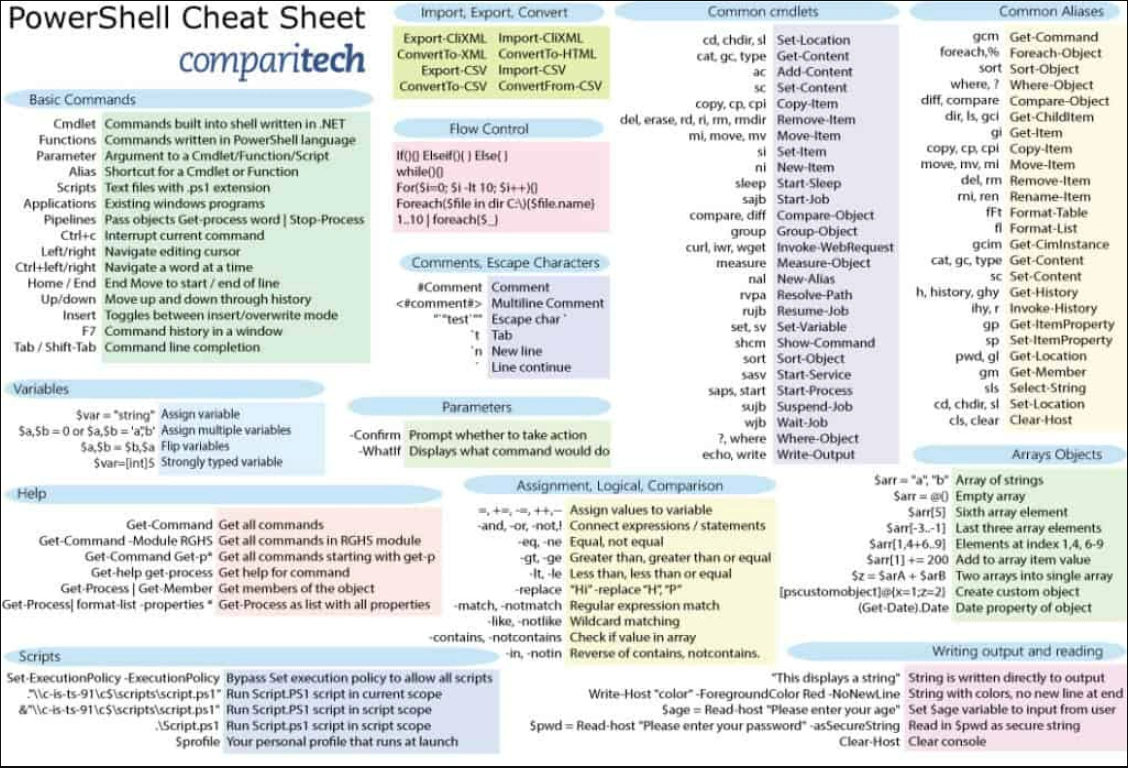
PowerShell commands are known as cmdlets.
- Basic PowerShell Cmdlets
- PowerShell Commands for Getting Things Done
- Cmdlets for Performance Monitoring, Testing, and Debugging
Here are 25 basic PowerShell comlets,
Join the conversation! Your thoughts help the community grow.