

Introduction
Xamarin.Forms code runs on multiple platforms - each of which has its own filesystem. This means that reading and writing files is most easily done using the native file APIs on each platform. Alternatively, embedded resources are a simpler solution to distribute data files with an app.

LiteDB

- LiteDB is a serverless database fully written in C# code.
- LiteDB stores documents in the BSON (Binary JSON) data format like MongoDB.
- LiteDB is a simple and fast NoSQL database. use to build Mobile, Desktop and small web applications.
Prerequisites
- Visual Studio 2017 or Later (Windows or Mac)
Setting up a Xamarin.Forms Project
Start by creating a new Xamarin.Forms project. You’ll learn more by going through the steps yourself or download the source from here.
Visual Studio 2019 has more options in the opening window. Clone or check out the code from any repository or, open a project or solution for your computer. Now, you need to click "Create a new project".
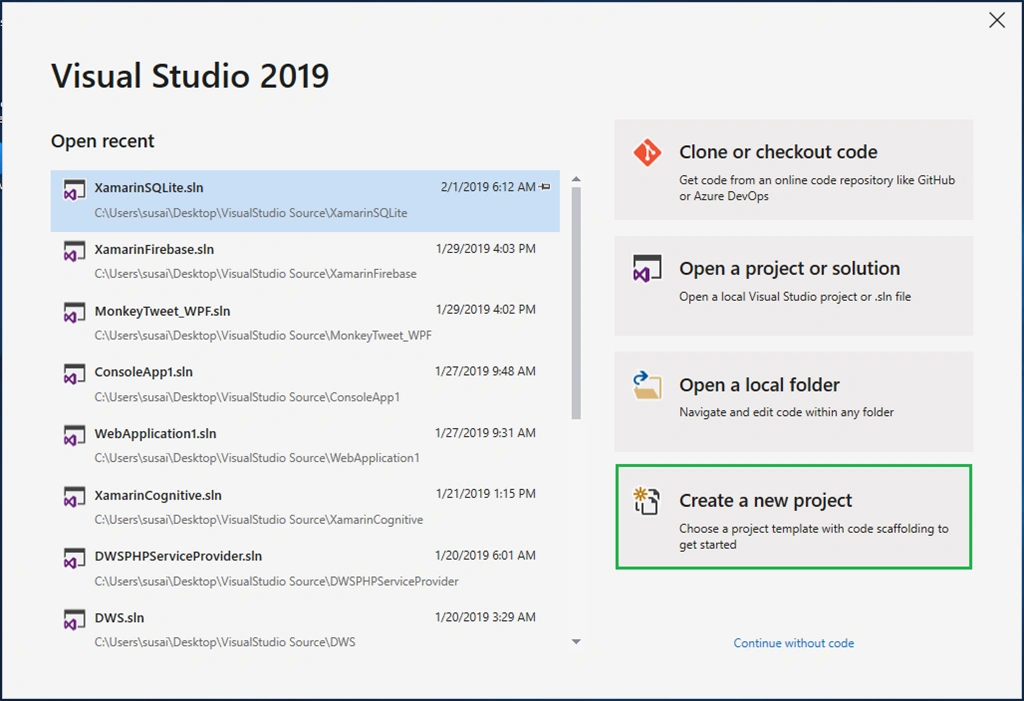
Now, filter by Project Type: Mobile
Choose the Mobile App (Xamarin. forms) project under C# and Mobile.
Name your app. You probably want your project and solution to use the same name as your app. Put it on your preferred location for projects and click "Create".
Now, select the blank app and target platforms - Android, iOS and Windows (UWP).
Subsequently, go to the solution. In there, you get all the files and sources of your project (.NET Standard). Now, select XAML page and double-click to open the MainPage.Xaml page.
You now have a basic Xamarin.Forms app. Click the "Play" button to try it out.
Setting up the User Interface
Go to MainPage.Xaml and write the following code.
MainPage.xaml
- <?xml version="1.0" encoding="utf-8" ?>
- <ContentPage xmlns="http://xamarin.com/schemas/2014/forms"
- xmlns:x="http://schemas.microsoft.com/winfx/2009/xaml"
- xmlns:local="clr-namespace:XamarinLiteDB"
- x:Class="XamarinLiteDB.MainPage">
- <StackLayout>
- <StackLayout>
- <StackLayout HorizontalOptions="Center" VerticalOptions="Start">
- <Image x:Name="imgBanner" Source="banner.png" ></Image>
- <Image Margin="0,0,0,10" HeightRequest="100" Source="liteDB.png" ></Image>
- <Label Margin="0,0,0,10" Text="LiteDB" FontAttributes="Bold" FontSize="Large" TextColor="Gray" HorizontalTextAlignment="Center" ></Label>
- <Entry x:Name="txtPersonId" Placeholder="PersonId Update and Delete"></Entry>
- <Entry x:Name="txtName" Placeholder="Enter Person Name"></Entry>
- <StackLayout HorizontalOptions="CenterAndExpand" Orientation="Horizontal">
- <Button x:Name="btnAdd" WidthRequest="200" Text="Add" Clicked="BtnAdd_Clicked" />
- <Button x:Name="btnRead" WidthRequest="200" Text="Read" Clicked="BtnRead_Clicked" />
- </StackLayout>
- <StackLayout HorizontalOptions="CenterAndExpand" Orientation="Horizontal">
- <Button x:Name="btnUpdate" WidthRequest="200" Text="Update" Clicked="BtnUpdate_Clicked" />
- <Button x:Name="btnDelete" WidthRequest="200" Text="Delete" Clicked="BtnDelete_Clicked" />
- </StackLayout>
- <ListView x:Name="lstPersons">
- <ListView.ItemTemplate>
- <DataTemplate>
- <TextCell Text="{Binding Name}" Detail="{Binding PersonId}"></TextCell>
- </DataTemplate>
- </ListView.ItemTemplate>
- </ListView>
- </StackLayout>
- </StackLayout>
- </StackLayout>
- </ContentPage>
Click the "Play" button to try it out.
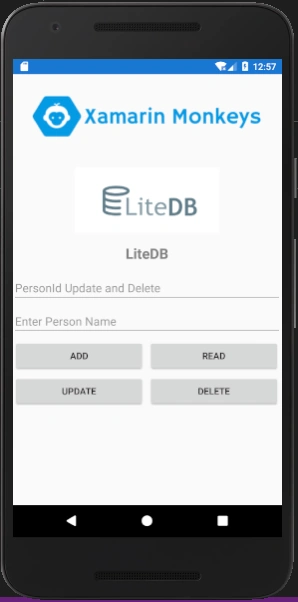
NuGet Packages
Now, add the following NuGet Packages.
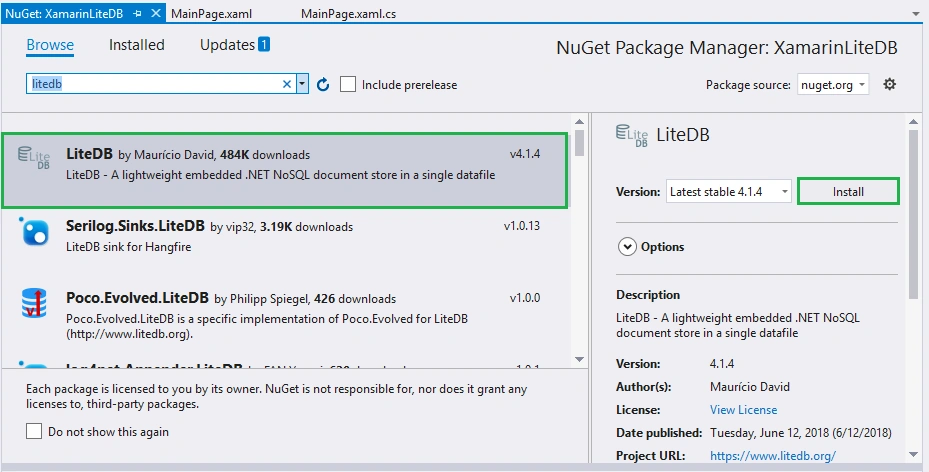
- LiteDB
Add LiteDB NuGet
Go to Solution Explorer and select your solution. Right-click and select "Manage NuGet Packages for Solution". Search "LiteDB" and add the package. Remember to install it for .NET Standard project.
Create a Model
In this step, you can create a model to create a table.
Person.cs
- namespace XamarinLiteDB
- {
- public class Person
- {
- public int PersonId { get; set; }
- public string Name { get; set; }
- }
- }
Get Local File Path
Write the following code to get the local file path for storing the database in App.xaml.cs.
App.xaml.cs
- static LiteDBHelper db;
- public static LiteDBHelper LiteDB
- {
- get
- {
- if (db == null)
- {
- db = new LiteDBHelper(Path.Combine(Environment.GetFolderPath(Environment.SpecialFolder.LocalApplicationData), "XamarinLiteDB.db"));
- }
- return db;
- }
- }
Create a Table
In this step, write the following code to create a LiteCollection and create the table in LiteDBHelper.cs constructor.
LiteDBHelper.cs
- protected LiteCollection<Person> personCollection;
- public LiteDBHelper(string dbPath)
- {
- using (var db = new LiteDatabase(dbPath))
- {
- personCollection = db.GetCollection<Person>("Persons");
- }
- }
Check Database
If you need to explore your LiteDB database, download LiteDBViewer
https://github.com/falahati/LiteDBViewer/releases
Example
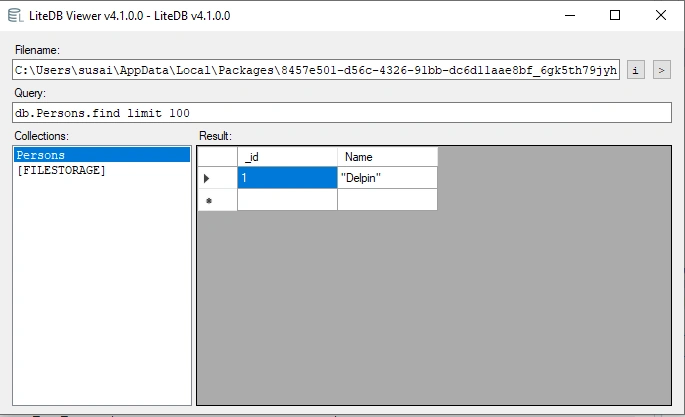
Read All
Now, write the code to read all data from LiteDB Database.
LiteDBHelper.cs
- //Get All Persons
- public List<Person> GetAllPersons()
- {
- var persons= new List<Person>(personCollection.FindAll());
- return persons;
- }
MainPage.Xaml.cs
- //Get All Persons
- var personList=App.LiteDB.GetAllPersons();
- if(personList.Count!=0)
- {
- lstPersons.ItemsSource = personList;
- }
Click the "Play" button to try it out.
Insert
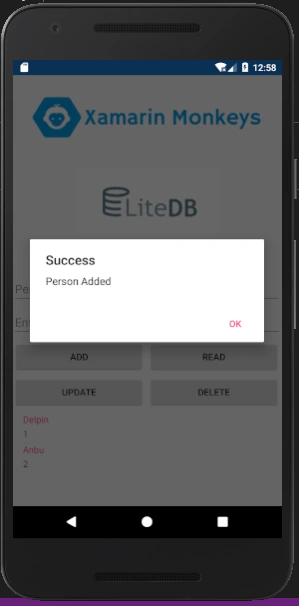
Now, write the following code to insert data into LiteDB Database.
- //Add New Person
- public void AddPerson(Person person)
- {
- personCollection.Insert(person);
- }
- private void BtnAdd_Clicked(object sender, EventArgs e)
- {
- if (!string.IsNullOrEmpty(txtName.Text))
- {
- Person person = new Person()
- {
- Name = txtName.Text
- };
- //Add New Person
- App.LiteDB.AddPerson(person);
- txtName.Text = string.Empty;
- DisplayAlert("Success", "Person Added", "OK");
- //Get All Persons
- var personList = App.LiteDB.GetAllPersons();
- if (personList.Count != 0)
- {
- lstPersons.ItemsSource = personList;
- }
- }
- }
Click the "Play" button to try it out.
Read
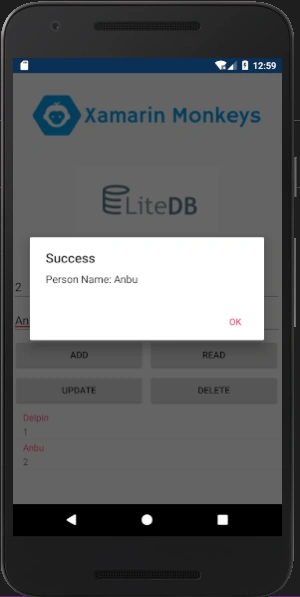
Now, write the following code to read data from LiteDB Database.
- //Get Person
- public Person GetPerson(int personId)
- {
- var person = GetAllPersons().Where(a => a.PersonId == personId).FirstOrDefault();
- return person;
- }
- private void BtnRead_Clicked(object sender, EventArgs e)
- {
- if(!string.IsNullOrEmpty(txtPersonId.Text))
- {
- var person= App.LiteDB.GetPerson(Convert.ToInt32(txtPersonId.Text));
- if(person!=null)
- {
- txtName.Text = person.Name;
- DisplayAlert("Success", "Person Name: "+person.Name, "OK");
- }
- else
- {
- DisplayAlert("Faild", "Person is not available", "OK");
- }
- }
- }
Click the "Play" button to try it out.
Update
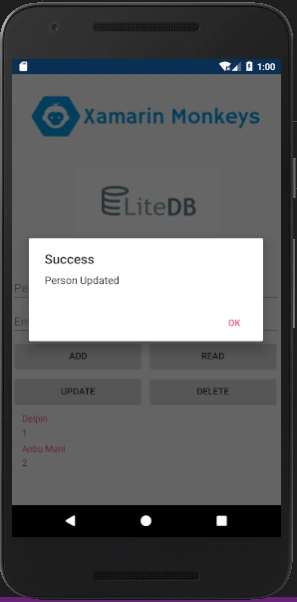
Now, write the following code to update data to LiteDB Database.
- //Update Person
- public void UpdatePerson(Person person)
- {
- personCollection.Update(person);
- }
- private void BtnUpdate_Clicked(object sender, EventArgs e)
- {
- if (!string.IsNullOrEmpty(txtPersonId.Text))
- {
- Person person = new Person()
- {
- PersonId = Convert.ToInt32(txtPersonId.Text),
- Name = txtName.Text
- };
- //Update person
- App.LiteDB.UpdatePerson(person);
- txtName.Text = string.Empty;
- txtPersonId.Text = string.Empty;
- DisplayAlert("Success", "Person Updated", "OK");
- //Get All Persons
- var personList = App.LiteDB.GetAllPersons();
- if (personList.Count != 0)
- {
- lstPersons.ItemsSource = personList;
- }
- }
- }
Click the "Play" button to try it out.
Delete
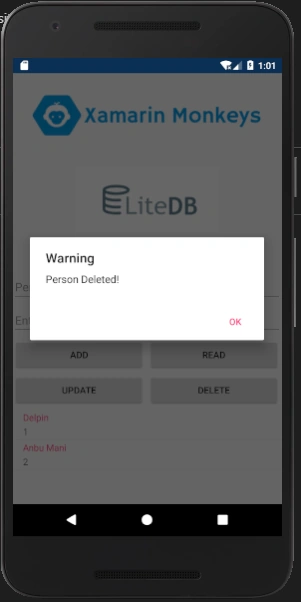
Now, write the following code to delete data from LiteDB Database.
- //Delete Person
- public void DeletePerson(int personId)
- {
- personCollection.Delete(a => a.PersonId == personId);
- }
- rivate void BtnDelete_Clicked(object sender, EventArgs e)
- {
- if(!string.IsNullOrEmpty(txtPersonId.Text))
- {
- //Delete Person
- App.LiteDB.DeletePerson(Convert.ToInt32(txtPersonId.Text));
- txtPersonId.Text = string.Empty;
- DisplayAlert("Warning", "Person Deleted!", "OK");
- //Get All Persons
- var personList = App.LiteDB.GetAllPersons();
- if (personList.Count != 0)
- {
- lstPersons.ItemsSource = personList;
- }
- }
- }
Click the "Play" button to try it out.
Full code
LiteDBHelper.cs
- using LiteDB;
- using System;
- using System.Collections.Generic;
- using System.Text;
- using System.Linq;
- namespace XamarinLiteDB
- {
- public class LiteDBHelper
- {
- protected LiteCollection<Person> personCollection;
- public LiteDBHelper(string dbPath)
- {
- using (var db = new LiteDatabase(dbPath))
- {
- personCollection = db.GetCollection<Person>("Persons");
- }
- }
- //Get All Persons
- public List<Person> GetAllPersons()
- {
- var persons= new List<Person>(personCollection.FindAll());
- return persons;
- }
- //Add New Person
- public void AddPerson(Person person)
- {
- personCollection.Insert(person);
- }
- //Update Person
- public void UpdatePerson(Person person)
- {
- personCollection.Update(person);
- }
- //Get Person
- public Person GetPerson(int personId)
- {
- var person = GetAllPersons().Where(a => a.PersonId == personId).FirstOrDefault();
- return person;
- }
- //Delete Person
- public void DeletePerson(int personId)
- {
- personCollection.Delete(a => a.PersonId == personId);
- }
- }
- }
MainPage.Xaml.cs
- using Xamarin.Forms;
- namespace XamarinLiteDB
- {
- public partial class MainPage : ContentPage
- {
- public MainPage()
- {
- InitializeComponent();
- //Get All Persons
- var personList=App.LiteDB.GetAllPersons();
- if(personList.Count!=0)
- {
- lstPersons.ItemsSource = personList;
- }
- }
- private void BtnAdd_Clicked(object sender, EventArgs e)
- {
- if (!string.IsNullOrEmpty(txtName.Text))
- {
- Person person = new Person()
- {
- Name = txtName.Text
- };
- //Add New Person
- App.LiteDB.AddPerson(person);
- txtName.Text = string.Empty;
- DisplayAlert("Success", "Person Added", "OK");
- //Get All Persons
- var personList = App.LiteDB.GetAllPersons();
- if (personList.Count != 0)
- {
- lstPersons.ItemsSource = personList;
- }
- }
- }
- private void BtnRead_Clicked(object sender, EventArgs e)
- {
- if(!string.IsNullOrEmpty(txtPersonId.Text))
- {
- var person= App.LiteDB.GetPerson(Convert.ToInt32(txtPersonId.Text));
- if(person!=null)
- {
- txtName.Text = person.Name;
- DisplayAlert("Success", "Person Name: "+person.Name, "OK");
- }
- else
- {
- DisplayAlert("Faild", "Person is not available", "OK");
- }
- }
- }
- private void BtnUpdate_Clicked(object sender, EventArgs e)
- {
- if (!string.IsNullOrEmpty(txtPersonId.Text))
- {
- Person person = new Person()
- {
- PersonId = Convert.ToInt32(txtPersonId.Text),
- Name = txtName.Text
- };
- //Update person
- App.LiteDB.UpdatePerson(person);
- txtName.Text = string.Empty;
- txtPersonId.Text = string.Empty;
- DisplayAlert("Success", "Person Updated", "OK");
- //Get All Persons
- var personList = App.LiteDB.GetAllPersons();
- if (personList.Count != 0)
- {
- lstPersons.ItemsSource = personList;
- }
- }
- }
- private void BtnDelete_Clicked(object sender, EventArgs e)
- {
- if(!string.IsNullOrEmpty(txtPersonId.Text))
- {
- //Delete Person
- App.LiteDB.DeletePerson(Convert.ToInt32(txtPersonId.Text));
- txtPersonId.Text = string.Empty;
- DisplayAlert("Warning", "Person Deleted!", "OK");
- //Get All Persons
- var personList = App.LiteDB.GetAllPersons();
- if (personList.Count != 0)
- {
- lstPersons.ItemsSource = personList;
- }
- }
- }
- }
- }
I hope you have understood how to use LiteDB Database and perform CRUD operations in Xamarin.Forms. Thanks for reading. Please share your comments and feedback.
Happy Coding :)
cheung hobunPosted Sep 24, 2021, 9:27 AM
IS Always return Cannot access dispose object when return Db
deepakkumar gurramPosted Feb 17, 2019, 10:35 PM
Hi, Very impressive article. Thank you for such nice information. I have doubt on lite DB i.e when we use lite DB instead of SQLite and what are the benefits we can get if we use lite DB instead of SQLite.