

Introduction
The KISS principle—short for “Keep It Simple, Stupid”—is a design philosophy that advocates simplicity as the foundation for efficiency and effectiveness. The term “stupid” is not intended as an insult; rather, it serves as a reminder to avoid unnecessary complexity and to produce solutions that are easily understandable. Alternative interpretations include “Keep It Short and Simple” or “Keep It Super Simple”. The aim is to preserve functionality while implementing the most streamlined solution possible, ensuring neither performance nor usability is compromised. Simplified architectures reduce complexity, making systems easier to maintain, debug, and scale—capabilities that are indispensable in dynamic, high-velocity development environments.
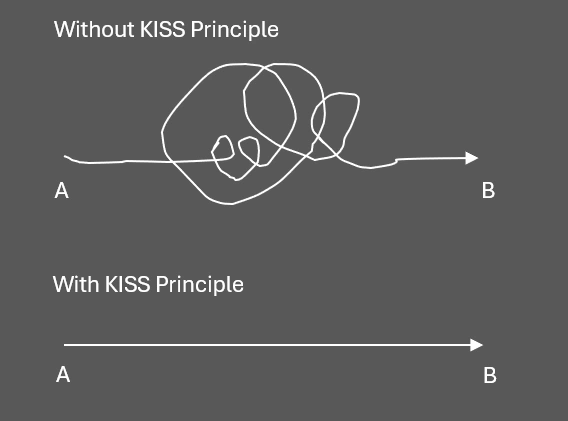
Key Benefits of the KISS Principle
Enhanced Comprehension: Simplified designs significantly improve team understanding by reducing cognitive complexity and clarifying system architecture. This accelerates onboarding, reduces training requirements, and enables seamless collaboration across cross-functional teams.
Risk Mitigation: Excessive complexity often introduces vulnerabilities such as defects, performance degradation, and maintenance difficulties. By simplifying designs, these risks can be significantly reduced, minimizing the probability of errors and ensuring that issues are easier to identify and resolve when they occur.
Improved Maintainability and Scalability: Simple systems are inherently easier to troubleshoot, update, and extend. This adaptability is critical in fast-paced development environments where requirements evolve rapidly.
Best Practices for Applying KISS
Avoid Overengineering: Implement only what is necessary to meet requirements.
Avoid unnecessary abstractions: Only introduce design patterns or abstractions when they serve a real purpose.
Use Clear and Consistent Naming Conventions: Improves readability and reduces confusion.
Prioritize clarity over clever tricks: Write code as if you’re explaining it to someone less experienced. If the logic is easy to follow, you’ve likely kept it simple
Modular Design: Break down systems into smaller, manageable components.
Break down complex problems: Simplify complex problems by breaking them into smaller, manageable functions or modules. Ensure each function focuses on a single responsibility.
Document for Clarity: Ensure that simplicity is complemented by clear documentation.
Regular Refactoring: Continuously simplify code and architecture as the system evolves.
Conclusion
The KISS principle highlights that simplicity is both elegant and practical. In a world where complexity often feels inevitable, focusing on simplicity leads to better outcomes, greater user satisfaction, and systems that are easier to maintain.
Join the conversation! Your thoughts help the community grow.