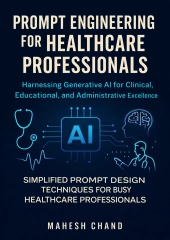

Prompt Engineering for Healthcare Professionals is a practical, real-world guide that teaches doctors, nurses, researchers, educators, and healthcare administrators how to safely and effectively use Generative AI tools such as ChatGPT, Gemini, Claude, and Med-PaLM in everyday healthcare workflows.
Healthcare professionals are under constant pressure from documentation, patient communication, research overload, teaching responsibilities, and administrative work. This book shows how prompt engineering—the skill of writing clear, structured instructions for AI, can significantly reduce workload while improving clarity, efficiency, and consistency.
Using simple explanations, real-world healthcare case studies, hands-on exercises, and proven frameworks such as RCTF (Role, Context, Task, Format), this book demonstrates how Generative AI can be used responsibly for clinical documentation, patient education, research synthesis, teaching, and policy drafting—without replacing professional judgment.
This eBook is designed for busy healthcare professionals who want practical results, not theory, and who want to stay compliant with privacy, safety, and ethical standards.
Chapter-Wise Overview
Generative AI and Healthcare
This section introduces Generative AI, Large Language Models (LLMs), and prompt engineering in the healthcare context. It explains how AI tools generate content, how they differ from traditional software, and how they can reduce documentation burden, administrative overload, and burnout. Real clinical examples show how AI supports-not replaces-healthcare professionals.
Prompt Design Framework (RCTF)
A simple and memorable framework—Role, Context, Task, Format—is introduced to help healthcare professionals write effective prompts. Clear examples compare vague prompts with structured prompts and demonstrate how better instructions lead to safer, more usable AI outputs in clinical and educational settings.
Core Prompting Techniques
This section outlines essential prompting methods, including zero-shot, few-shot, and chain-of-thought prompting. It shows when to use each technique for documentation, teaching, and reasoning tasks, and highlights risks, such as generic outputs or hallucinations, when prompts are poorly designed.
Prompts for Clinical Documentation
Clinical documentation workflows, including SOAP notes, SBAR handoffs, and discharge summaries, are covered in detail. Readers learn how structured prompts can generate accurate first drafts, reduce charting time, and improve consistency while maintaining clinical responsibility and compliance.
Prompts for Clinical Reasoning
This section focuses on using AI to support diagnostic thinking, differential diagnosis generation, investigation planning, and step-by-step reasoning. It emphasizes that AI supports structured thinking and education but does not replace medical decision-making or professional judgment.
Prompts for Patient Communication
Effective patient communication is critical for outcomes. This chapter demonstrates how AI can translate medical jargon into plain language, create age-appropriate explanations, and generate multilingual patient education materials. Examples show how prompts improve health literacy while maintaining empathy and clarity.
Prompts for Research and Evidence
Healthcare research demands constant review of studies and guidelines. This section shows how AI can summarize articles, compare studies, create evidence tables, and draft abstracts. It clearly stresses the importance of verifying AI outputs against original sources.
Prompts for Teaching and Training
Teaching healthcare students and professionals requires time-consuming preparation. This chapter explains how AI can generate quizzes, case scenarios, role-play simulations, and simplified explanations for different learning levels, helping educators focus on discussion rather than content creation.
Prompts for Administration
Administrative work, such as policies, staff communication, meeting summaries, and grant drafting, is addressed here. Structured prompts help administrators produce consistent, professional documents faster while ensuring alignment with institutional and regulatory standards.
Building Prompt Libraries for Teams
To ensure consistency across departments, this section explains how to build reusable prompt libraries for clinical care, education, research, and administration. Real examples show how prompt libraries reduce onboarding time, improve quality, and standardize workflows across teams.
Beyond Basic Prompts
Advanced techniques, including sequential prompting, role handovers, and workflow chains, are introduced. These methods mirror real-world healthcare workflows, enabling professionals to generate multiple outputs—clinical notes, patient handouts, and teaching materials—from a single source of information.
Privacy, Safety, and Compliance
This critical chapter covers the safe use of AI in healthcare, including de-identification, HIPAA/GDPR compliance, and institutional safeguards. Readers learn what data should never be entered into AI tools and how to design prompts that protect patient privacy.
The Future of Prompt Engineering in Healthcare
Emerging trends such as AI copilots in EHRs, specialty-specific AI models, voice-based assistants, and workflow automation are explored. The chapter explains why prompt engineering will remain a core skill even as AI becomes embedded in healthcare systems.
Case Studies in Action
Real-world case studies from physicians, nurses, researchers, educators, and administrators show how prompt engineering saves time, improves communication, and enhances workflows. Common lessons emphasize review, verification, and responsible AI usage.
Hands-On Workshop
The final section provides guided exercises across clinical documentation, reasoning, teaching, research, administration, and multilingual communication. Readers practice building prompts and complete an end-to-end workflow to experience real productivity gains.
Join the conversation! Your thoughts help the community grow.