

Introduction
The AI race just got bigger. Much bigger.
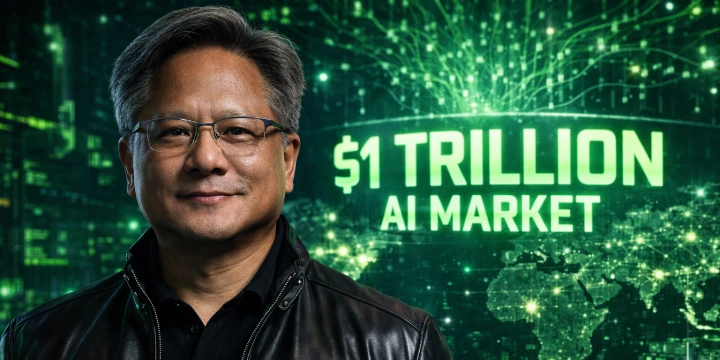
At its latest GTC event, Nvidia CEO Jensen Huang stunned the industry by doubling the company’s AI infrastructure demand outlook to $1 trillion over the next few years.
This is not just another forecast. It is a bold signal that the AI economy is entering a new phase, one that could redefine how software, infrastructure, and enterprise systems are built.
And not everyone is taking it lightly.
What Exactly Did Nvidia Announce?
Nvidia now believes that total AI infrastructure demand could reach $1 trillion by 2027, up from its earlier estimate of around $500 billion.
This includes demand for
AI GPUs and accelerators
Data center infrastructure
AI networking and systems
Enterprise and cloud AI deployments
The key shift behind this projection is simple
AI is moving from training models → to running them at scale (inference)
And inference is where the real money is.
The Big Shift: Training vs Inference
For the past few years, the AI boom has been driven by training large models like GPT and other foundation models.
Now, the next phase is unfolding
AI inference at scale
This means
• AI agents running continuously
• Copilots embedded in every app
• Real time AI decision systems
• Enterprise automation powered by AI
In short
Every company becomes an AI company → Every app becomes an AI app
That shift dramatically increases compute demand.
Why the $1 Trillion Number Matters
This number is not just hype. It reflects a structural shift in the global tech economy.
Here’s why it is important
| Factor | Impact |
|---|---|
| AI adoption across enterprises | Massive infrastructure demand |
| Rise of AI agents | Continuous compute usage |
| Cloud + on prem AI deployments | Hybrid scaling explosion |
| Real time inference | Higher GPU utilization |
| Developer ecosystem growth | More AI powered apps |
The takeaway
AI demand is not slowing down. It is accelerating into a much bigger phase.
Analyst Reactions: Bullish and Shocked
The reaction from analysts and media personalities was immediate.
Gene Munster described the projection as
“Absolutely wild”
Meanwhile, Jim Cramer responded positively, reinforcing the view that Nvidia remains at the center of the AI revolution.
The sentiment is clear
Even bullish analysts were surprised by the scale of this forecast.
But Not Everyone Is Convinced
Despite the excitement, skepticism remains.
Here are the key concerns
• Can enterprises sustain this level of AI spending?
• Will cloud providers build their own chips and reduce Nvidia dependence?
• Are we overestimating near term AI monetization?
• Will supply chain constraints slow growth?
Reality check
This is a best case scenario, not a guaranteed outcome.
What This Means for Developers and Builders
For developers, founders, and tech leaders, this is the real signal
We are entering the AI Infrastructure Economy
This means
• Building AI native applications becomes mandatory
• Understanding inference optimization is critical
• AI agents will dominate workflows
• GPU aware architecture will matter more than ever
• Cost optimization becomes a competitive advantage
If you are building products today
You are building in a trillion dollar opportunity window
The Bigger Picture: AI Is Becoming Core Infrastructure
Just like cloud computing transformed software over the past decade
AI is now becoming the next foundational layer
We are moving toward a world where
• Every business runs AI models
• Every workflow is AI assisted
• Every platform integrates AI agents
And companies like Nvidia are positioning themselves as
The backbone of this new economy
Final Thoughts
Jensen Huang’s $1 trillion prediction is bold, aggressive, and forward looking.
It may not play out exactly as forecasted
But one thing is clear
The AI wave is not peaking
It is expanding into something far bigger
For builders, investors, and innovators
This is not the time to wait
This is the time to build
Because if Nvidia is even partially right
The biggest phase of AI growth is still ahead.
Join the conversation! Your thoughts help the community grow.