

What is "URL rewriting"?
Most sites include variables in their URLs that tell the site what information to be shown to the user. It is something like telling the code to load particular details of item number 7 from a shopping site.
For example, the site may look as in the following:
http://www.cshopping.com/showitem.aspx?itemid=7
The problem with the preceding URL is it cannot be remembered. It is even difficult to read on your mobile. Even the search engines like Google cannot get any information about the content of a page from the URL. What if you wanted to convey that itemid = 7 means a laptop with brand as "DELL"? This is not saying what it should say.
So, what we expect from the preceding URL is it should be easily understandood. Will it not be good if the URL is as below?
http://www.cshopping.com/laptops/Dell/
Now looking at the preceding URL you can easily tell that it is related to laptops and the brand is DELL. So, there is a need to rewrite the URL to be somewhat meaningful and easily conveyable.
How to rewrite URL in ASP.NET?
To rewrite URLs in ASP.NET we are going to use HTTP Modules. HTTP Modules are called before and after the HTTP handler executes. HTTP modules help us to intercept, participate in, or modify each individual request. HTTP Modules implement an IHttpModule interface, which is located in the System.Web namespace. Modules are the ones which handles authentication and authorization of the ASP.NET applications. If you want to implement encryption of the URL string or any custom changes to the application, it can be done by writing our HTTP Module.
Straight to the point, let us create a class in your app_Code directory called "URLRewriter.cs" and add the following code:
1. Create a web site using Visual Studio and name it as "URLRewriteTestingApp" and add a class file "URLRewriter.cs".
2. Visual Studio will ask whether to create a directory called "App_Code" and place the class file in the folder. Select "OK" to proceed.
Your solution structure should look something like this:
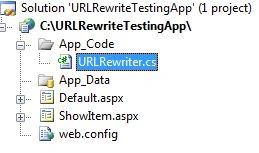
3. Now open the file "URLRewriter.cs" and add the code for HTTP Module as below.
Basically your class must implement the IHttpModule interface to implement its methods. You will see these 2 methods created for you once you implement the interface.
- Dispose
- Init
The Init method takes HttpApplication as a parameter. So, you need to create an event handler for the first request of the HttpApplication to handle the request.
Here is your code for the Module:
using System;
using System.Web;
/// <summary>
/// Summary description for URLRewriter
/// </summary>
public class URLRewriter : IHttpModule
{
    #region IHttpModule Members
    /// <summary>
    /// Dispose method for the class
    /// If you have any unmanaged resources to be disposed
    /// free them or release them in this method
    /// </summary>
    public void Dispose()
    {
        //not implementing this method
        //for this example
    }
    /// <summary>
    /// Initialization of the http application instance
    /// </summary>
    /// <param name="context"></param>
    public void Init(HttpApplication context)
    {
        context.BeginRequest += new EventHandler(context_BeginRequest);
    }
    /// <summary>
    /// Event handler of instance begin request
    /// </summary>
    /// <param name="sender"></param>
    /// <param name="e"></param>
    void context_BeginRequest(object sender, EventArgs e)
    {
        //Create an instance of the application that has raised the event
        HttpApplication httpApplication = sender as HttpApplication;
        //Safety check for the variable httpApplication if it is not null
         if (httpApplication != null)
         {
             //get the request path - request path is    something you get in
             //the URL
             string requestPath = httpApplication.Context.Request.Path;
             //variable for translation path
             string translationPath = "";
             //if the request path is /urlrewritetestingapp/laptops/dell/
            //it means the site is for DLL
            //else if "/urlrewritetestingapp/laptops/hp/"
            //it means the site is for HP
            //else it is the default path
            switch (requestPath.ToLower())
            {
                case "/urlrewritetestingapp/laptops/dell/":
                    translationPath = "/urlrewritetestingapp/showitem.aspx?itemid=7";
                    break;
                case "/urlrewritetestingapp/laptops/hp/":
                    translationPath = "/urlrewritetestingapp/showitem.aspx?itemid=8";
                    break;
                default:
                    translationPath = "/urlrewritetestingapp/default.aspx";
                    break;
            }
            //use server transfer to transfer the request to the actual translated path
            httpApplication.Context.Server.Transfer(translationPath);
        }
    }
    #endregion
}
4. Now open your default.aspx page in the solution and add the following HTML:
This code is to display two laptop brands HP and DELL.
Note: Since I am not deploying the application in IIS you will see the runtime host created by Visual Studio as localhost:8648. If your application has a different port number or if you have hosted your web application in IIS, you may have to change the values of href in the following HTML.
<%@ Page Language="C#" AutoEventWireup="true"  CodeFile="Default.aspx.cs" Inherits="_Default" %>
<!DOCTYPE html PUBLIC "-//W3C//DTD XHTML 1.0 Transitional//EN""http://www.w3.org/TR/xhtml1/DTD/xhtml1-transitional.dtd">
<html xmlns="http://www.w3.org/1999/xhtml">
<head runat="server">
    <title>Laptop Brands</title>
</head>
<body>
    <form id="form1" runat="server">
    <div>
    <a href="http://localhost:8648/URLRewriteTestingApp/laptops/Dell/">Dell</a>
    <br/>
    <a href="http://localhost:8648/URLRewriteTestingApp/laptops/HP/">HP</a>
    </div>
    </form>
</body>
</html>
5. Since we are placing references in the HTML code we do not need to do anything in the code behind file. Now add one more webform ShowItem.aspx in the website. This page is to display the actual data that clicking on the hyperlink in the default page should take it to. We are just trying to make the application look simple and so we just display the name of the laptop and a back button.
6. The HTML of the ShowItem.aspx page looks as in the following:
<%@ Page Language="C#" AutoEventWireup="true" CodeFile="ShowItem.aspx.cs" Inherits="ShowItem" %>
 <!DOCTYPE html PUBLIC "-//W3C//DTD XHTML 1.0 Transitional//EN" "http://www.w3.org/TR/xhtml1/DTD/xhtml1-transitional.dtd">
<html xmlns="http://www.w3.org/1999/xhtml">
<head runat="server">
    <title>Untitled Page</title>
</head>
<body>
    <form id="form1" runat="server">
    <div>
    <asp:Label runat="server" ID="labelShow"></asp:Label>
    <br/>
    <br/>
    <asp:Button runat="server" ID="back" Text="Back"/>
    </div>
    </form>
</body>
</html>
7. The Code behind file looks as in the following:
The Code behind is to display the text of the laptop and the back button event handler that takes back the user back to the default page.
using System;
public partial class ShowItem : System.Web.UI.Page
{
    /// <summary>
    /// Page load event for the page
    /// </summary>
    /// <param name="sender"></param>
    /// <param name="e"></param>
    protected void Page_Load(object sender, EventArgs e)
    {
        //read the query string value of itemid that is coming
        //from default page when user clicks on the hyperlink
        string laptopName = Request.QueryString["itemid"];
        //if value is "8" display the text of the label as "HP"
        //else display the label as "DELL"
        labelShow.Text = laptopName == "8" ? "HP" : "DELL";
        //back button event handler
        back.Click += new EventHandler(back_Click);
    }
    /// <summary>
    /// Back button click event
    /// </summary>
    /// <param name="sender"></param>
    /// <param name="e"></param>
    void back_Click(object sender, EventArgs e)
    {
        //transfer the page back to default.aspx
        Server.Transfer("../default.aspx");
    }
}
8. Now we need to configure our custom HttpModule "URLRewriter" in the configuration file to use the module.
<system.web>
   <httpModules>
      <add name="URLRewriter" type="URLRewriter"/>
   </httpModules>
</system.web>
Now our coding is complete and let us test our application by pressing F5 button.
Our default.aspx page:
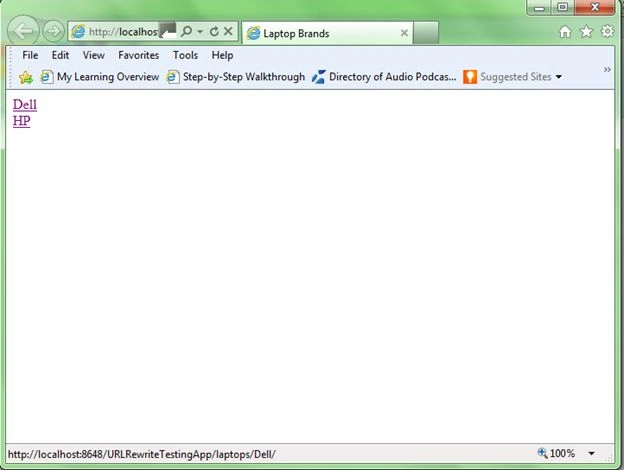
When I place my cursor over Dell, the URL looks like http://localhost:8648/URLRewriteTestingApp/laptops/Dell/ and similarly if you place your cursor on HP, it should look like http://localhost:8648/URLRewriteTestingApp/laptops/HP/ Put break points in your HTTP Module methods and now click on any of the hyperlinks.
I clicked on the Dell and the value at the breakpoint now shows the value of requestPath.
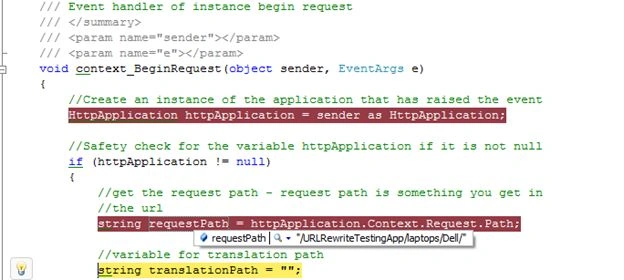
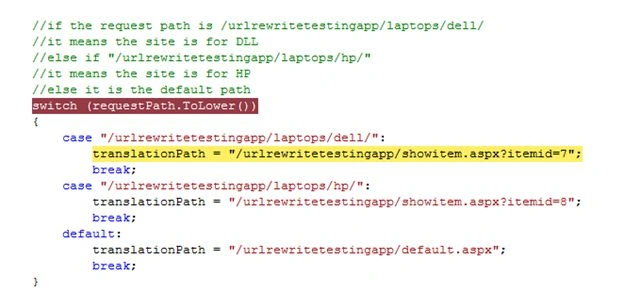
Now the requestPath variable value is "/URLRewriteTestingApp/laptops/Dell/". Our rewriting code must now identify the requestPath and change the path to the actual URL path so that the correct page gets called in the IIS by the engine. So, our translated path will be "/urlrewritetestingapp/showitem.aspx?itemdid=7".
Now the page looks as in the following:
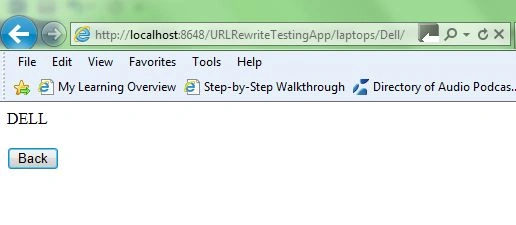
Clicking on the "Back" button will take the user to the default page.
Hope you like this article. If you have multiple URLs to be maintained in your application, it is better to handle the URLs by one dedicated server that processes the requests and redirects the request to the relevant page for processing.
Sujit WarrierPosted Sep 21, 2015, 7:22 AM
An ASP.NET setting has been detected that does not apply in Integrated managed pipeline mode. i am getting this error for iis 8
sachin patilPosted Nov 24, 2014, 4:04 AM
for above errors, add namespace.classname instead of simple classname. <add name="UrlRewriter" type="WebApplication1.UrlRewriter"/>
dinesh baskaranPosted May 22, 2014, 2:54 AM
Source Error: Line 15: <system.web> Line 16: <httpModules> Line 17: <add name="URLRewriter" type="URLRewriter"/>
dinesh baskaranPosted May 22, 2014, 2:53 AM
could not load type Rewriter Source Error: Line 15: <system.web> Line 16: <httpModules> Line 17: <add name="URLRewriter" type="URLRewriter"/>
dinesh baskaranPosted May 22, 2014, 2:53 AM
i am getting error
PankajPosted Mar 21, 2014, 8:31 AM
How can I pass dynamically page name with dynamic Id....Its nice article but please explain with dynamic concept with database values...
manuPosted Aug 23, 2013, 1:51 AM
I can't handle session in destination page.ERROR LINE Code : HttpContext.Current.Session[USERADMIN] == null ERROR Message: System.NullReferenceException: Object reference not set to an instance of an object. Please help me
Mark EblingPosted Feb 13, 2013, 12:31 AM
Thanks for the great article. Anyone working on large dynamic sites is going to want to do it this way. I have many URL's and the paths are created dynamically so hard coding them into a case statement isn't practical or possible. I don't worry about the paths until later in the code when I interpret them and it’s wonderful that I don’t have to set up rules, use regular expressions, install another tool, or any of that other stuff I read about. However, here is a note that may help someone if they experience a similar problem. I don’t use a lot of images so I didn’t notice it at first but every time while I’m developing this site I noticed that page_load in default.aspx.cs was firing twice creating two records in my log. I found that the page was called once for the page itself and for anything else that required a request like css files, javascript and in my case it was the favorites icon. It’s important to note that this code will fire for everything needed on the page. As a workaround here’s what I did to make sure page load only fires when I want it to: string requestType = httpApplication.Context.Request.CurrentExecutionFilePathExtension.ToString();. if (requestType == ".aspx"). { string translationPath = "/Default.aspx";. httpApplication.Context.Server.Transfer(translationPath); } And our course everything else like css files, images, etc. doesn’t need path translation. If there is a better solution please post. Thanks! Hope this helps anyone having a similar problem.
Akkiraju IvaturiPosted Oct 14, 2012, 1:01 PM
Hi Shivanand, Look at the link by a IIS team member http://ruslany.net/2008/09/aspnet-routing-request-filtering-url-rewriting/ I will respond to you in my own words when I get time... Thanks..
Akkiraju IvaturiPosted Oct 14, 2012, 12:57 PM
Hi Arti, what is the error you are getting? Send me the error message. And sorry for being late in answering... I was busy with some other stuff since 2 months.. Thanks
arti guptaPosted Oct 11, 2012, 6:56 AM
<add name="URLRewriter" type="URLRewriter"/> is showing error when i m using above code. Please help
Shivanand ArurPosted Oct 5, 2012, 10:36 AM
Akki Sir, I have heard that Microsoft has given "URL Routing" which is much better than "URL Re-writing". Though earlier they introduced this technique only for MVC projects and apps, but now that they have also incorporated it in a normal ASP.Net project, So sir can you please explain the difference between the 2. Though I know some information like for "URL Rewriting" the rewriting process is done first and then the ASP.NET engine points as to who is going to process the request. This is the opposite in URL Routing... Please correct me if I am wrong!!! And if possible, so can you explain some more differences between the 2 and also how to do "URL Routing". Btw thanks for this article. You have explained it quite nicely. Cheers!!!
Akkiraju IvaturiPosted Sep 5, 2012, 12:19 PM
Let me add it again and will let you know.
Venkatesh KumarPosted Sep 4, 2012, 3:20 AM
Attachment file is not working, Please check it.