

Welcome to the “Fundamentals of Unit Testing” article series, in our previous article we learned many interesting concepts of unit testing. You can read them here.
- Fundamentals of Unit Testing: Getting Started With Unit Testing
- Fundamentals of Unit Testing: Test Your Application by Visual Studio Unit Test
- Fundamentals of Unit Testing: Understand AAA in Unit Testing
- Fundamental of Unit Testing: Understand AreEqual and AreEqual<T> in Unit Testing
- Fundamental of Unit Testing: Test Initialize and Test Setup
- Fundamentals of Unit Testing: Understand CollectionAssert() in Unit Testing
- Fundamentals of Unit Testing: Understand ExpectedException in Unit Testing
- Fundamentals of Unit Testing: Don't Test Your Private Method
- Fundamentals of Unit Testing: Unit Test Using Nunit
In this article we will discuss one very important concept called mocking in unit testing. Let's discuss, why mocking is needed the actual uses of it, and how it comes into unit testing scenarios.
What is mocking?
Let's think that one application is being developed and many developers are working in this project and each one is assigned to develop a function. Let's think that I am developing a function that will insert one employee's information into the DB; if it is not present in the DB then fine and one of my fellow developer is developing the function to check the existence.
And I have completed my function but this guy has not, as he has a little bit of a workload, haha.. Now, as I completed my task, I wanted to test my function but for that, I need to depend on the checking function that is still not developed.
So, how I will do that? I need to create a mock object that will bypass the checking function. The point to make here is that there are many mocking frameworks to implement the mock object. In this article, we will use MOQ as a mocking framework.
So, let's create one unit test application and pass this library as a reference of the application from the NuGet Package Manager.
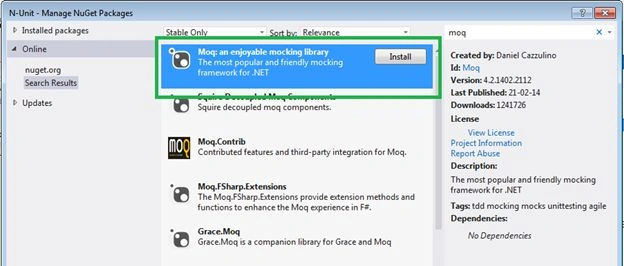
Here is the code that we will test using the unit test application.
using System;
using System.Collections.Generic;
using System.Linq;
using System.Text;
using System.Threading.Tasks;
namespace TestProjectLibrary
{
    public class checkEmployee
    {
        public virtual bool checkEmp()
        {
            throw new NotImplementedException();
        }
    }
    public class processEmployee
    {
        public bool insertEmployee(checkEmployee objtmp)
        {
            objtmp.checkEmp();
            return true;
        }
    }
}
Now, see the implementation, the checkEmployee class contains a checkEmp() function that is still not implemented. We are sending an object of the checkEmployee class to the insertEmployee() function to check whether the employee already exists before it is inserted into the DB.
So, the concept is that since the checkEmployee class is not fully implemented, we will send a mock object of the checkEmployee class as an argument of the insertEmployee() function. Here is a sample code of the implementation.
using System;
using Microsoft.VisualStudio.TestTools.UnitTesting;
using TestProjectLibrary;
using Moq;
namespace UnitTest
{
    [TestClass]
    public class UnitTest
    {
        [TestMethod]
        public void TestMethod2()
        {
            Mock<checkEmployee> chk = new Mock<checkEmployee>();
            chk.Setup(x => x.checkEmp()).Returns(true);
            processEmployee obje = new processEmployee();
            Assert.AreEqual(obje.insertEmployee(chk.Object), true);
        }
    }
}
Have a look at the first two lines of TestMethod2(). We are defining a mock object associated with the checkCmployee class and in the next line, we are setting the mock object.
chk.Setup(x => x.checkEmp())
   .Returns(true);
The preceding line is a bit interesting. Moq has a Setup() function by which we can set up the mock object. We need to use a lambda expression to point to a specific function. Here we are referring to the checkEmp() function and the Returns parameter value is true.
This means that whenever the unit test application encounters the checkEmp() function it will always return true without executing its code. So, ultimately, it will not execute at all and the result will be always true.
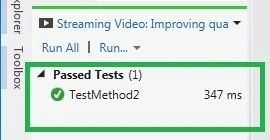
Now, if we run the test then we will see it passes.
Conclusion
Mocking is very useful concept when the project is distributed among many team members. The fundamental idea behind mocking is to inject dependency and perform a unit test.
Mihail VladovPosted May 21, 2020, 9:50 AM
I personally prefer to use JustMock Lite as an alternative to Moq as Moq is capable of mocking only public API. Where JustMock Lite is more powerful and in addition to that if you even need to mock static, extension, or non-public methods, or even methods from mscorlib you can simply upgrade to the paid version of JustMock without any need of migration and modification of your code.But this is just my opinion.
Hadshana KamalanathanPosted Jul 22, 2018, 4:48 AM
Good one...
Satish Kumar VadlavalliPosted Jan 3, 2018, 10:41 PM
Please change ref for Fundamental of Unit Testing: Test Initialize and Test Setup
Sebastian InonesPosted Jun 16, 2017, 3:56 AM
"Fundamental of Unit Testing: Test Initialize and Test Setup":http://www.c-sharpcorner.com/UploadFile/dacca2/test-initialize-and-test-setup/
amit guptaPosted Mar 1, 2017, 9:17 AM
Both, "Fundamental of Unit Testing: Test Initialize and Test Setup" & "Fundamental of Unit Testing: Understand AreEqual and AreEqual<T> in Unit Testing" refers to http://www.c-sharpcorner.com/UploadFile/dacca2/fundamental-of-unit-testing-understand-areequal-and-areequa/ Please correct them.
Shital KenjalePosted Aug 8, 2016, 8:03 AM
Article is very good for beginners. But "Fundamental of Unit Testing: Understand AreEqual and AreEqual<T> in Unit Testing" & "Fundamental of Unit Testing: Test Initialize and Test Setup" pointing to same link. have problem opening "Fundamentals of Unit Testing: Don't Test Your Private Method" link too. Kindly please help.
Rahul MasalkarPosted Mar 1, 2016, 5:28 AM
Article is good for beginners. But "Fundamental of Unit Testing: Understand AreEqual and AreEqual<T> in Unit Testing" & "Fundamental of Unit Testing: Test Initialize and Test Setup" pointing to same link. have problem opening "Fundamentals of Unit Testing: Don't Test Your Private Method" link too
arul smithPosted Sep 3, 2015, 2:29 AM
I would like to unit test the Save method but it shouldn't actually save to the Database. How Can this be done?
Gowtham RajamanickamPosted Apr 25, 2015, 5:29 AM
good
Sam HobbsPosted May 4, 2014, 11:09 AM
I know that you did not initiate the use of the terms mock and mocking in this context. Those terms in this context sounds incorrect to me. I wish the people that did initiate use of that terminology for this did not use those terms. The term that has been used traditionally is stub and it is a good term here too. I see absolutely no reason not to call them stub functions instead of mock or mocking functions.