

Introduction
This is a process to read the value from web.xml file into the servlet. The servlet can get a value from its user without having an HTML form. The value of a parameter can be fetched from web.xml file by using getInitParameter() method of the servlet. The initial parameter can be defined in web.xml file by using the following tags given below as,
- <init-param>,<param-name>,<param-value>
- <servlet>
- <servlet-name>This contains a name to refer the servlet inside this file </servlet-name>
- <servlet-class>This contains class name of the servlet</servlet-class>
- <init-param>
- <param-name>This contains name of the initial parameter</param-name>
- <param-value> This contains value of the initial parameter </param-value>
- </init-param>
- </servlet>
Example
- //using initial parameter in a servlet
- import javax.servlet.*;
- import javax.servlet.http.*;
- import java.io.*;
- public class initParamServ extends HttpServlet
- {
- public void doGet(HttpServletRequest req,HttpServletResponse res)throws IOException,ServletException
- {
- String s1=getInitParameter("gp");
- res.setContentType("text/html");
- PrintWriter out=res.getWriter();
- out.println("<Html><body bgcolor='CYAN'>");
- out.println("<H1><font color='blue'>Today's Gold price<blink>"+s1+"</blink></font></h1>");
- out.println("</Body></html>");
- }
- }
Storing and Compiling
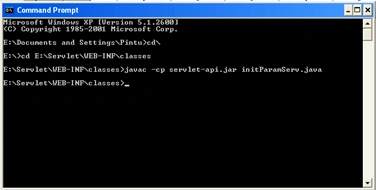
Store the file inside a class folder of the context (E:\Servlet\WEB-INF\classes).
Compile the file as below
javac -cp servlet-api.jar number.java (for tomcat 6.0)
Setting in web.xml file
Note: - Note the Highlighted or bold portion in the below web.xml file, to be added.
- <?xml version="1.0" encoding="ISO-8859-1" ?> -
- <!--
- Licensed to the Apache Software Foundation (ASF) under one or more
- contributor license agreements. See the NOTICE file distributed with
- this work for additional information regarding copyright ownership.
- The ASF licenses this file to You under the Apache License, Version 2.0
- (the "License"); you may not use this file except in compliance with
- the License. You may obtain a copy of the License at
- http://www.apache.org/licenses/LICENSE-2.0
- Unless required by applicable law or agreed to in writing, software
- distributed under the License is distributed on an "AS IS" BASIS,
- WITHOUT WARRANTIES OR CONDITIONS OF ANY KIND, either express or implied.
- See the License for the specific language governing permissions and
- limitations under the License.
- --> <!-- Inject Script Filtered -->
- <web-app xmlns="http://java.sun.com/xml/ns/javaee" xmlns:xsi="http://www.w3.org/2001/XMLSchema-instance" xsi:schemaLocation="http://java.sun.com/xml/ns/javaee
- http://java.sun.com/xml/ns/javaee/web-app_2_5.xsd" version="2.5">
- <servlet>
- <servlet-name>initParamServ</servlet-name>
- <servlet-class>initParamServ</servlet-class>
- <init-param>
- <param-name>gp</param-name>
- <param-value>21500</param-value>
- </init-param>
- </servlet>
- <servlet-mapping>
- <servlet-name>initParamServ</servlet-name>
- <url-pattern>/initParamServ</url-pattern>
- </servlet-mapping>
- </web-app>
Running it in a web browser
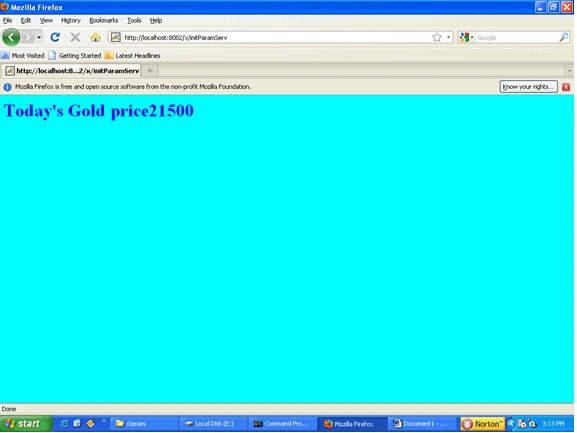
Please use the Mozilla Firefox browser to blink the value because Internet Explorer does not support <blink></blink> tag property.
First start the Apache Tomcat 6.0,
First start the Apache Tomcat 6.0,
Here x is the context path location, which we have to give in the server.xml file, which is present inside the Tomcat installation directory (E:\Program Files\Apache Software Foundation\Tomcat 6.0\conf)
Server.xml settings
Server.xml settings
Note: - In the below server.xml file we have to specify the context path as below.
<Context path="/x" docBase="E:\Servlet" reloadable="true" debug="0" />
server.xml file
- <?xml version='1.0' encoding='utf-8'?>
- <!--
- Licensed to the Apache Software Foundation (ASF) under one or more
- contributor license agreements. See the NOTICE file distributed with
- this work for additional information regarding copyright ownership.
- The ASF licenses this file to You under the Apache License, Version 2.0
- (the "License"); you may not use this file except in compliance with
- the License. You may obtain a copy of the License at
- http://www.apache.org/licenses/LICENSE-2.0
- Unless required by applicable law or agreed to in writing, software
- distributed under the License is distributed on an "AS IS" BASIS,
- WITHOUT WARRANTIES OR CONDITIONS OF ANY KIND, either express or implied.
- See the License for the specific language governing permissions and
- limitations under the License.
- -->
- <!-- Note: A "Server" is not itself a "Container", so you may not
- define subcomponents such as "Valves" at this level.
- Documentation at /docs/config/server.html
- -->
- <Server port="8005" shutdown="SHUTDOWN">
- <!--APR library loader. Documentation at /docs/apr.html -->
- <Listener className="org.apache.catalina.core.AprLifecycleListener" SSLEngine="on" />
- <!--Initialize Jasper prior to webapps are loaded. Documentation at /docs/jasper-howto.html -->
- <Listener className="org.apache.catalina.core.JasperListener" />
- <!-- JMX Support for the Tomcat server. Documentation at /docs/non-existent.html -->
- <Listener className="org.apache.catalina.mbeans.ServerLifecycleListener" />
- <Listener className="org.apache.catalina.mbeans.GlobalResourcesLifecycleListener" />
- <!-- Global JNDI resources
- Documentation at /docs/jndi-resources-howto.html
- -->
- <GlobalNamingResources>
- <!-- Editable user database that can also be used by
- UserDatabaseRealm to authenticate users
- -->
- <Resource name="UserDatabase" auth="Container"
- type="org.apache.catalina.UserDatabase"
- description="User database that can be updated and saved"
- factory="org.apache.catalina.users.MemoryUserDatabaseFactory"
- pathname="conf/tomcat-users.xml" />
- </GlobalNamingResources>
- <!-- A "Service" is a collection of one or more "Connectors" that share
- a single "Container" Note: A "Service" is not itself a "Container",
- so you may not define subcomponents such as "Valves" at this level.
- Documentation at /docs/config/service.html
- -->
- <Service name="Catalina">
- <!--The connectors can use a shared executor, you can define one or more named thread pools-->
- <!--
- <Executor name="tomcatThreadPool" namePrefix="catalina-exec-"
- maxThreads="150" minSpareThreads="4"/>
- -->
- <!-- A "Connector" represents an endpoint by which requests are received
- and responses are returned. Documentation at :
- Java HTTP Connector: /docs/config/http.html (blocking & non-blocking)
- Java AJP Connector: /docs/config/ajp.html
- APR (HTTP/AJP) Connector: /docs/apr.html
- Define a non-SSL HTTP/1.1 Connector on port 8080
- -->
- <Connector port="8082" protocol="HTTP/1.1"
- connectionTimeout="20000"
- redirectPort="8443" />
- <!-- A "Connector" using the shared thread pool-->
- <!--
- <Connector executor="tomcatThreadPool"
- port="8080" protocol="HTTP/1.1"
- connectionTimeout="20000"
- redirectPort="8443" />
- -->
- <!-- Define a SSL HTTP/1.1 Connector on port 8443
- This connector uses the JSSE configuration, when using APR, the
- connector should be using the OpenSSL style configuration
- described in the APR documentation -->
- <!--
- <Connector port="8443" protocol="HTTP/1.1" SSLEnabled="true"
- maxThreads="150" scheme="https" secure="true"
- clientAuth="false" sslProtocol="TLS" />
- -->
- <!-- Define an AJP 1.3 Connector on port 8009 -->
- <Connector port="8009" protocol="AJP/1.3" redirectPort="8443" />
- <!-- An Engine represents the entry point (within Catalina) that processes
- every request. The Engine implementation for Tomcat stand alone
- analyzes the HTTP headers included with the request, and passes them
- on to the appropriate Host (virtual host).
- Documentation at /docs/config/engine.html -->
- <!-- You should set jvmRoute to support load-balancing via AJP ie :
- <Engine name="Standalone" defaultHost="localhost" jvmRoute="jvm1">
- -->
- <Engine name="Catalina" defaultHost="localhost">
- <!--For clustering, please take a look at documentation at:
- /docs/cluster-howto.html (simple how to)
- /docs/config/cluster.html (reference documentation) -->
- <!--
- <Cluster className="org.apache.catalina.ha.tcp.SimpleTcpCluster"/>
- -->
- <!-- The request dumper valve dumps useful debugging information about
- the request and response data received and sent by Tomcat.
- Documentation at: /docs/config/valve.html -->
- <!--
- <Valve className="org.apache.catalina.valves.RequestDumperValve"/>
- -->
- <!-- This Realm uses the UserDatabase configured in the global JNDI
- resources under the key "UserDatabase". Any edits
- that are performed against this UserDatabase are immediately
- available for use by the Realm. -->
- <Realm className="org.apache.catalina.realm.UserDatabaseRealm"
- resourceName="UserDatabase"/>
- <!-- Define the default virtual host
- Note: XML Schema validation will not work with Xerces 2.2.
- -->
- <Host name="localhost" appBase="webapps"
- unpackWARs="true" autoDeploy="true"
- xmlValidation="false" xmlNamespaceAware="false">
- <!-- SingleSignOn valve, share authentication between web applications
- Documentation at: /docs/config/valve.html -->
- <!--
- <Valve className="org.apache.catalina.authenticator.SingleSignOn" />
- -->
- <!-- Access log processes all example.
- Documentation at: /docs/config/valve.html -->
- <!--
- <Valve className="org.apache.catalina.valves.AccessLogValve" directory="logs"
- prefix="localhost_access_log." suffix=".txt" pattern="common" resolveHosts="false"/>
- -->
- <Context path="/x" docBase="E:\Servlet" reloadable="true" debug="0" />
- </Host>
- </Engine>
- </Service>
- </Server>
Output
Thanks for reading and please be kind enough to give the feedback.
Yaduveer SainiPosted Oct 21, 2015, 7:49 AM
Good Job