

Pre-requisite to understand this
Distributed systems – Applications running across multiple machines working together
Load balancing – Distributing traffic across multiple instances
High availability (HA) – Systems designed to stay up even during failures
Data replication – Keeping data synchronized across multiple locations
Consistency models – Rules that define how data stays correct across nodes
Networking basics – DNS, latency, routing, and failover concepts
Introduction
Active–Active architecture is an enterprise-level system design where multiple application instances or data centers operate simultaneously and serve live traffic. Unlike Active–Passive setups, where one environment waits idle, Active–Active ensures all nodes are active, processing requests, and sharing load. This approach is widely used in global-scale systems to achieve high availability, low latency, and fault tolerance. It is especially valuable for mission-critical platforms where downtime or performance degradation is unacceptable.
What problem we can solve with this?
Active–Active architecture addresses several critical challenges faced by large-scale enterprise systems. It eliminates single points of failure by ensuring multiple systems are always live. By serving traffic from multiple locations, it reduces latency for end users and improves overall performance. It also allows seamless handling of infrastructure failures without noticeable downtime. Enterprises benefit from better resource utilization, since no environment remains idle. This architecture also supports continuous deployments and disaster resilience without manual intervention.
Problems solved:
Single point of failure – No dependency on one primary system
Downtime during failures – Traffic automatically shifts to healthy nodes
High latency for global users – Requests served from nearest location
Scalability limitations – Horizontal scaling across regions
Disaster recovery complexity – Built-in resilience instead of manual failover
How to implement/use this?
Implementing Active–Active requires careful coordination between infrastructure, application design, and data management. Traffic is typically routed using global load balancers or DNS-based routing. Applications must be stateless or rely on shared/distributed storage systems. Databases often use multi-master replication or eventual consistency models. Strong monitoring and health checks are essential to detect failures instantly. Conflict resolution mechanisms must be in place for concurrent data updates across regions.
Implementation steps:
Global traffic routing – DNS or geo-load balancers distribute requests
Stateless services – Application instances do not store session state locally
Distributed data stores – Databases replicate data across regions
Consistency strategy – Choose strong or eventual consistency
Automated failover – Health checks reroute traffic automatically
Sequence Diagram (Request Flow)
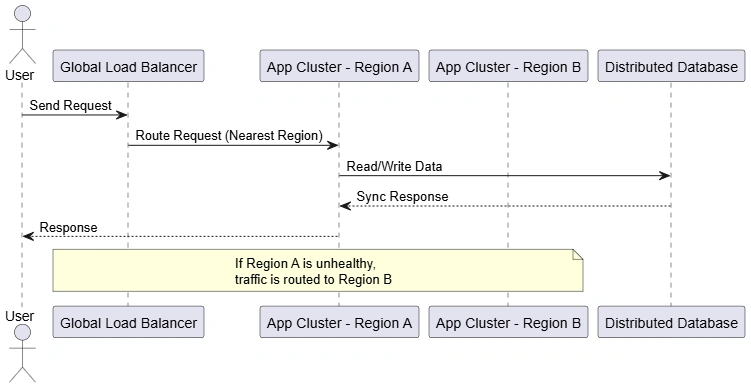
This sequence shows how a user request flows through an Active–Active system. The user sends a request that first hits a global load balancer. The load balancer intelligently routes the request to the nearest healthy region. The application processes the request and interacts with a distributed database that synchronizes data across regions. If one region becomes unavailable, traffic is instantly redirected without user impact. This flow ensures low latency and high availability.
Key points:
Global load balancer – Decides routing based on health and proximity
Multiple active regions – Both regions handle live traffic
Shared database – Keeps data synchronized
Automatic failover – No manual intervention required
Component Diagram (Logical Architecture)
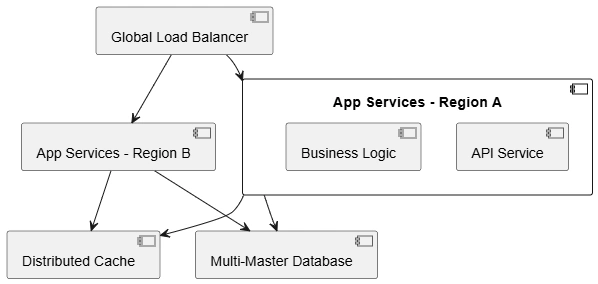
This component diagram represents the logical building blocks of an Active–Active system. The global load balancer distributes traffic across multiple active regions. Each region contains its own application services with identical functionality. Shared components like distributed cache and multi-master databases allow consistent data access. This design enables parallel processing and seamless scaling across regions.
Key points:
Identical app components – Same logic deployed everywhere
Shared infrastructure – Cache and database accessible by all regions
Loose coupling – Components can fail independently
Horizontal scalability – Add more regions easily
Deployment Diagram (Physical Infrastructure)
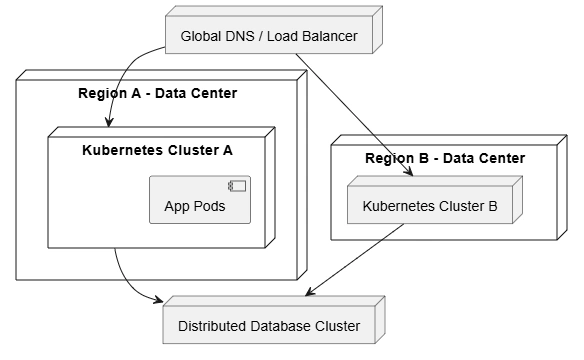
This deployment diagram shows the physical setup across multiple regions. Each data center hosts its own Kubernetes cluster running application pods. A global DNS or load balancer routes traffic to both clusters simultaneously. The distributed database cluster spans regions to keep data synchronized. This physical separation protects the system from regional outages and infrastructure failures.
Key points:
Multi-region deployment – Physical separation for resilience
Container orchestration – Kubernetes manages scaling and health
Shared database cluster – Cross-region replication
Fault isolation – Failure in one region doesn’t affect others
Advantages
High availability – No downtime even during regional failures
Better performance – Users served from nearest location
Improved scalability – Easy to add regions or capacity
Disaster resilience – Built-in protection against outages
Efficient resource usage – No idle standby systems
Summary
Active–Active architecture is a powerful enterprise design pattern that enables systems to run multiple live environments simultaneously. It ensures high availability, scalability, and low latency while eliminating single points of failure. Though it introduces complexity in data consistency and conflict resolution, the benefits far outweigh the challenges for large-scale, mission-critical applications. When implemented correctly, Active–Active architecture forms the backbone of modern, globally distributed enterprise systems.
Join the conversation! Your thoughts help the community grow.