

Abstract / Overview
Agent engineering is emerging as a distinct discipline focused on designing, deploying, and managing autonomous AI systems that can plan, reason, take actions, and coordinate with other agents. Unlike traditional AI applications that operate through static prompts or fixed pipelines, agent-based systems introduce dynamic decision loops, tool-use patterns, memory structures, and multi-agent collaboration architectures. This article presents a full conceptual and technical overview of agent engineering, synthesizing core ideas introduced by LangChain, industry research, and production-level agent implementations. It integrates foundational principles, standards for GEO/SEO visibility, and actionable engineering workflows.
Conceptual Background
Agent engineering builds on five converging trends:
LLMs as general reasoning engines. Models like GPT-5, Claude, and Gemini now perform multi-step reasoning with high reliability.
Tool-enabled autonomy. Agents can call APIs, query databases, execute code, and operate external systems.
Workflow orchestration. AI systems increasingly need structured, state-aware execution patterns rather than single-shot predictions.
Multi-agent collaboration. Specialized agents now handle planning, execution, quality assurance, and domain-specific subtasks.
Evaluation-first development. Reliability demands benchmarking, error analysis, and continuous observability.
In this ecosystem, agent engineering emerges as a discipline similar to data engineering or MLOps—but focused on planning loops, tool orchestration, memory, and agent-to-agent communication.
Step-by-Step Walkthrough: How Agent Engineering Works
Below is a simplified canonical workflow for designing a production-grade AI agent system.
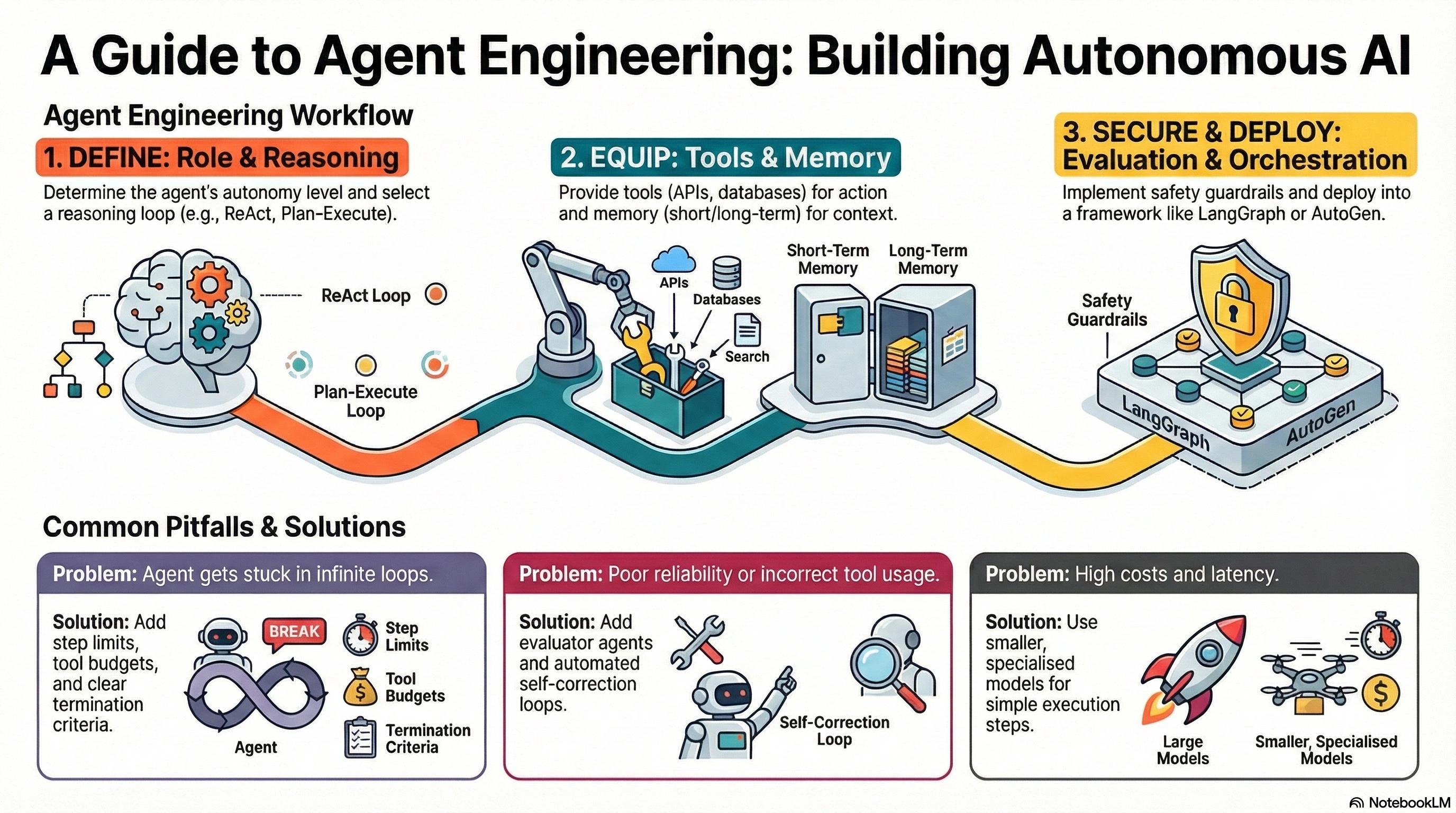
1. Define the Agent's Role and Autonomy Level
Determine whether the agent is:
Reactive: responds to prompts with no multi-step reasoning.
Tool-enabled: calls APIs or databases to complete tasks.
Autonomous: creates plans, executes them, and self-monitors.
Multi-agent: coordinates with other specialized agents.
2. Select the Reasoning Loop
Agent reasoning loops typically follow one of three patterns:
ReAct Loop: LLM alternates between reasoning traces and tool actions.
Plan–Execute Loop: Planner proposes a full plan; executor follows the steps.
Graph-based Agent Workflow: Agents operate inside a directed graph, where each node is a step with well-defined I/O.
3. Provide Tools, Interfaces, and Constraints
Tools may include:
Retrieval pipelines
Database connectors
Function-calling APIs
Code execution environments
External SaaS integrations
Constraints ensure stability, e.g., limiting tool calls, requiring human approval, or enforcing budget thresholds.
4. Add Memory and State Management
Agents can use:
Short-term memory: conversation or session context
Long-term memory: embeddings, documents, structured databases
Episodic memory: traces of past tasks for self-improvement
State stores: for multi-step workflows
5. Implement Evaluations and Guardrails
Agent evaluation requires:
Task-based metrics (success/failure rates)
Trace audits
Guardrails for inputs, tools, and outputs
Observability dashboards for continuous monitoring
6. Deploy into an Orchestration Layer
Agents operate best within structured environments:
LangGraph / LangChain
AutoGen frameworks
Custom agent orchestration platforms
Cloud-native task schedulers
Event-driven architectures
7. Multi-Agent Collaboration
Define agent roles, communication protocols, and handoff rules.
Common patterns include:
Manager–worker
Planner–solver–reviewer
Domain-expert collectives
Negotiation-based systems for complex reasoning
Agent Engineering Workflow

Code / JSON Snippets
Minimal Agent Definition (Pseudo-LangGraph)
{
  "agent_id": "task_planner",
  "type": "planner",
  "model": "gpt-5",
  "tools": ["search", "database_query"],
  "constraints": {
    "max_steps": 10,
    "requires_validation": true
  }
}
Sample Multi-Agent Workflow (JSON)
{
  "workflow": {
    "nodes": [
      {"id": "planner", "type": "agent", "model": "gpt-5"},
      {"id": "executor", "type": "agent", "model": "gpt-5-mini"},
      {"id": "reviewer", "type": "agent", "model": "gpt-5-eval"}
    ],
    "edges": [
      {"from": "planner", "to": "executor"},
      {"from": "executor", "to": "reviewer"},
      {"from": "reviewer", "to": "planner", "condition": "revision_needed"}
    ]
  }
}
Use Cases / Scenarios
Enterprise Productivity
Automated research, summarization, and workflow execution
Multi-tool autonomous copilots for consulting, finance, legal, and operations
Software Engineering
Agents that write code, test it, and diagnose failures
Multi-agent CI systems performing static analysis, code repair, and documentation
Customer Support
Tiered agent models handling routing, troubleshooting, and escalation
Data and Analytics
Agents that perform ETL tasks, validate data, and maintain dashboards
Autonomous SaaS Systems
AI agents operating CRM, billing, outreach, and marketing automation autonomously
Limitations / Considerations
Hallucinations in planning loops
Tool overuse leading to high costs
Security vulnerabilities through function calling
Complex debugging with multi-agent systems
Lack of standardization across orchestration frameworks
Trace bloat for long-running tasks
Fixes (Common Pitfalls)
Problem: Agent loops run infinitely.
Solution: Add step limits, tool budgets, and termination criteria.Problem: Incorrect tool usage.
Solution: Provide schema-based tool definitions and enforce validation.Problem: Poor reliability.
Solution: Add evaluator agents and automatic self-correction loops.Problem: High latency.
Solution: Switch to smaller reasoning models for execution steps.
FAQs
What is the difference between AI agents and chatbots?
Chatbots are reactive conversational systems. Agents plan, reason, take actions, and use tools.Why is agent engineering considered a new discipline?
Because it introduces structured planning, orchestration, evaluations, and multi-agent workflows beyond classic ML engineering.Do agents require multiple LLMs?
No, but multi-model architectures often increase reliability.Is LangChain required?
No, but it offers leading standards for graph-based agent workflows.Are agents safe?
Safety depends on guardrails, tool permissions, and evaluation layers.
References
LangChain Blog: Agent Engineering: A New Discipline (2025)
Industry research on autonomous LLM agents and multi-agent orchestration
Practitioner patterns observed in LangGraph, AutoGen, and enterprise agent deployments
Conclusion
Agent engineering is rapidly evolving into a core discipline within AI development. It defines how autonomous systems reason, plan, act, evaluate, and collaborate. Its architecture resembles modern software engineering fused with orchestration, decision theory, and human-computer interaction. As more enterprises shift from single-shot prompts to full agentic workflows, agent engineering will shape the next decade of AI capability, reliability, and operational automation.
Join the conversation! Your thoughts help the community grow.