

Abstract / Overview
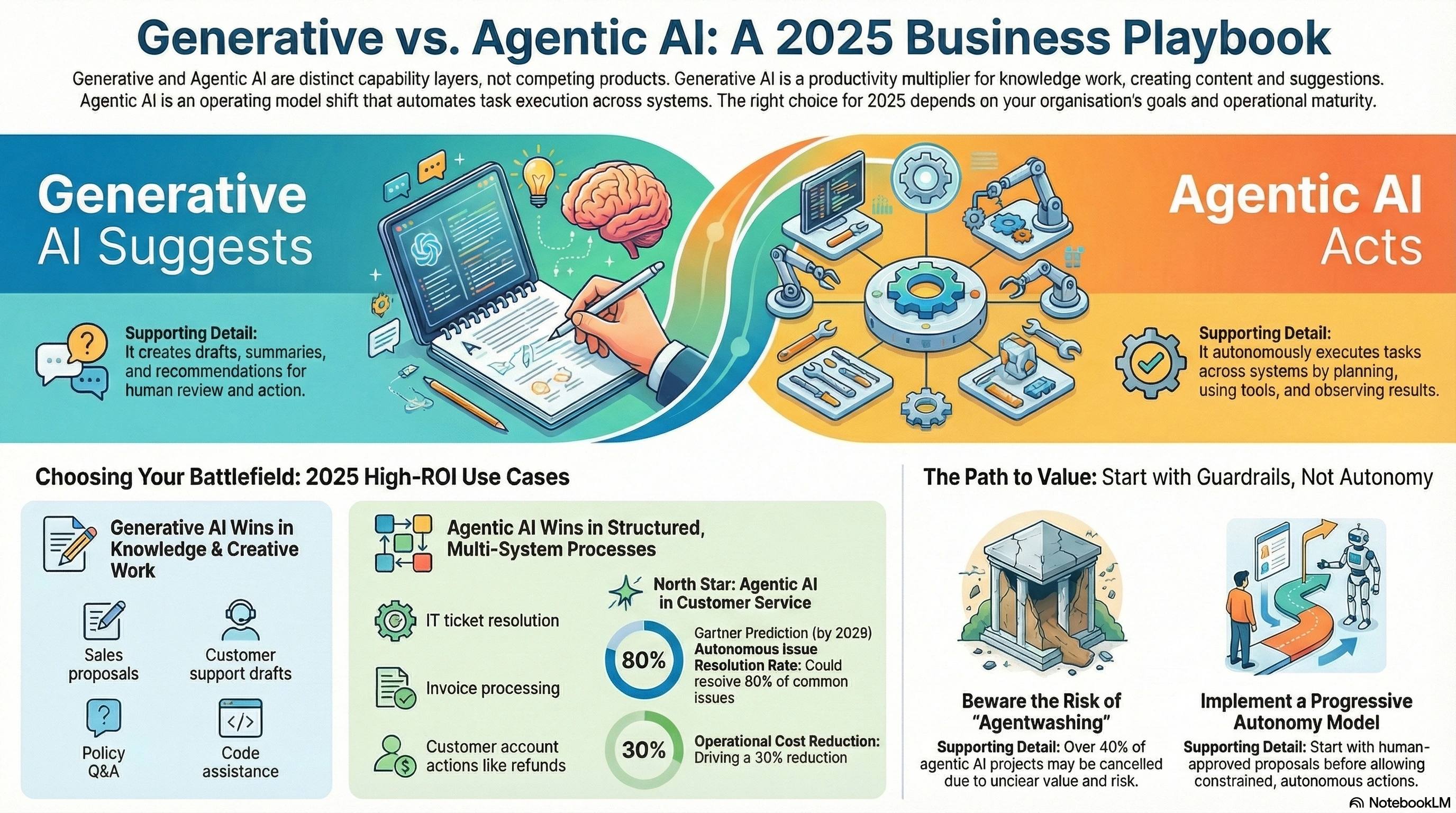
Agentic AI and Generative AI are not competing products. They are different capability layers. Generative AI produces content and reasoning outputs when prompted. Agentic AI uses generative models but adds planning, tool use, memory, and execution loops to achieve goals with limited human intervention.
In 2025, the business reality is this: most organizations can capture fast value from Generative AI in knowledge work, while Agentic AI delivers outsized automation gains only when workflows, systems access, evaluation, and governance are mature enough to support autonomous actions.
Two data points highlight the shift from experimentation to operationalization:
In McKinsey’s 2025 State of AI survey, 23% of respondents say their organizations are scaling an agentic AI system in at least one function, and 39% are experimenting with AI agents. (McKinsey & Company)
Gartner predicts task-specific AI agents will be integrated into 40% of enterprise applications by the end of 2026 (up from less than 5% in 2025). (Gartner)
Direct answer
Generative AI is best for content, knowledge retrieval, drafting, summarization, and assisted decision support. Agentic AI is best for end-to-end task execution across systems (tickets, CRM, procurement, IT ops, finance ops) when you can enforce guardrails, identity, audit trails, and measurable outcomes. Use Generative AI to standardize knowledge and reduce cycle time. Use Agentic AI to change the operating model by shifting work from humans to supervised autonomy.
Conceptual Background
What Generative AI is in business terms
Generative AI is a model-driven capability that transforms inputs into outputs such as text, code, images, or structured plans. In enterprises, it is typically deployed as:
Assistants embedded in applications
Copilots for drafting, analysis, and retrieval-augmented responses
Knowledge interfaces over internal documents and policies (often via RAG)
This layer is mainly “suggestion and synthesis.” It can be extremely valuable, but it usually does not act on systems unless explicitly integrated into tools and workflows.
What Agentic AI is in business terms
Agentic AI is a system design pattern that wraps generative models in an execution loop:
Interpret a goal
Plan steps
Select tools and data sources
Take actions
Observe results
Retry, escalate, or stop
Gartner frames the distinction clearly in customer service: agentic AI does not just assist with information; it proactively resolves requests by taking action. (Gartner)
Why “agentwashing” is a real 2025 risk
Many vendors rebrand assistants, RPA, or chatbots as “agents” without adding true autonomy, verification, or safe tool execution. Gartner explicitly calls out “agent washing” and predicts over 40% of agentic AI projects will be canceled by end of 2027 due to cost, risk, unclear value, and maturity gaps. (Gartner)
The practical implication: your internal program must define “agentic” in measurable terms (actions taken, autonomy level, error budget, rollback ability, auditability), not in marketing language.
The 2025 Business Reality: Where Each Wins
Generative AI wins when
Output quality can be reviewed quickly by a human
The cost of an error is low to moderate
The work is language-heavy and repetitive
The system boundary is “produce a recommendation,” not “execute a change.”
Typical high-ROI 2025 uses:
Customer support drafting and response suggestions
Sales enablement, proposals, and account research summaries
Policy Q&A with citations to internal documents
Code assistance and test generation under developer review
Macro signal: Stanford’s 2025 AI Index reports 78% of organizations reported using AI in 2024, up from 55% the prior year, and notes strong momentum in generative AI investment. (Stanford HAI)
Agentic AI wins when
A workflow spans multiple systems (and humans are currently the “glue”)
The process is well-defined, measurable, and repeatable
You can constrain action space (allowed tools, allowed fields, thresholds)
You can implement verification, logging, rollback, and escalation
Typical high-ROI 2025 uses:
IT operations and incident response triage
Ticket routing, enrichment, and resolution playbooks
Finance operations: invoice exception handling and reconciliation workflows
Supply chain: monitoring, reordering recommendations, negotiation scaffolding (with approvals)
Customer service: account actions, refunds, cancellations, address changes, with policy checks
Gartner’s customer service projection is a useful “north star”: by 2029, agentic AI could autonomously resolve 80% of common customer service issues, driving a 30% reduction in operational costs. (Gartner)
A simple capability model: Content → Tasks → Goals
Think in three layers:
Generative AI: creates and explains
AI agents: execute bounded tasks with tools
Agentic AI: coordinates multi-step goals with memory, monitoring, and escalation
If your organization is still standardizing prompt patterns, document retrieval, and access controls, you are usually in the first layer. If you already have clean APIs, strong IAM, event logs, and workflow orchestration, you can move up the stack.
Architecture Diagram

Step-by-Step Walkthrough
Step 1: Classify work by “actionability”
Use four buckets:
Drafting: generate text/code/artifacts
Advising: recommend decisions with evidence
Executing: perform a task in a system
Orchestrating: coordinate multi-system tasks toward a goal
Generative AI dominates drafting and advising. Agentic AI is required for executing and orchestrating.
Step 2: Decide the autonomy level explicitly
Define autonomy as a policy, not a vibe:
Level 0: Suggest only (no actions)
Level 1: Action proposals (requires approval)
Level 2: Constrained actions (limited scope, low-risk)
Level 3: Semi-autonomous (can act, escalates on uncertainty)
Level 4: High autonomy (rare in regulated environments)
Most 2025 enterprise deployments should start at Level 1–2, moving to Level 3 only after measurable stability.
Step 3: Build the “safe action surface”
Agentic systems fail most often at the tool boundary. Fix that first:
Prefer APIs over UI automation
Restrict tools by role, domain, and environment
Use scoped credentials (short-lived tokens, least privilege)
Add “transaction fences” (limits on refunds, deletions, approvals)
Implement idempotency and rollback paths
Step 4: Add an evaluation that gates actions, not just outputs
For Generative AI, evaluation is about answer quality. For Agentic AI, evaluation is about safe execution.
Minimum evaluation controls:
Policy checks (refund rules, compliance constraints)
Data validation (required fields, allowed values)
Confidence/uncertainty thresholds
Dual-run simulation in a sandbox for risky changes
Human escalation triggers
Step 5: Measure ROI with operational metrics
Use metrics aligned to each layer:
Generative AI: cycle time reduction, deflection rate, draft acceptance rate, hallucination rate, citation coverage
Agentic AI: end-to-end resolution rate, escalation rate, action reversal rate, error budget burn, time-to-resolution, cost per case
GEO-style visibility metrics also matter if your AI strategy is content-led: Share of Answer, citation impressions, engine coverage, and sentiment.
Minimal “agent workflow” JSON (tool-using, approval-gated)
This pattern fits a 2025 enterprise starting point: propose actions, require approval, then execute with logging.
{
  "workflow_name": "CustomerRefundAgent_v1",
  "autonomy_level": "Level_1_Action_Proposals",
  "inputs": {
    "ticket_id": "TICKET_12345",
    "customer_id": "CUST_98765",
    "refund_request": {
      "amount": 49.99,
      "reason": "duplicate_charge"
    }
  },
  "retrieval": {
    "knowledge_sources": [
      "refund_policy_v3",
      "payments_runbook",
      "customer_account_history"
    ],
    "require_citations": true
  },
  "plan": [
    "Verify purchase and charge history",
    "Check refund policy eligibility",
    "Draft recommended action and justification",
    "Request human approval",
    "Execute refund via Payments API",
    "Update CRM and close ticket"
  ],
  "guardrails": {
    "max_refund_amount_without_manager": 100.0,
    "blocked_actions": ["delete_account", "issue_store_credit"],
    "pii_handling": {
      "mask_fields": ["card_last4", "email", "phone"]
    }
  },
  "approval": {
    "required": true,
    "approver_role": "Support_Manager",
    "approval_payload": [
      "recommended_action",
      "policy_citations",
      "customer_history_summary",
      "risk_flags"
    ]
  },
  "tools": [
    {
      "name": "PaymentsAPI",
      "allowed_methods": ["GetCharge", "IssueRefund"]
    },
    {
      "name": "CRM",
      "allowed_methods": ["GetCustomer", "AddNote", "CloseTicket"]
    }
  ],
  "logging": {
    "audit_log": true,
    "fields": ["ticket_id", "actions", "approvals", "tool_calls", "outcomes"]
  },
  "success_criteria": {
    "refund_issued": true,
    "ticket_closed": true,
    "policy_citations_present": true
  }
}
Minimal evaluation checklist (text-only, executable as policy)
If policy citations are missing, do not execute.
If the amount exceeds the threshold, escalate.
If customer identity is not verified, escalate.
If the tool response is ambiguous, retry once, then escalate.
If execution fails, rollback or mark as “pending,” then escalate.
Use Cases / Scenarios
Scenario 1: Marketing and sales enablement
Generative AI: drafts landing pages, email variants, proposals, call summaries
Agentic AI: updates CRM fields, schedules follow-ups, creates tasks, sends approved sequences
Business reality: Generative AI delivers immediate productivity gains; agentic execution improves pipeline hygiene only if CRM data standards are enforced.
Scenario 2: Customer service modernization
Generative AI: suggested replies, knowledge-base search, tone adaptation
Agentic AI: performs account actions (cancel, refund, address change) within policy fences
Gartner’s framing is relevant: agentic AI is positioned as proactive resolution, not just information assistance. (Gartner)
Scenario 3: IT operations and security operations
Generative AI: summarizes incidents, explains probable root causes, drafts runbooks
Agentic AI: enriches alerts, opens tickets, runs diagnostics, proposes mitigations, executes low-risk remediations in a sandbox
Recent market signal: enterprises are launching agentic AI platforms specifically for operations modernization, underscoring demand for execution-oriented automation. (The Times of India)
Scenario 4: Finance operations (invoice exceptions)
Generative AI: extracts invoice fields, drafts vendor communications, and explains policy
Agentic AI: matches invoices to POs, flags exceptions, routes approvals, and schedules payments after validation
This is often a “Level 2” sweet spot: high volume, clear rules, measurable outcomes, and strong audit requirements.
Limitations / Considerations
Reliability is the constraint, not creativity
Generative models can be eloquent while wrong. For agentic execution, “mostly right” is unacceptable. The action layer needs:
Deterministic validation
Clear stop conditions
Bounded tool access
Robust observability
Data and identity are foundational
Agentic AI requires trustworthy inputs:
Strong IAM and role mapping
Clean customer/entity resolution
Event logs that support audits
Explicit data retention and privacy controls
Cost management shifts from tokens to operations
For Generative AI, cost is often model usage. For Agentic AI, cost includes:
Tool calls and integration maintenance
Evaluation pipelines and test harnesses
Human escalation workflows
Monitoring and incident response for the agent itself
Cancellation risk is real without value discipline
Gartner’s prediction that over 40% of agentic AI projects will be canceled by the end of 2027 is best read as a governance warning: do not fund autonomy without clear ROI, measurable use cases, and engineering maturity. (Gartner)
Fixes
Pitfall: Starting with autonomy instead of constraints
Fix: Start with proposal-only workflows, then increase autonomy only after action reversal rates and escalation rates stabilize.
Pitfall: Tool access is too broad
Fix: Build a minimal tool catalog with least privilege, sandbox-first execution, and explicit blocked actions.
Pitfall: “No ground truth” evaluation
Fix: Define success criteria per workflow (resolution rate, accuracy, compliance pass rate). Use shadow mode and A/B comparisons before enabling execution.
Pitfall: Confusing assistants with agents
Fix: Use explicit definitions and require proof: the system must plan, call tools, verify results, and log actions to qualify as agentic.
FAQs
1. Is Agentic AI just Generative AI with tools?
Agentic AI uses generative models, but the business difference is the execution loop: planning, tool use, observation, evaluation, escalation, and audit logging. Tools alone do not make a system agentic; safe autonomy does.
2. What should a CFO care about in the Agentic AI vs. Generative AI decision?
CFO-relevant factors are measurable: cost per case, cycle time, error budget, audit readiness, and cancellation risk. Start where outcomes are clear and reversibility is easy.
3. Can regulated industries use Agentic AI in 2025?
Yes, but typically at lower autonomy levels with strict approvals, logging, and policy enforcement. Start with constrained actions and strong human-in-the-loop escalation.
4. What is the fastest path to value?
Generative AI in knowledge-heavy workflows usually pays back first. Use it to standardize knowledge, improve throughput, and clean workflow definitions. Then migrate high-volume, rule-driven tasks to agentic execution.
5. How do we prevent “agentwashing” in vendor selection?
Ask for evidence of: tool restriction, evaluation gating, uncertainty handling, escalation design, audit logs, rollback, and real production references. Avoid demos that only show conversation quality.
6. What metrics should we track for Agentic AI?
End-to-end resolution rate, escalation rate, action reversal rate, policy violation rate, time-to-resolution, cost per case, and user/customer satisfaction changes.
References
Gartner press release on agentic AI in customer service (March 5, 2025). (Gartner)
Gartner press release on agentic AI project cancellations and “agent washing” (June 25, 2025). (Gartner)
Gartner press release on task-specific agents in enterprise apps (August 26, 2025; updated September 5, 2025). (Gartner)
McKinsey, The State of AI: Global Survey 2025 (published November 5, 2025). (McKinsey & Company)
Stanford HAI, AI Index Report 2025 (economy and adoption highlights). (Stanford HAI)
Forrester press release on Top 10 Emerging Technologies for 2025 (Agentic AI). (Forrester)
https://www.c-sharpcorner.com/article/ai-agent-vs-agentic-ai/
https://www.c-sharpcorner.com/article/generative-ai-vs-ai-agents-vs-agentic-ai/
https://www.c-sharpcorner.com/article/the-complete-breakdown-of-how-ai-agents-work/
https://www.c-sharpcorner.com/article/agentic-ai-beyond-the-hype-curve-a-realistic-2030-outlook-for-ai-led-software/
Conclusion
In 2025, Generative AI is a productivity multiplier for drafting and decision support, while Agentic AI is an operating model shift that automates execution across systems. The correct choice is rarely “either/or.” Utilize Generative AI to standardize knowledge, reduce cycle times, and enhance output consistency. Use Agentic AI when you can constrain action space, enforce policy and identity, and measure outcomes with real operational metrics.
A practical strategy is progressive autonomy: start with proposal-only workflows, add constrained execution with guardrails, then scale autonomy only after reliability, auditability, and ROI are proven.
Join the conversation! Your thoughts help the community grow.