

Pre-requisite to understand this
Client–Server Architecture – System where a requester (client) communicates with a service provider (server).
JSON-RPC 2.0 – Lightweight remote procedure call protocol using JSON messages.
API (REST/HTTP) – Standard way backend systems expose functionality.
Process Communication (STDIO/WebSocket/HTTP) – Ways two programs exchange messages.
Tool Calling Concept in AI – AI can invoke structured functions instead of generating plain text.
Schema Validation – Ensuring inputs/outputs match predefined structure.
Separation of Concerns – Different layers handle different responsibilities.
Introduction
MCP (Model Context Protocol) defines a standardized communication model between an AI application (MCP Client) and an MCP Server. The MCP Client is typically embedded in an AI application or agent runtime, while the MCP Server acts as a structured gateway that exposes tools, resources, and prompts in a safe and controlled way. Communication happens via JSON-RPC 2.0 messages over transports such as STDIO, HTTP, or WebSocket. The MCP Server does not replace your backend; instead, it acts as an adapter layer between AI systems and existing services.
What problem we can solve with this?
When AI systems need to interact with real-world systems (databases, CRMs, file systems, payment gateways), direct API access becomes unsafe and unreliable. AI models may hallucinate endpoints, send malformed payloads, or call restricted operations. MCP solves this by introducing a structured, discoverable, and validated communication mechanism between AI and external systems. It ensures only approved tools are exposed and all inputs/outputs follow defined schemas. This reduces integration complexity and increases security. It also standardizes how AI interacts with tools across different systems. Ultimately, MCP creates a safe automation boundary for AI-driven actions.
Problems Solved
Prevents AI from hallucinating API formats
Ensures strict input/output validation
Provides controlled exposure of backend capabilities
Standardizes AI-to-system integration
Enables secure tool execution
Supports streaming and structured responses
How MCP Client Communicates with MCP Server & Role of MCP Server
The MCP Client initiates communication by establishing a transport connection (STDIO, HTTP, or WebSocket). It sends an initialize request to negotiate protocol version and capabilities. The MCP Server responds with supported tools and resources. The client can then request capability listings like tools/list. When the AI decides to perform an action, the client sends a tools/call request. The MCP Server validates arguments, invokes backend services if required, and returns structured results. Throughout this process, the MCP Server enforces validation, permissions, logging, and safety checks.
Implementation / Usage Steps
Establish transport connection (STDIO/HTTP/WebSocket)
Perform initialization handshake
Discover available tools
AI selects and calls a tool
MCP Server validates request
MCP Server invokes backend/service
Structured response returned to client
Sequence Diagram
The sequence starts when the AI determines an action is required. The MCP Client initializes communication with the MCP Server and retrieves its capabilities. After discovering available tools, the client invokes a specific tool using tools/call. The MCP Server validates inputs and forwards the request to the appropriate backend API. Once the backend responds, the MCP Server transforms the response into a structured format and sends it back to the client. The client then integrates this result into the AI's final response. This ensures structured, validated, and secure communication.
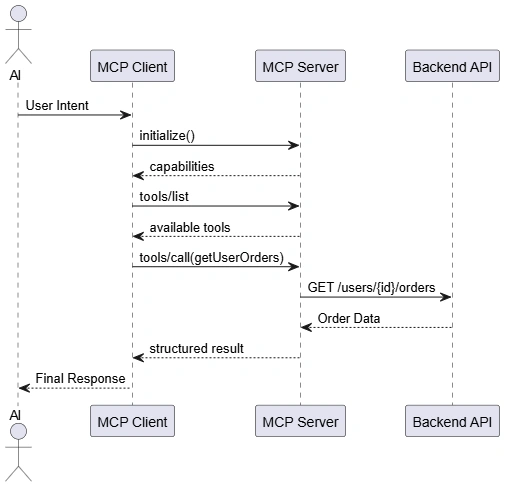
Step Flow
AI generates intent
Client initializes MCP session
Server shares capabilities
Client calls tool
Server validates and executes
Backend returns data
Structured result flows back
Component Diagram
The component diagram shows logical separation of responsibilities. The AI Engine determines intent but does not directly access backend services. The MCP Client handles protocol communication. The MCP Server acts as a controlled integration layer. It connects securely to backend APIs, which in turn interact with databases. The numbered arrows represent request and response flow. The MCP Server plays a central role as a validation and transformation layer. This architecture enforces separation between AI reasoning and enterprise systems.
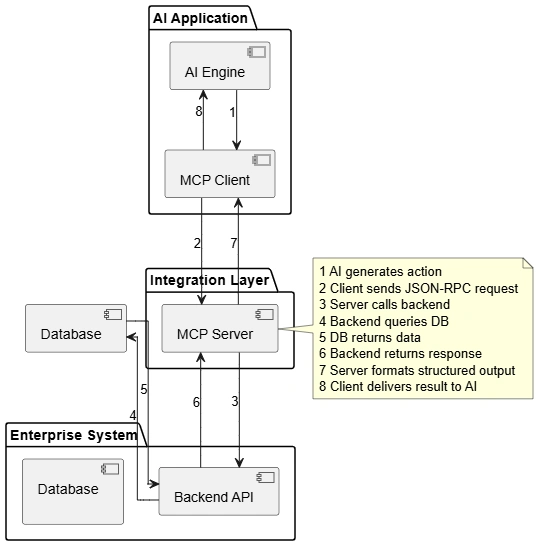
Component Roles
AI Engine – Determines intent
MCP Client – Protocol handler
MCP Server – Tool gateway & validator
Backend API – Business logic layer
Database – Persistent storage
Deployment Diagram
The deployment diagram shows physical distribution. The AI application and MCP Client may run on a user device or application server. The MCP Server may run as a separate service (local process, container, or dedicated host). Backend APIs and databases typically run in cloud or enterprise infrastructure. Communication between client and server can be STDIO (local) or HTTP/WebSocket (remote). The MCP Server isolates enterprise systems from direct AI access. This ensures secure and scalable deployment patterns.
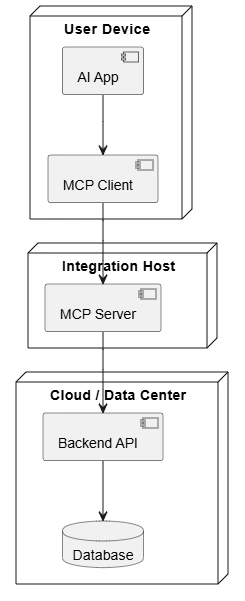
Deployment Highlights
AI App and MCP Client can be co-located
MCP Server may run locally or remotely
Backend hosted in cloud/data center
Communication via secure transport
Clear isolation boundaries
Advantages
Standardized AI-to-system communication
Strong validation and schema enforcement
Controlled exposure of backend capabilities
Secure execution boundary
Transport-agnostic (STDIO/HTTP/WebSocket)
Supports streaming and structured responses
Scalable across multiple backend systems
Summary
MCP enables structured communication between an AI-driven MCP Client and an MCP Server using JSON-RPC over flexible transports. The MCP Client handles protocol-level messaging, while the MCP Server acts as a secure adapter layer that exposes validated tools and interacts with backend systems. This architecture prevents unsafe direct API access, standardizes AI integrations, and enforces strict validation and control. By separating AI reasoning from enterprise execution layers, MCP creates a secure, scalable, and maintainable foundation for AI-powered automation.
Join the conversation! Your thoughts help the community grow.