Pre-requisites to understand this
Sensitive Data (PII/PHI): Personal or confidential data that must be protected.
Data Security: Practices to prevent unauthorized access and breaches.
Encryption: Converting data into unreadable form using keys.
Access Control: Restricting who can view or modify data.
Compliance Regulations: Laws like GDPR, HIPAA requiring data protection.
Data Lifecycle: Flow of data from creation to deletion.
Introduction
Data Masking and Data Redaction are critical techniques used in modern security architectures to protect sensitive information from unauthorized access. While both aim to secure data, masking replaces sensitive data with realistic but fictitious values, preserving usability, whereas redaction permanently removes or obscures sensitive data. These techniques are widely used in industries such as banking, healthcare, and e-commerce to ensure data privacy, regulatory compliance, and secure data sharing across environments like development, testing, and analytics.
What problem we can solve with this?
Organizations handle vast amounts of sensitive data, which increases the risk of data breaches, insider threats, and accidental exposure. Without proper protection, even non-production environments like testing can become attack surfaces. Data masking and redaction help minimize these risks by ensuring that sensitive data is never exposed unnecessarily. Masking allows safe usage of data in lower environments, while redaction ensures complete removal of confidential information when sharing externally. These techniques also help meet strict compliance requirements and reduce legal and financial risks associated with data leaks.
Key Problems Solved:
Prevent exposure of sensitive data in non-production systems
Reduce risk of insider threats
Enable safe data sharing with third parties
Ensure compliance with data protection regulations
Protect against data breaches and leaks
Maintain customer trust and brand reputation
How to implement/use this?
Implementing data masking and redaction involves identifying sensitive data fields, defining policies, and applying transformation techniques either statically (before storage) or dynamically (at runtime). Masking can be applied using techniques like substitution, shuffling, or encryption-like transformations. Redaction is typically enforced at the presentation or API layer where sensitive fields are removed entirely. Integration with access control systems ensures that only authorized users can view original data. Organizations often use specialized tools or middleware to automate masking and redaction processes across databases, APIs, and applications.
Masking Credit Card & Email
def mask_credit_card(card_number):
    # Keep last 4 digits, mask rest
    return "XXXX-XXXX-XXXX-" + card_number[-4:]


def mask_email(email):
    # Mask part of email before @
    name, domain = email.split("@")
    return name[0] + "***@" + domain


def mask_user_data(user):
    return {
        "name": user["name"],  # no masking needed
        "email": mask_email(user["email"]),
        "credit_card": mask_credit_card(user["credit_card"])
    }


# Example usage
user_data = {
    "name": "John Doe",
    "email": "[email protected]",
    "credit_card": "1234567812345678"
}

masked_data = mask_user_data(user_data)
print(masked_data)
Output
{
    "name": "John Doe",
    "email": "j***@gmail.com",
    "credit_card": "XXXX-XXXX-XXXX-5678"
}
Implementation Steps:
Identify sensitive fields (e.g., SSN, credit card)
Define masking/redaction policies
Choose masking techniques (static/dynamic)
Apply redaction rules at UI/API level
Integrate with authentication & authorization
Monitor and audit data access
Sequence Diagram
This sequence diagram shows how data masking and redaction are applied during a user request. When a user requests data, the application retrieves raw sensitive data from the database. Before sending the response, the system applies masking to hide sensitive portions while keeping data usable. Then, based on user roles or permissions, redaction is applied to completely remove restricted information. Finally, the processed data is returned to the user. This layered approach ensures that sensitive data is protected at multiple levels and only the minimum required information is exposed.
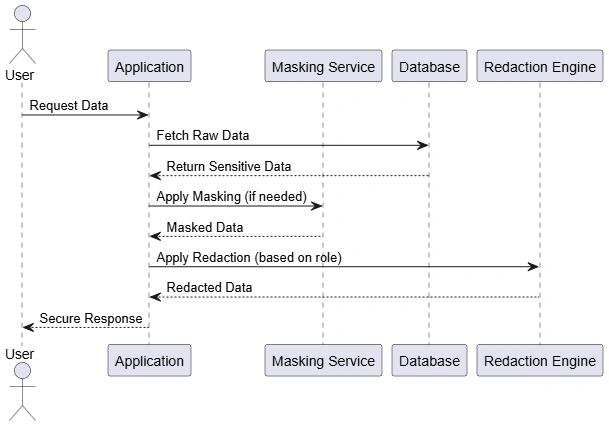
Key Steps:
User requests data from application
Application fetches raw data from database
Masking service obfuscates sensitive fields
Redaction engine removes restricted data
Final secure response sent to user
Component Diagram
The component diagram represents the architectural view of how different modules interact in a system implementing data masking and redaction. The user interface initiates requests that pass through an API gateway for routing and security checks. The application service acts as the central processor, coordinating with masking and redaction modules. The masking module ensures sensitive data is transformed, while the redaction module removes data based on policies. The database stores the original sensitive data securely. This modular design allows scalability, maintainability, and enforcement of security policies at multiple layers.
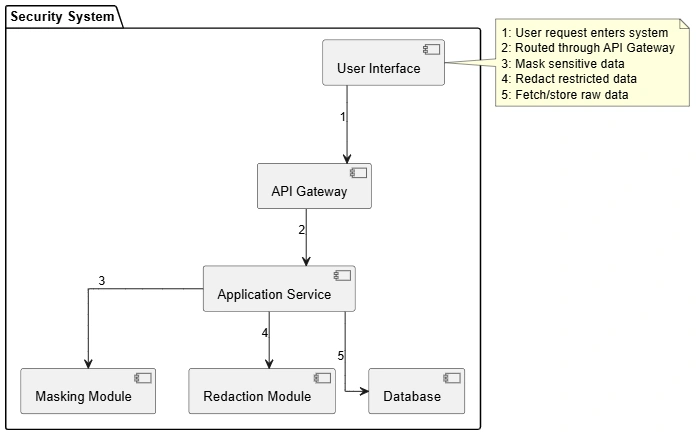
Key Components:
User Interface: Entry point for users
API Gateway: Handles routing and security
Application Service: Core processing logic
Masking Module: Obfuscates sensitive data
Redaction Module: Removes sensitive data
Database: Stores original data securely
Deployment Diagram
The deployment diagram illustrates how data masking and redaction components are distributed across physical or virtual infrastructure. The client device interacts with the API service hosted on the application server. The API service coordinates with masking and redaction services to process sensitive data before sending responses. The secure database server stores the original unmasked data. This separation ensures that sensitive operations are handled in controlled environments, reducing the attack surface and improving security. It also supports scalability by allowing independent deployment of masking and redaction services.
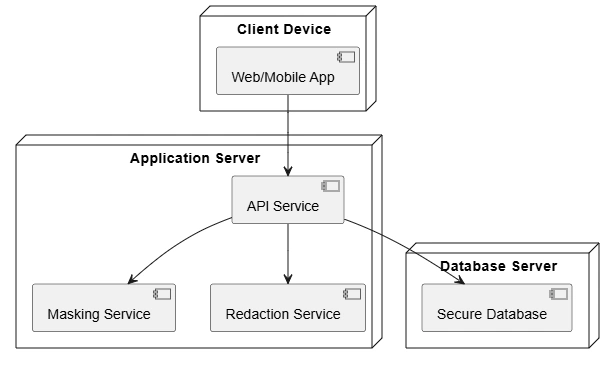
Key Deployment Points:
Client interacts via web/mobile app
API service processes requests
Masking and redaction services handle data protection
Database securely stores raw sensitive data
Separation improves scalability and security
Advantages
Protects sensitive data from unauthorized access
Enables safe use of production-like data in testing
Ensures regulatory compliance (GDPR, HIPAA)
Reduces risk of data breaches
Supports secure data sharing
Enhances customer trust
Minimizes insider threat risks
Summary
Data masking and redaction are essential techniques for safeguarding sensitive information in modern systems. Masking ensures data remains usable while hiding critical details, whereas redaction completely removes sensitive information for maximum security. Together, they provide a layered defense strategy that protects data across its lifecycle—from storage to access and sharing. By integrating these techniques into application architecture, organizations can significantly reduce security risks, comply with regulations, and maintain trust in an increasingly data-driven world.


Join the conversation! Your thoughts help the community grow.