

Introduction
Modern distributed systems rely heavily on how services communicate - whether synchronously (blocking) or asynchronously (non-blocking/event-driven). Choosing the right approach directly affects scalability, performance, and architectural complexity.
This article explains synchronous vs asynchronous communication and how it applies to:
FastAPI
Flask
Django
Synchronous Communication
Definition
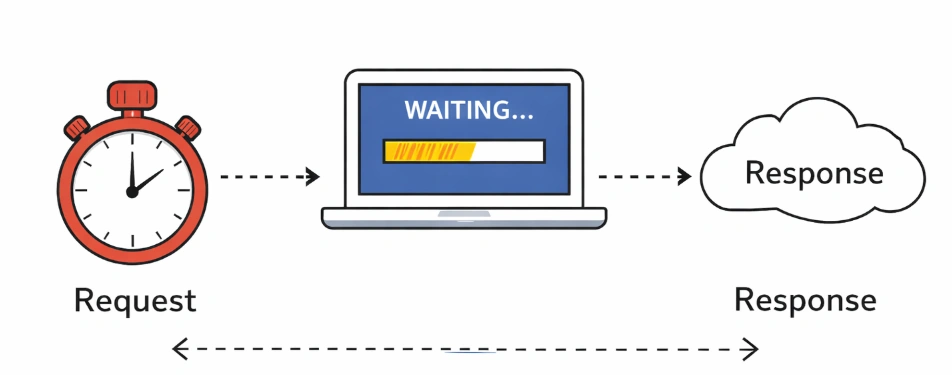
Synchronous communication follows a request–response model:
Client sends request
Server processes
Server returns response
Client waits until response arrives
The caller is blocked until the operation completes.
Example: Sync Endpoint (Flask)
from flask import Flask
import time

app = Flask(__name__)

@app.route("/sync")
def sync_endpoint():
    time.sleep(5)  # Blocking operation
    return {"message": "Done"}
If 100 users call this endpoint:
Each request occupies a worker thread/process
The server must scale using more threads/processes
Characteristics
Simple mental model
Easier debugging
Thread/process-based concurrency
Limited scalability for I/O-heavy workloads
When Sync Works Well
CPU-bound operations
Simple CRUD APIs
Traditional enterprise applications
Internal systems with moderate traffic
Asynchronous Communication
Definition
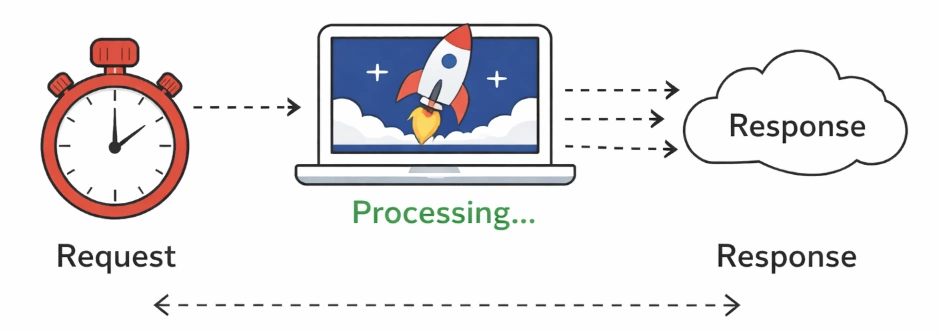
Asynchronous communication allows non-blocking execution:
Request is sent
Processing happens without blocking the main thread
Other requests continue processing
Response returned when ready
Based on event loops and cooperative multitasking.
Example: Async Endpoint (FastAPI)
from fastapi import FastAPI
import asyncio

app = FastAPI()

@app.get("/async")
async def async_endpoint():
    await asyncio.sleep(5)  # Non-blocking
    return {"message": "Done"}
While waiting:
Event loop processes other requests
No thread is blocked
Characteristics
High concurrency
Efficient for I/O-bound tasks
Uses event loop instead of threads
Better resource utilization
When Async Works Best
External API calls
Database queries
File I/O
WebSockets
Streaming APIs
Microservices communication
Framework-Level Comparison
FastAPI
FastAPI is:
ASGI-based
Async-first
Built on Starlette
Supports both
async defanddef
Runs on ASGI servers such as:
Uvicorn
Hypercorn
Internal Handling
async def→ Runs in event loopdef→ Automatically executed in threadpool
FastAPI is ideal for high-concurrency APIs and microservices.
Flask
Flask is:
WSGI-based
Primarily synchronous
Thread/process concurrency model
Although modern Flask versions allow async views, it is not truly async-native.
Runs typically on:
Gunicorn (WSGI mode)
Concurrency is handled by:
Multiple processes
Multiple threads
Best suited for traditional synchronous web apps.
Django
Django historically:
WSGI-based
Fully synchronous
Modern Django versions support ASGI and async views.
However:
ORM is still largely synchronous
Middleware ecosystem is mostly sync
Async support is partial
Django excels in:
Full-stack applications
Admin dashboards
Enterprise web platforms
WSGI vs ASGI
For detail understanding of WSGI and ASGI, you can check my article WSGI vs ASGI Application Servers in Python.
Join the conversation! Your thoughts help the community grow.