Breach and Attack Simulation vs. Security Control Validation vs. Agentic AI Penetration Testing
Three approaches, three different questions, and a shift in how we think about cybersecurity.
Let's be honest. We have spent years investing in firewalls, EDR, SIEM, XDR, WAF, CNAPP, vulnerability scanners and countless other security solutions.
We run simulations. We validate controls. We conduct penetration tests. We receive reports, close findings and present dashboards to management.
Yet one uncomfortable question remains:
Do we know whether our security controls work, or do we know whether an attacker can still find a way around them?
These are two very different questions. As attack surfaces grow, applications become more complex, and AI changes how security testing is performed, understanding that difference matters.
Breach and Attack Simulation (BAS), Security Control Validation, and Agentic AI Penetration Testing are related. They can complement one another. But they are not the same.
1. Breach and Attack Simulation: Can our defences recognise a known attack?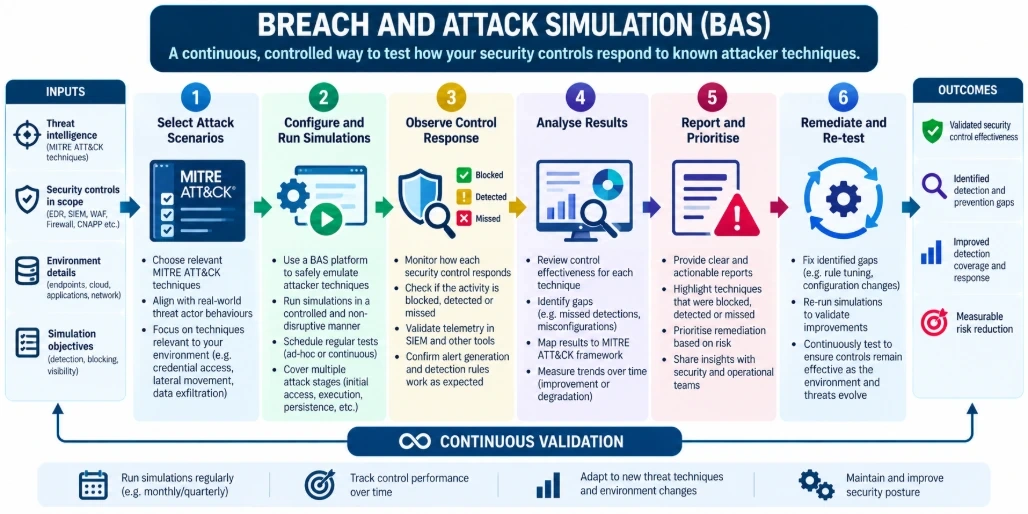
Imagine your organisation has invested heavily in an EDR solution, a SIEM platform and a next-generation firewall. Everything is deployed. The dashboards are green. The security team is confident.
But deployment does not automatically mean effectiveness.
Breach and Attack Simulation (BAS) uses controlled simulations of known attacker techniques to assess how defensive technologies respond. It can help determine whether a technique is blocked, detected, or missed entirely. Many platforms map tests to the MITRE ATT&CK framework.
A practical example
Imagine a threat actor attempts a known credential-access technique against an endpoint. A BAS platform safely emulates the relevant behaviour and observes the response.
Did endpoint protection block the activity?
Did the SIEM receive the relevant telemetry?
Was an alert generated?
Did the detection rule work as expected?
If not, you have evidence of a defensive gap. BAS helps organisations repeatedly test known attack behaviours, identify control weaknesses and measure whether security configurations continue to work as expected.
BAS primarily tests how your defences respond to selected attack techniques. It does not, by itself, establish whether an attacker can discover and exploit an entirely new vulnerability or chain several weaknesses together.
Think of BAS as regularly testing the alarm system, locks and cameras. You know whether they respond to the tests you perform, but you have not necessarily tested every possible way someone could enter the building.
2. Security Control Validation: Are our security investments delivering the protection we expect?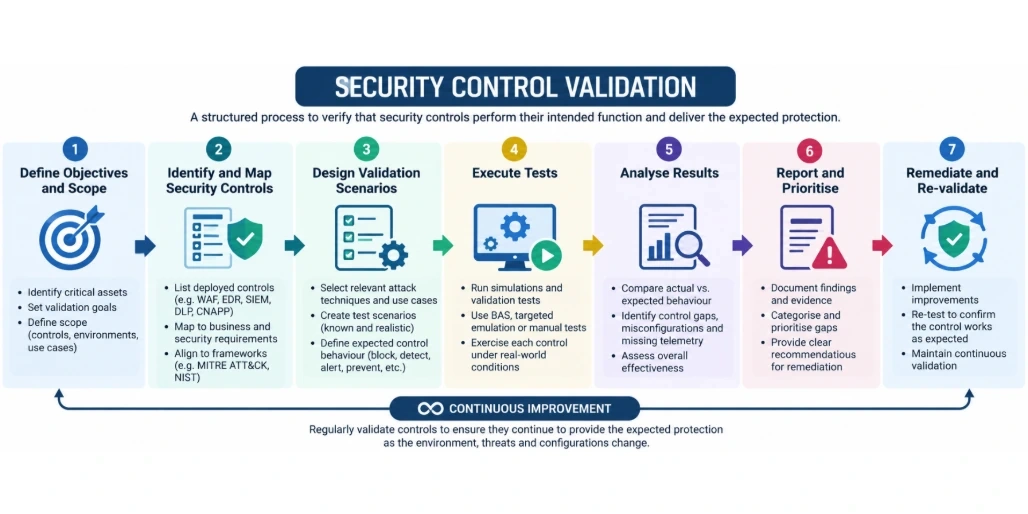
Security Control Validation is the broader discipline of gathering evidence that security controls perform their intended function under relevant attack conditions. Depending on the organisation and terminology, it can encompass BAS, targeted attack emulation, detection engineering tests and other validation methods.
The objective is not simply to confirm that a security product exists. It is to verify that it provides the expected protection.
A practical example
Your organisation has deployed a WAF to protect internet-facing applications, EDR for endpoints, a SIEM to correlate security events, and DLP to help prevent sensitive information from leaving the organisation.
A validation exercise might test whether the WAF blocks selected malicious requests, whether EDR detects a defined attack technique, whether the SIEM receives and correlates relevant events, and whether DLP enforces a particular data-protection policy.
The results can reveal misconfigurations, missing telemetry, ineffective detection rules and gaps between expected and actual control behaviour.
A control can be deployed correctly from an installation perspective and still fail to deliver the intended security outcome.
BAS is one way to perform this validation. Security Control Validation is the wider objective and practice. But what happens when the weakness is not in the alarm system? What if an attacker finds a weakness in the application, combines it with an access-control flaw, and reaches sensitive data without triggering the behaviour you originally tested? That is where penetration testing enters the picture.
3. Agentic AI Penetration Testing: Can an attacker find a path we did not anticipate?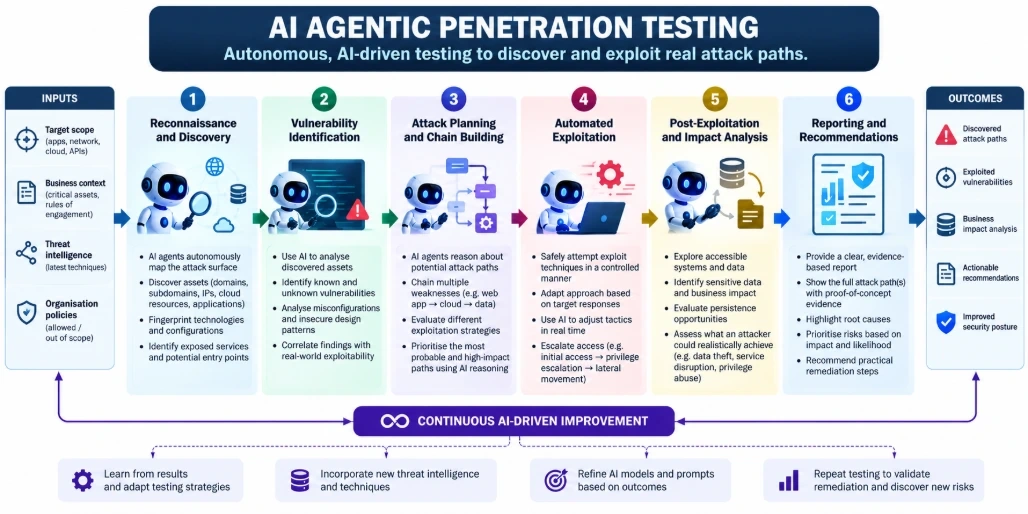
Traditional penetration testing relies on skilled security professionals using experience, tools and judgement to identify and exploit weaknesses within an authorised scope. It remains essential. Human creativity, intuition and adversarial thinking are difficult to replace.
However, traditional testing is often time-bound. The tester has a defined scope, a limited engagement window and a finite amount of time to explore the environment.
Agentic AI Penetration Testing introduces a different approach. Rather than simply executing a fixed list of tests, an AI agent can, depending on the platform, interpret evidence, formulate hypotheses, select the next test, evaluate the result and adapt its approach.
The critical distinction is not that AI performs a test. It is that the system can use the result of one test to decide what to investigate next.
That is the difference between executing a predefined workflow and performing goal-directed, adaptive testing.
A practical example
Imagine an organisation has a customer-facing web application. A conventional scanner identifies several potential issues:
An exposed API endpoint.
Different permissions between two user roles.
An application workflow involving customer records.
A possible weakness in session or access-control handling.
Each finding may look manageable when considered independently. An agentic penetration testing system, within an authorised scope and with appropriate safeguards, could investigate the relationships between these observations.
It might ask: Does the API enforce the correct permissions? Can one user access another user's records? Does the application trust a client-side value that should be verified on the server? Can a sequence of ordinary actions expose information the user should never access?
The system can test a hypothesis, inspect the response, refine its next step and attempt to establish whether the suspected weakness is genuinely exploitable. If a hypothesis fails, it can explore another permitted path. If it succeeds, it can gather evidence to demonstrate the impact.
The result is potentially more than a list of isolated findings. It is an evidence-backed explanation of how weaknesses may combine into a meaningful attack path.
Not every AI-enabled penetration testing product is genuinely agentic, and not every platform can test every application layer or vulnerability class. These capabilities must be verified rather than assumed.
4. The difference, explained in one tableDimension | Breach and Attack Simulation | Security Control Validation | Agentic AI Penetration Testing |
Primary question | Do defences detect or block selected attack techniques? | Are controls delivering intended protection? | Can an attacker discover and exploit weaknesses, potentially chaining them? |
Main focus | Known attacker behaviours and defensive responses | Evidence of control effectiveness | Adaptive testing of in-scope application, API, infrastructure and other weaknesses |
Approach | Repeatable attack simulations | A broader validation discipline using suitable methods | Adaptive, hypothesis-driven testing where supported |
Typical outcome | Detection gaps and control coverage | Measured control effectiveness and remediation priorities | Confirmed vulnerabilities, exploitation evidence and potential attack paths |
Strength | Repeatability and continuous defensive assurance | Confidence in security investment effectiveness | Exploration beyond predefined test cases |
Key limitation | Does not prove every exploitable weakness has been found | Depends on which controls and scenarios are validated | Agentic reasoning does not guarantee complete coverage or replace human expertise |
One important clarification: these categories overlap. Security Control Validation is not necessarily a separate product category, and some platforms combine multiple capabilities. The purpose of the comparison is to distinguish the questions being answered, not to force every vendor into a rigid box.
5. Why agentic AI penetration testing could change the game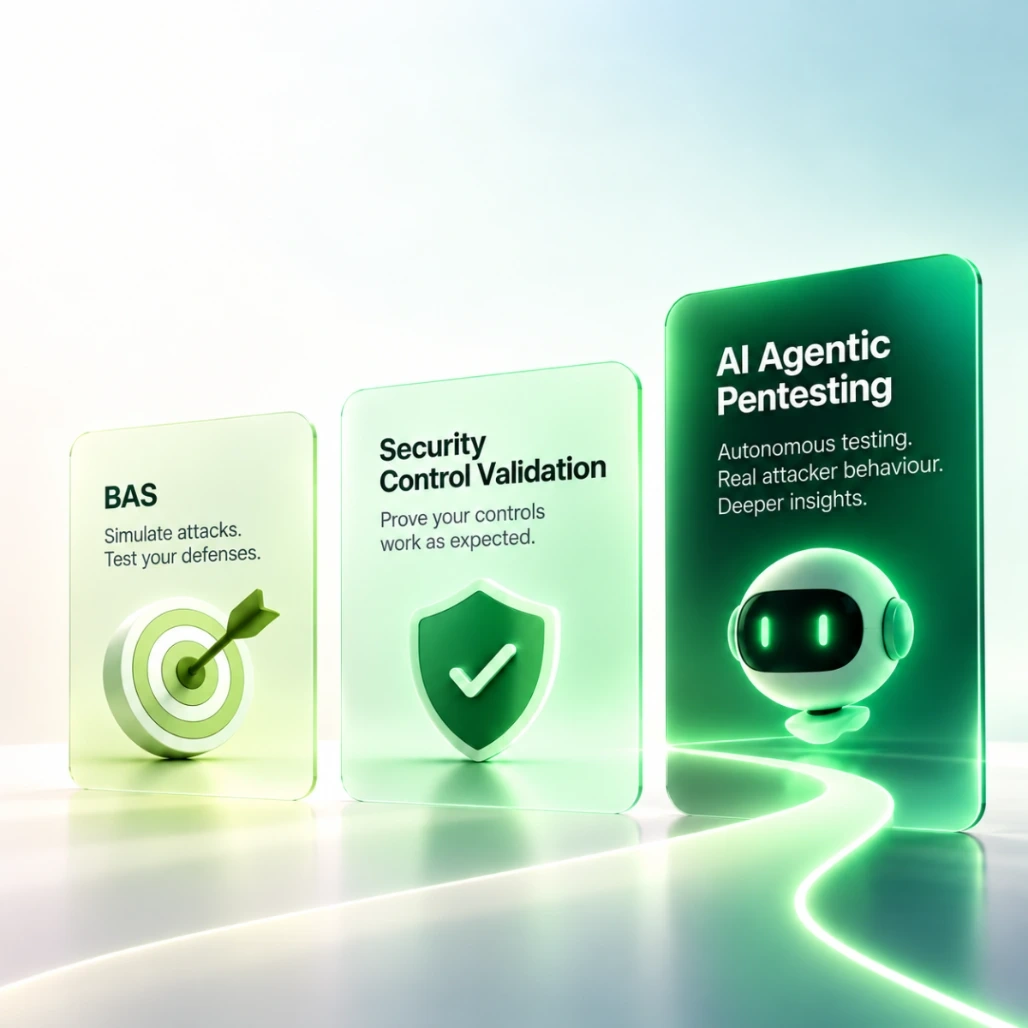
The future of security testing is not simply about running more tests. It is about making testing more adaptive, contextual and closely aligned with how weaknesses can be exploited in the real world.
1. From testing individual weaknesses to investigating attack paths
A vulnerability rarely tells the entire story. A low-severity access-control flaw, a misconfigured service and an exposed API might each appear manageable in isolation. Together, under the right conditions, they could create a significant risk. Agentic testing can investigate those relationships rather than treating every finding as an independent spreadsheet item.
2. From fixed test cases to adaptive investigation
A predefined test follows a known path. An agentic system can potentially change direction when evidence suggests another route is worth investigating. This matters because applications contain workflows, permissions, dependencies and business logic—not just lists of endpoints.
3. From periodic snapshots towards continuous testing
Traditional penetration testing engagements are often periodic, although continuous and automated testing models already exist. Agentic systems could help make deeper, adaptive testing more frequent after application releases, infrastructure updates or configuration changes. Safe execution, scope control, rate limits, human approvals and production safeguards remain essential.
4. From vulnerability counts to business context
A report containing 500 findings can be less useful than one demonstrating a credible route to a critical business asset. Security leaders need to understand what can be reached, which assumptions failed, what evidence supports the conclusion and what should be fixed first. The goal is not more findings; it is better evidence for better decisions.
5. From AI as an assistant to AI as an active investigator
An AI assistant can explain a vulnerability, suggest a test or generate a script. An agentic system can potentially plan a sequence of authorised tests, execute them through tools, assess results and decide what to do next.
The future is not unrestricted AI hacking. It is governed, evidence-driven, adaptive security testing.
Autonomy introduces risk. A system that can take actions must be constrained by explicit authorisation, least privilege, controlled execution, auditability and human oversight.
6. One important reality check: Agentic does not automatically mean betterIt is easy to become excited about AI and assume that a system capable of autonomous action must outperform every existing method. That would be a mistake.
AI agents can misinterpret application behaviour, produce false positives, miss vulnerabilities, repeat unproductive tests or take unsafe actions if permissions and execution environments are poorly designed.
Traditional penetration testers bring contextual understanding, creativity and judgement that remain valuable. BAS platforms provide repeatable, scalable tests of defensive controls that application-focused penetration testing may not cover. Security Control Validation helps organisations establish whether controls perform as intended.
These are complementary capabilities. A mature security programme should not choose one simply because it has the newest name. It should understand what each approach proves, where its evidence ends and which gaps remain.
7. What should organisations do next?If I were evaluating a modern security testing programme, I would start with three questions.
First: Are our controls actually working?
Use appropriate validation methods to test whether critical preventive and detective controls behave as expected.
Second: Can our critical assets be reached through an exploitable path?
Use penetration testing to investigate vulnerabilities, access-control failures, application logic and the relationships between weaknesses.
Third: Can we make that testing more adaptive and more frequent without compromising safety?
Evaluate agentic testing capabilities against realistic scenarios in an authorised environment. Ask vendors to demonstrate their reasoning process, evidence collection, reproducibility, scope enforcement, human approval mechanisms and remediation verification.
Do not settle for a polished dashboard or an impressive demonstration. Ask the vendor to show a complete test: the initial hypothesis, actions taken, evidence collected, conclusion reached and controls that prevented the system from going beyond its authorisation.
That is how you distinguish a genuinely useful capability from a new label attached to existing automation.
My conclusionCybersecurity has never suffered from a shortage of tools. What we often lack is sufficient evidence that those tools, configurations and processes work together against the risks that matter most.
Breach and Attack Simulation helps us understand whether selected attack techniques are detected or blocked. Security Control Validation helps us establish whether our defences deliver their intended outcomes. Agentic AI Penetration Testing offers a promising evolution in how we discover and investigate exploitable weaknesses: through adaptive reasoning, iterative testing and evidence-driven exploration.
And that is why I believe agentic AI penetration testing will become an increasingly important part of the security testing landscape.
Not because it makes humans irrelevant. Not because it replaces BAS. And certainly not because adding AI to a product automatically makes it intelligent.
It matters because security testing can move beyond asking whether a predefined test passed, towards investigating what an attacker could actually achieve.
The real measure of progress is not how many attacks we simulate, how many controls we validate or how many vulnerabilities we report.
It is how confidently we can answer one question:
If someone tried to exploit our environment tomorrow, what evidence do we have that we would find the weakness before they do?
That is the conversation the industry needs to have. And it is one worth having now.
What is your view? Are we moving towards genuinely agentic security testing, or are we simply rebranding automation with an AI label?


Join the conversation! Your thoughts help the community grow.