

Introduction
Three parts in series,
Setup a GitHub Repository
So login to your GitHub account and create a repository.
Once you have created a repository, it's time to get it to your local system and start hacking. But before you do that, please make sure that you have Git installed on your system, if not head on to Git download page and set it up. It's easy!
Now, on GitHub, select the repository you have just created. To the right you should see "Clone or download" button, click on it and you have the URL to clone your repository.
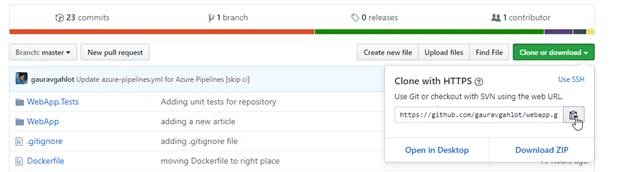
- $ git clone <repository-clone-url>
Create an ASP .Net Core Web Application
Now, if you are on Windows open Visual Studio and create a new ASP .Net Core Web Application Project.
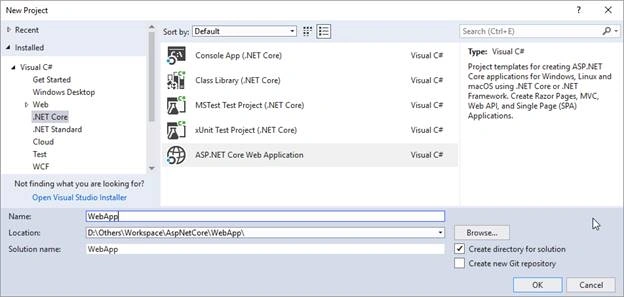
If you are on Linux or Mac OS, open a terminal and navigate to the clone directory. You can create a .Net Core MVC Web App using the following command:
- $ dotnet new mvc --name <your-project-name>
Once done, you can now use your favorite editor to make required changes.
For further learning or solving an issue, I would highly recommend you checkout my YouTube video playlist about Getting started with .Net Core on Linux or Mac OS.
At this point, I leave it to you, my dear reader, to come up with an idea of your simple application and bring it to life. Or you can follow along as I make the changes to my application.
I am building a simple blog that displays a list of latest articles. Please feel free to clone my GitHub repository to get the latest of source code and all the resources used.
Adding Articles Link to Navigation Bar
An ASP .Net Core web application comes with a neat predefined template. To update the navigation bar, open Views/Shared/_Layout.cshtml. Under body>nav section add a link for Articles:
- ...
- <nav class="navbar navbar-inverse navbar-fixed-top">
- <div class="container">
- <div class="navbar-header">
- <button type="button" class="navbar-toggle" data-toggle="collapse" data-target=".navbar-collapse">
- <span class="sr-only">Toggle navigation</span>
- <span class="icon-bar"></span>
- <span class="icon-bar"></span>
- <span class="icon-bar"></span>
- </button>
- <a asp-area="" asp-controller="Home" asp-action="Index" class="navbar-brand">Docker WebApp</a>
- </div>
- <div class="navbar-collapse collapse">
- <ul class="nav navbar-nav">
- <li><a asp-area="" asp-controller="Home" asp-action="Index">Home</a></li>
- <li><a asp-area="" asp-controller="Home" asp-action="Articles">Articles</a></li>
- </ul>
- </div>
- </div>
- </nav>
- ...
Adding required models
Under the Models directory, add a .cs file ArticlesViewModel.cs, which will have the required model classes:
- using System;
- using System.Collections.Generic;
- namespace WebApp.Models
- {
- public class ArticlesViewModel
- {
- public List<Article> Articles { get; set; }
- public ArticlesViewModel()
- {
- Articles = new List<Article>();
- }
- }
- public class Article
- {
- public int Id { get; set; }
- public string Title { get; set; }
- public string Author { get; set; }
- public DateTime PublishedOn { get; set; }
- public string Content { get; set; }
- }
- }
- using System;
- using System.Collections.Generic;
- using System.Linq;
- using WebApp.Models;
- namespace WebApp
- {
- public class ArticleRepository
- {
- private List<Article> articles = new List<Article>
- {
- new Article
- {
- Id = 1,
- Title = "What is Lorem Ipsum?",
- Author= "Gaurav Gahlot",
- PublishedOn = new DateTime(2019, 01, 20),
- Content = "Lorem Ipsum is simply dummy text of the printing and typesetting industry."
- },
- }
- public List<Article> GetLatest()
- {
- return articles;
- }
- }
- }
Updating the Home Controller
The Home controller needs to have an action that can handle the requests coming for a list of the latest articles. Here is the new controller with Articles action for GET requests:
- using Microsoft.AspNetCore.Mvc;
- using System.Collections.Generic;
- using System.Net.Http;
- using WebApp.Models;
- namespace WebApp.Controllers
- {
- public class HomeController : Controller
- {
- public IActionResult Index()
- {
- return View();
- }
- public IActionResult Articles()
- {
- var model = new ArticlesViewModel();
- model.Articles = new ArticleRepository().GetLatest();
- return View(model);
- }
- }
- }
- @{
- ViewData["Title"] = "Articles";
- }
- <div id="myCarousel" class="carousel slide" data-ride="carousel" data-interval="6000">
- <div class="carousel-inner" role="listbox">
- <div class="item active">
- <img src="~/images/docker.png" alt="Docker" class="img-responsive" />
- <div class="carousel-caption" role="option">
- <p style="font-size:xx-large; color:darkslategrey">
- If you see me swim, your application is up and running in Docker.
- </p>
- </div>
- </div>
- </div>
- </div>
Push your code to GitHub
Once you are done making the code changes, it's time to push your code on GitHub. Open a terminal and navigate to the project directory.
- $ git status
You should see all the files and directories being added or update. Now, to stage all the changes in your repository run the command,
- $ git add .
Let's commit the changes with a short meaningful message,
- $ git commit -m "your-commit-message"
Finally push all the committed changes to remote branch on GitHub,
- $ git push origin
Note
It is not a good practice to commit all the changes at the end. In fact, you should frequently commit all the changes that can be grouped logically.
At this point, I am assuming that your application is working well and you are ready containerize your application with Docker.
Dockerfile
According to Docker documentation,
Here is the Dockerfile for my application,
- # STAGE01 - Build application and its dependencies
- FROM microsoft/dotnet:2.1-sdk AS build-env
- WORKDIR /app
- COPY WebApp/*.csproj ./
- COPY . ./
- RUN dotnet restore
- # STAGE02 - Publish the application
- FROM build-env AS publish
- RUN dotnet publish -c Release -o /app
- # STAGE03 - Create the final image
- FROM microsoft/dotnet:2.1-aspnetcore-runtime
- WORKDIR /app
- LABEL Author="Gaurav Gahlot"
- LABEL Maintainer="quickdevnotes"
- COPY --from=publish /app .
- ENTRYPOINT ["dotnet", "WebApp.dll", "--server.urls", "http://*:80"]
At a high level, a multi-stage build is much like what we generally do while building and publishing our projects. Here is a brief breakdown of the stages,
- STAGE01 - At this stage we restore the packages and dependencies our application requires to build. Notice that the building the project .Net Core SDK, which is our base image.
- STAGE02 - Once the first stage is successful, we publish our application and store the generated binaries in /app directory.
- STAGE03 - In this stage we use the .Net Core Runtime as our base layer and copy the binaries from /appdirectory, generated in previous stage.
It's a great feature to minimize the size of your Docker images and you can read more about it from the docs.
Because this Dockerfile is specific to my application, you might have to make some changes for it to work.
Running a Container
It's time to build a Docker image for your application and spin up a container. Open up a terminal and navigate to the directory where the Dockerfile is saved. Now build a Docker image using the command:
- $ docker build -t webapp .
This will build a Docker image and keep it on our local system. To test our image and application we will now run a container using the command:
- $ docker run -d -p 5000:80 --rm --name webapp webapp
- 19c758fdb9bfb608c4b261c9f223d314fce91c6d71d33d972b79860c89dd9f15
The above command creates a container and prints the container ID as output. You may verify that the container is running using the docker ps command.
- $ docker ps
- CONTAINER ID IMAGE PORTS NAMES MOUNTS
- 19c758fdb9bf webapp 0.0.0.0:5000->80/tcp webapp
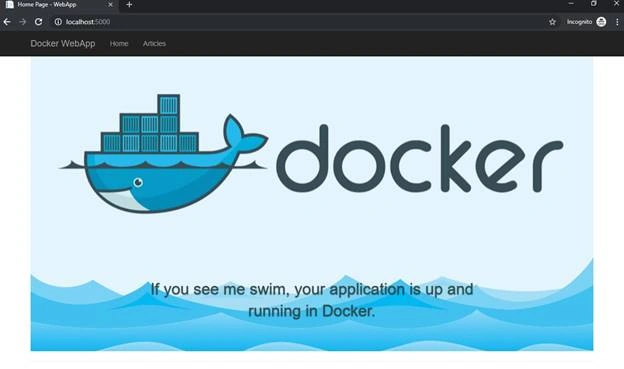
Now, open a browser and go to the URL http://localhost:5000/.
If everything is working fine, you must see your web application's home page. In my case it looks like this,
Conclusion
In this we have developed a web application using ASP .Net Core and put it on a GitHub repository. We also tested our application by building a Docker image and running a Docker container out of it.
The next step is to setup a Build pipeline on Microsoft Azure DevOps. This pipeline will connect with our GitHub repository. We will also set the pipeline to trigger a build each time a push is made to a master branch on the repository. The pipeline will create a Docker image and push it to Docker Hub.
Mangesh GPosted Oct 30, 2019, 7:32 AM
Great writeup Gaurav :) , Trying my hands on docker and this will be usefull to me