

This is one of the most common questions people ask once they understand how multisig wallets work, and it is the right question to ask.
If multisig wallets are so secure, can they still be hacked?
The honest answer is yes, but not in the way most people imagine. A multisig wallet does not make funds magically untouchable. What it does is remove entire classes of failure that plague single-key wallets. To understand the real risk, you have to separate technical exploits from human failure.
What People Usually Mean by “Hacked”
When people say “hacked,” they often picture a stranger breaking into a wallet from the outside and draining it. In practice, most crypto losses do not happen that way.
The most common causes of lost funds are compromised private keys, phishing, poor operational security, and insider abuse. Multisig is designed specifically to reduce the damage from those scenarios.
A multisig wallet does not protect against everything. It protects against the most common and costly failures.
Can Someone Hack a Multisig Wallet Directly?
If the multisig wallet is built using a well-audited, battle-tested implementation, the answer is effectively no in the traditional sense.
Most serious multisig wallets on Ethereum and EVM chains are implemented using Safe, which has been audited extensively and secures billions of dollars in assets. There is no known exploit that allows an external attacker to bypass the approval threshold and drain a properly configured Safe.
This is an important distinction. Attacking a multisig wallet usually does not mean breaking the contract. It means attacking the people who control the keys.
How a Mulitisig Wallet is Hacked
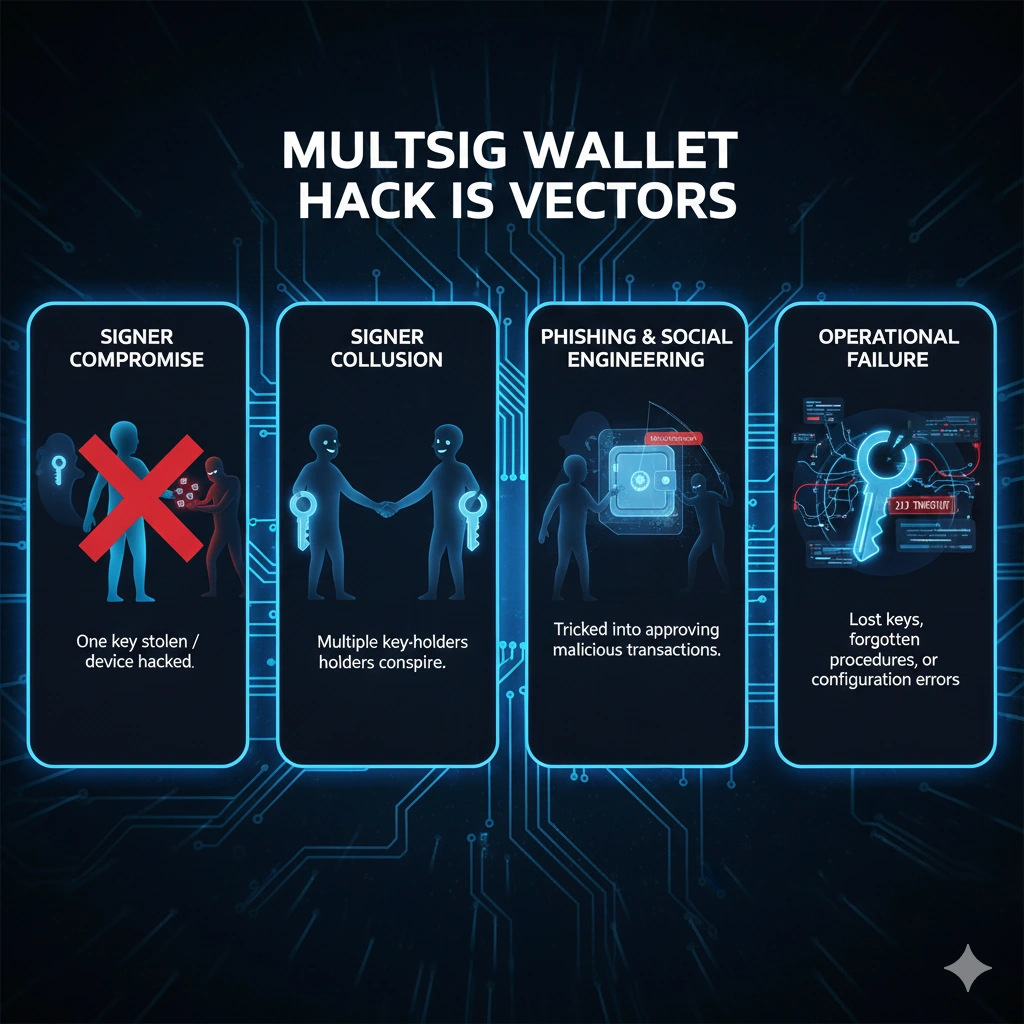
The most realistic risks to a multisig wallet fall into a few categories.
The first is signer compromise. If enough signers have their private keys compromised, an attacker can approve transactions legitimately. For example, in a 2-of-3 multisig, compromising two signers gives full control. Multisig reduces the likelihood of this happening, but it does not make it impossible.
The second is signer collusion. Multisig does not prevent authorized signers from acting together. If the required number of signers agree to move funds, the wallet will execute the transaction. Multisig enforces rules, not morality.
The third is phishing and social engineering. Attackers often target signers individually, tricking them into approving malicious transactions. This is why reviewing transaction details and using hardware wallets is critical.
The fourth is operational failure. Storing multiple keys on the same device, having one person control multiple signer keys, or using insecure signing environments undermines the entire multisig model. These failures are surprisingly common.
What Multisig Protects Against Very Well
Multisig is extremely effective at eliminating single-point-of-failure risk. One compromised laptop cannot drain the wallet. One careless click does not destroy the treasury. One insider cannot act alone. These are the exact failure modes that cause the majority of catastrophic losses in crypto. For teams, DAOs, and treasuries, this protection alone justifies multisig.
What Multisig Does Not Protect Against
Multisig does not protect against poor governance. If signers are not independent, if one person controls multiple keys, or if signers blindly approve transactions, multisig becomes theater rather than security. It also does not protect against total signer failure. If enough keys are lost or unavailable and the approval threshold cannot be met, funds can become permanently inaccessible. Multisig reduces risk. It does not eliminate responsibility.
How Professional Teams Reduce Multisig Risk
Teams that manage serious funds treat multisig as part of a broader security model, not a checkbox. They distribute signer keys across independent people and organizations. They require hardware wallets for all signers. They establish clear approval processes and transaction review standards. They plan for signer rotation and key loss. They audit not just code, but governance. Multisig works best when humans respect the assumptions it is built on.
Why Multisig Is Still the Industry Standard
Despite its limitations, multisig remains the gold standard for managing shared crypto assets. There is no alternative that offers the same balance of transparency, security, and operational control. Single-key wallets are too fragile. Fully automated governance is not mature enough for most use cases. Multisig sits in the middle, enforcing shared control while remaining flexible.
Conclusion
Yes, a multisig wallet can be compromised, but not easily and not accidentally. Breaking a properly designed multisig requires either multiple independent failures or deliberate coordination among signers. That is a much higher bar than compromising a single private key. Multisig does not make you invincible. It makes catastrophic failure much harder. For serious teams and treasuries, that difference is everything.
Join the conversation! Your thoughts help the community grow.