

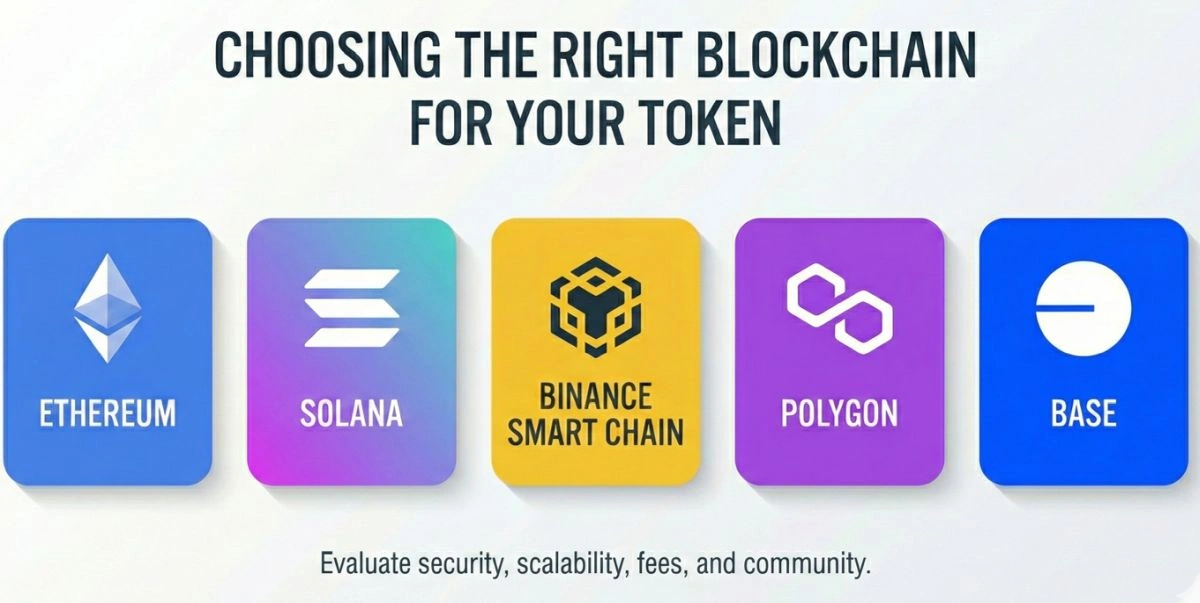
Choosing the right blockchain for a token is one of the most critical decisions a founder or architect will make. A bad choice could kill your token before even it was launched. Not only picking right chain can help speed up the launch but can also save you ton of money and headache in coming time.
These are some of the factors you may consider before choosing a chain for your token:
Purpose of the token
Scalability and affordability
Security and network maturity
Developer ecosystem and tooling
Community and ecosystem support
Brand exposure and partnerships
This article brings everything together in one place to help you pick a chain.
What Is a Blockchain and Why Does It Exist 🧱
Before choosing a blockchain, it is important to understand what a blockchain actually is and what problem it solves. At its core, a blockchain is a distributed ledger that records transactions in a secure, transparent, and tamper resistant way. Instead of relying on a central database controlled by a single entity, a blockchain stores data across a network of independent nodes that agree on the state of the system through consensus.
The primary purposes of a blockchain are:
To store transactions in an immutable and verifiable way
To establish trust without requiring a central authority
To ensure transparency and auditability
To prevent double spending and fraud
To enable programmable logic through smart contracts
Every transaction on a blockchain is grouped into blocks. Each block references the previous one, forming a chain. Once data is finalized, it becomes extremely difficult or economically infeasible to alter.
For tokens, the blockchain acts as:
The source of truth for token ownership
The execution layer for token transfers and smart contracts
The settlement layer for value exchange
The security layer that protects assets
When you choose a blockchain, you are choosing where your token's history lives forever . That is why this decision has long term consequences.
Start With the Token's Real Purpose 🎯
Before comparing chains, you must be honest about why the token exists.
Is it a utility or payment token used frequently
Is it a governance token used occasionally
Is it a rewards or loyalty token with high volume actions
Is it an RWA or revenue backed token
Is it primarily held or actively transacted
A rewards or Learn to Earn token with frequent actions has very different requirements than a governance or RWA token. If the use case is unclear, the blockchain choice will be wrong by default.
Transaction Costs Are a Business Model Decision 💸
Gas fees are the fees you pay every time a transaction occur on a blockchain. Some chains have higher gas fees such as Bitcoin and Ethereum.
Consider a realistic example.
A consumer app processes 100,000 on chain actions per day.
If the average transaction cost is $0.30
Daily cost becomes $30,000
Monthly cost becomes $900,000
If the average transaction cost is $0.005
Daily cost becomes $500
Monthly cost becomes $15,000
That difference alone determines whether your product is viable.
Ethereum mainnet provides unmatched security and liquidity but fees fluctuate widely during congestion. Ethereum Layer 2 networks such as Polygon, Arbitrum, Optimism, and Base consistently offer costs that are orders of magnitude lower, making them far more suitable for high volume usage.
Low and predictable fees are not optional for mass adoption tokens.
Scalability, Throughput, and Finality ⚡
Scalability, throughput, and finality are also very important. You may need transactions to be processed and final in milliseconds. However, some chains take minutes and even longer. For example, Ethereum may take several minutes while L2 chains such as Polygon and Solana have fast confirmations with very low fees.
Security and Network Maturity 🔐
Your token inherits the security of the underlying chain.
Ask hard questions.
How long has the network been live
How much real economic value is secured
How decentralized is validator participation
How often has the network experienced outages
Do not pick a chain that is new and have not proven itself for few years with hundreds of projects.
Developer Ecosystem and Tooling 🛠️
Great ideas fail when developers struggle to build.
Evaluate:
Smart contract language support
Quality of documentation and SDKs
Availability of audited standards
Depth of the developer community
EVM compatible chains benefit from Solidity, mature tooling, audited ERC standards, and a massive global developer base. Non EVM chains can be excellent, but they require specialized expertise and different tooling. That increases hiring cost and execution risk.
Liquidity is oxygen for a token.
Ethereum and its Layer 2 ecosystem dominate DeFi liquidity. Launching within this ecosystem makes it easier to attract market makers, liquidity providers, and exchange integrations. Lower fee or niche chains may save transaction costs but often struggle to attract deep liquidity.
Compliance and Enterprise Readiness 🏛️
For tokens touching regulated industries, chain selection matters even more.
Evaluate:
Institutional custody support
Auditability and transparency
Reputation with regulators and enterprises
Compatibility with compliance tooling
Interoperability and Future Proofing 🔗
No serious token ecosystem stays on one chain forever.
Ask:
How mature are bridges and cross chain tools
Is multi chain expansion realistic
Will migration be painful later
Why Support From the Blockchain Ecosystem Matters 🤝
Chain support is a first order factor, especially for early stage projects.
Support includes:
Technical onboarding and architecture guidance
Access to ecosystem BD and developer relations teams
Marketing amplification and launch visibility
Introductions to wallets, DEXs, auditors, and infrastructure providers
Grants, credits, and incentives
How Support Differs Across Chains 🧭
Ethereum mainnet offers credibility but almost no project level support. Teams are expected to be self sufficient. Ethereum Layer 2 ecosystems such as Polygon, Arbitrum, Optimism, and Base actively support builders through grants, co marketing, technical guidance, and ecosystem introductions. Grant programs commonly range from $10,000 to $500,000 or more for aligned projects.
Polygon has historically been very founder friendly, especially for consumer apps, gaming, and NFTs.
Base focuses heavily on consumer adoption and distribution through the Coinbase ecosystem.
BNB Smart Chain offers strong retail exposure and exchange adjacency with more centralized trade offs.
Solana provides deep support for high throughput consumer and gaming apps, including grants that often range from $25,000 to $250,000 or more, but requires commitment to its native tooling.
Chain Support Is Not Liquidity Support ⚖️
Chains rarely provide liquidity directly.
What they provide is:
Introductions to market makers
Introductions to DEX teams
Visibility that attracts LPs
Credibility that reduces friction
The Final Decision Framework ✅
Estimate your monthly transaction volume
Define acceptable cost per action
Understand your finality requirements
Prioritize liquidity access if trading matters
Evaluate developer speed and hiring risk
Assess ecosystem support honestly
Reach out to the local community and see what support you can get
Conclusion 🚀
Choosing a blockchain is not a popularity contest. It is a system architecture and go to market decision. The right choice reduces cost, accelerates adoption, attracts liquidity, and enables long term growth. The wrong choice multiplies friction everywhere. Build for the next five years, not the next five weeks.
Join the conversation! Your thoughts help the community grow.