

Introduction
During the last few decades, classical cryptographic algorithms such as RSA and Elliptic Curve Cryptography (ECC) have served as the foundation of secure communication across the Internet. From online banking and e-commerce to cloud computing and digital signatures, these algorithms have protected sensitive information from unauthorized access.
However, the rapid progress in quantum computing has raised a critical question: Will today's cryptographic systems remain secure tomorrow?
As a researcher and educator in the field of Computer Science, I have observed growing interest in Post-Quantum Cryptography (PQC), which aims to develop cryptographic systems capable of resisting attacks from both classical and quantum computers. This article presents a comparative overview of Classical Cryptography and Post-Quantum Cryptography, highlighting their working principles, strengths, limitations, and future relevance.
Classical vs Post-Quantum Cryptography
| Parameter | Classical Cryptography | Post-Quantum Cryptography |
|---|---|---|
| Popular Algorithms | RSA, ECC | Kyber, Dilithium |
| Security Basis | Factorization, Discrete Logarithms | Lattice Problems |
| Quantum Resistance | No | Yes |
| NIST Future Standard | Being Replaced | Recommended |
| Long-Term Security | Limited | High |
Classical RSA-Based Secure Banking Communication- Today's Real-World Example
Imagine a bank encrypting customer data using RSA-2048. The example illustrates a traditional secure online banking communication system based on RSA public-key cryptography. Initially, a customer generates a transaction request or sensitive information through a computing device. Before transmission, the data is encrypted using the bank's public RSA key, ensuring that only the intended bank server can access the original information.
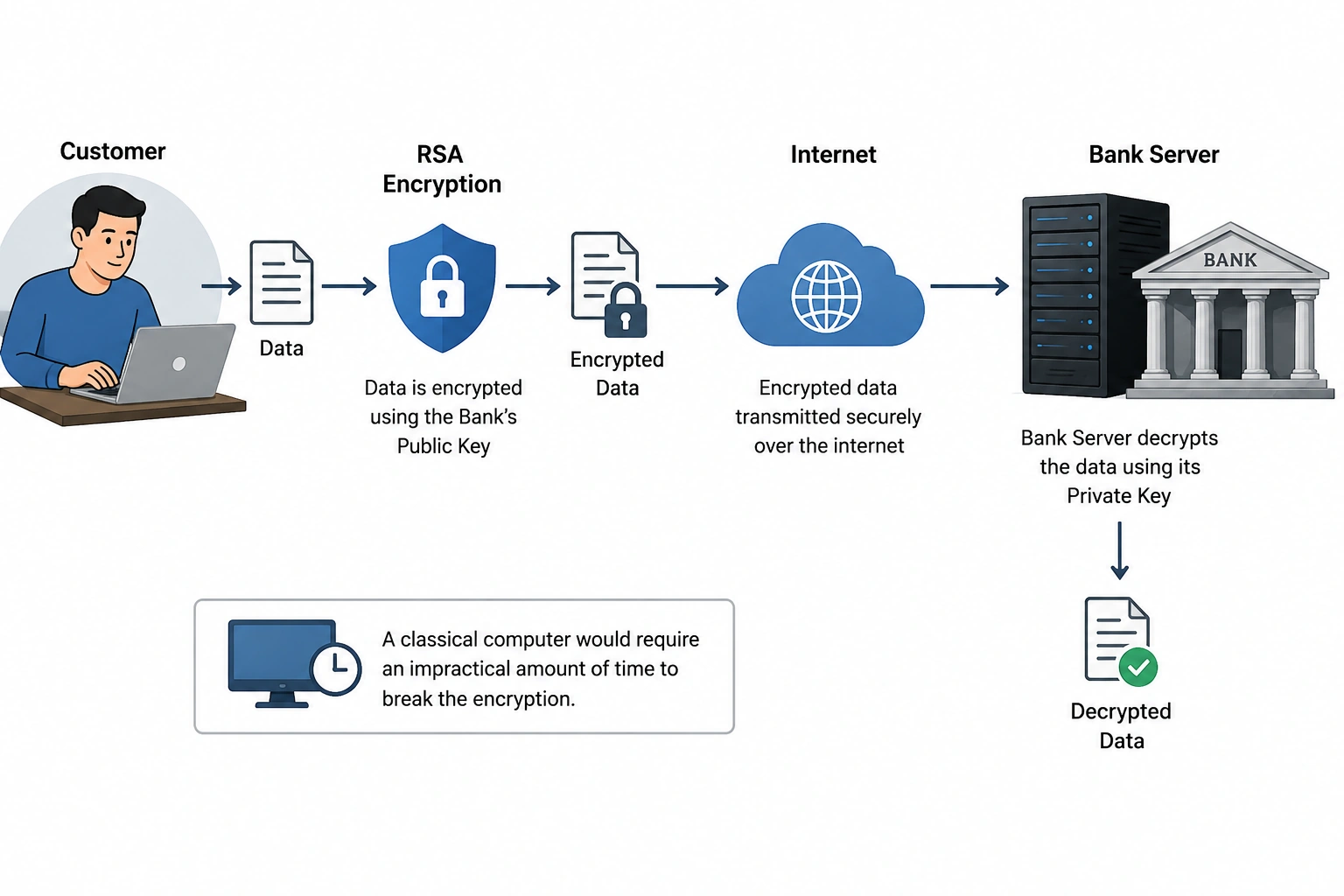
The encrypted data is then transmitted securely over the Internet. Since the information is protected by RSA encryption, any unauthorized party intercepting the communication cannot easily decipher the contents without possessing the corresponding private key.
Upon receiving the encrypted message, the bank server utilizes its private RSA key to decrypt and recover the original data. This asymmetric encryption mechanism provides confidentiality, authentication, and secure data exchange between customers and banking institutions.
In the current classical computing era, RSA encryption remains highly secure because breaking large RSA keys requires factoring extremely large integers, a computational task that would demand an impractical amount of time and resources for conventional computers. Consequently, RSA has been widely adopted in online banking, e-commerce, secure email systems, and digital certificate infrastructures.
However, the emergence of quantum computing poses potential challenges to RSA-based security models, motivating ongoing research into post-quantum cryptography and quantum-resistant encryption techniques.
Future Quantum Scenario
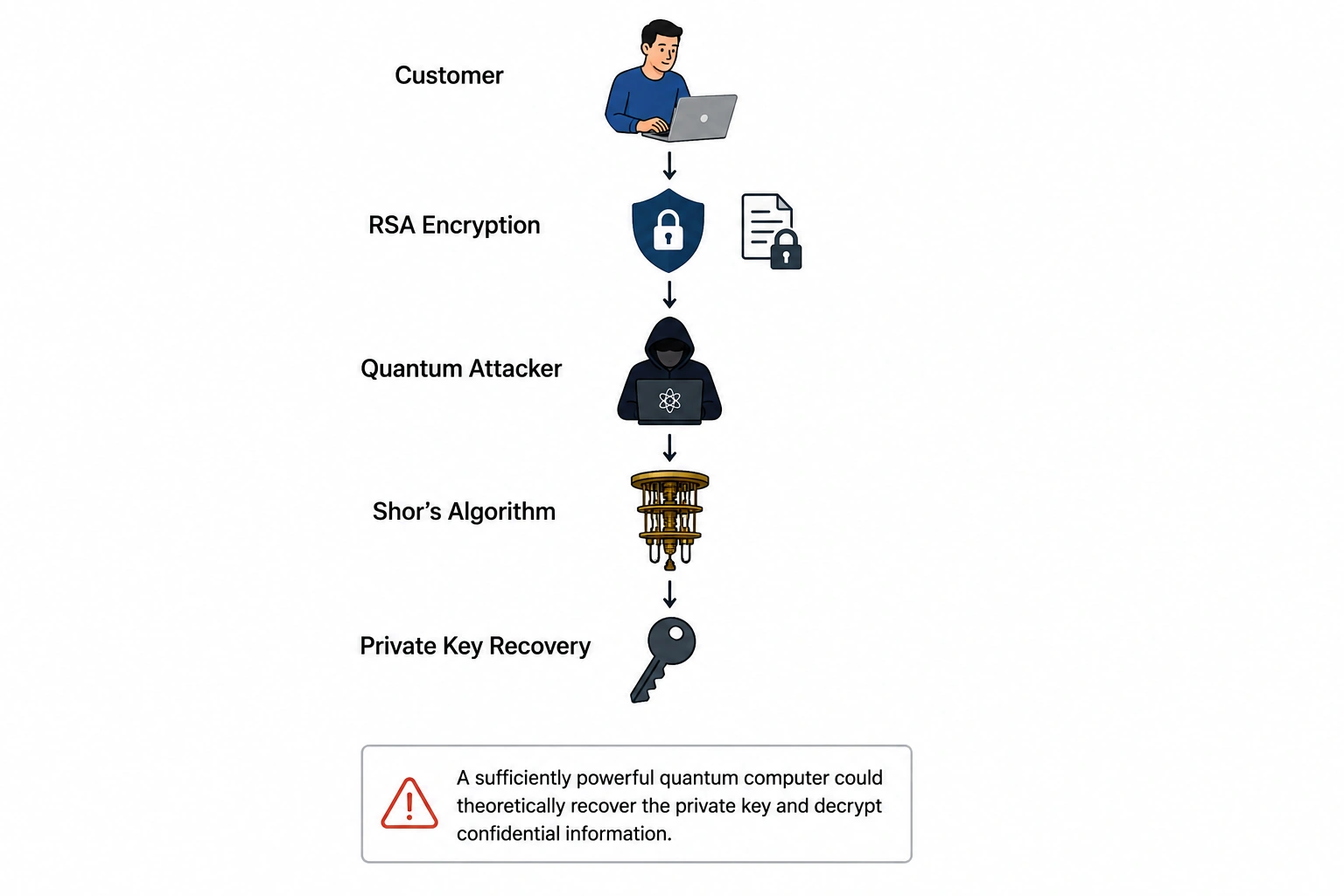
The figure illustrates a potential future cybersecurity scenario in which powerful quantum computers pose a significant threat to traditional RSA-based encryption systems. In the current communication process, a customer encrypts sensitive information using RSA cryptography before transmitting it across a network. While this encryption remains secure against classical computers, the emergence of large-scale quantum computers could fundamentally change the security landscape.
A quantum attacker equipped with a fault-tolerant quantum computer may utilize Shor’s Algorithm to efficiently factor the large integers that form the basis of RSA security. By exploiting quantum computational advantages, the attacker could theoretically recover the private key associated with the encrypted communication.
Once the private key is obtained, previously secure encrypted data may become vulnerable to decryption, potentially exposing confidential financial transactions, personal information, and sensitive organizational data. This scenario highlights the urgency of developing and deploying Post-Quantum Cryptography (PQC) and other quantum-resistant security mechanisms to protect future digital infrastructures.
The quantum threat does not imply that RSA is currently broken; rather, it emphasizes the need for proactive migration toward cryptographic systems capable of withstanding future quantum attacks.
RSA Example
from Crypto.PublicKey import RSA
key = RSA.generate(2048)
print("Public Key:")
print(key.publickey().export_key().decode())
print("\nPrivate Key:")
print(key.export_key().decode())
RSA remains secure against conventional attacks, but quantum computers running Shor's Algorithm could compromise it.
RSA vs Kyber
| Aspect | RSA | Kyber |
|---|---|---|
| Type | Public Key Cryptography | Post-Quantum Key Encapsulation Mechanism |
| Security Foundation | Integer Factorization | Module Learning With Errors (MLWE) |
| Quantum Resistance | No | Yes |
| Key Size | Large | Smaller and Efficient |
| Performance | Moderate | Faster |
| Future Suitability | Limited | Highly Suitable |
RSA is one of the most widely used public-key cryptographic algorithms. It's security depends on the difficulty of factoring large integers. Quantum computers running Shor's Algorithm can break RSA efficiently. Kyber, on the other hand, is based on lattice cryptography and is resistant to known quantum attacks, making it a preferred choice for future secure communications.
ECC vs Dilithium
| Aspect | ECC | Dilithium |
|---|---|---|
| Type | Digital Signature Algorithm | Post-Quantum Digital Signature |
| Security Foundation | Elliptic Curve Discrete Logarithm Problem | Lattice-Based Cryptography |
| Quantum Resistance | No | Yes |
| Signature Generation | Fast | Fast |
| Verification Speed | Fast | Efficient |
| NIST Recommendation | Legacy Technology | PQC Standard |
Elliptic Curve Cryptography (ECC) provides strong security with smaller key sizes compared to RSA. However, ECC is vulnerable to quantum attacks. Dilithium is a post-quantum digital signature scheme designed to replace ECC-based signatures. It offers strong security against both classical and quantum adversaries.
Why Classical Cryptography is Vulnerable?
As we know, the Classical cryptographic algorithms such as RSA, Diffie-Hellman (DH), and Elliptic Curve Cryptography (ECC) have served as the foundation of secure digital communication for several decades. These algorithms derive their security from mathematical problems that are extremely difficult for conventional computers to solve. However, the emergence of quantum computing has introduced a new computational paradigm capable of solving these problems much more efficiently, thereby threatening the security of classical cryptographic systems.
1. Dependence on Mathematical Hardness Problems
Most classical public-key cryptographic systems rely on mathematical problems that are computationally infeasible for traditional computers.
RSA relies on the difficulty of integer factorization.
Diffie-Hellman relies on the discrete logarithm problem.
ECC relies on the elliptic curve discrete logarithm problem.
While these problems may require thousands or even millions of years to solve using classical computers, quantum computers can potentially solve them in a significantly shorter time.
2. Impact of Shor’s Algorithm
In 1994, mathematician Peter Shor introduced Shor's Algorithm, a quantum algorithm capable of efficiently solving integer factorization and discrete logarithm problems.
As a result:
RSA encryption can be broken.
Diffie-Hellman key exchange can be compromised.
ECC-based security mechanisms can become ineffective.
This poses a serious threat to current Internet security infrastructure, including online banking, digital signatures, virtual private networks (VPNs), and secure web communications.
3. Impact of Grover’s Algorithm
Another important quantum algorithm is Grover's Algorithm, which accelerates brute-force search operations. Although Grover's Algorithm does not completely break symmetric cryptography such as AES, it effectively reduces the security level of cryptographic keys.
| Symmetric Key Size | Effective Security under Grover's Algorithm |
|---|---|
| AES-128 | Approximately 64-bit Security |
| AES-256 | Approximately 128-bit Security |
Therefore, larger key sizes are required to maintain adequate security in a quantum computing environment.
4. Harvest Now, Decrypt Later Threat
A major concern for cybersecurity experts is the concept of "Harvest Now, Decrypt Later" (HNDL).
In this attack strategy:
Adversaries collect encrypted data today.
The data is stored for future use.
Once powerful quantum computers become available, the stored encrypted information can be decrypted.
This threat is particularly critical for government records, healthcare information, financial transactions, military communications, and intellectual property that require long-term confidentiality.
5. Increasing Quantum Computing Capabilities
Technology companies and research organizations are continuously advancing quantum computing technologies. As quantum processors become more stable and scalable, the feasibility of breaking classical cryptographic systems increases.
Consequently, organizations worldwide are beginning to transition toward Post-Quantum Cryptography (PQC) to protect sensitive information against future quantum attacks.
Key Reasons for Vulnerability
| Reason | Impact on Classical Cryptography |
|---|---|
| Shor's Algorithm | Breaks RSA, DH, and ECC |
| Grover's Algorithm | Weakens Symmetric Encryption |
| Integer Factorization Attacks | Threatens RSA Security |
| Discrete Logarithm Attacks | Threatens DH and ECC |
| Harvest Now, Decrypt Later | Risks Long-Term Confidentiality |
| Quantum Computing Growth | Accelerates Cryptographic Obsolescence |
Summary
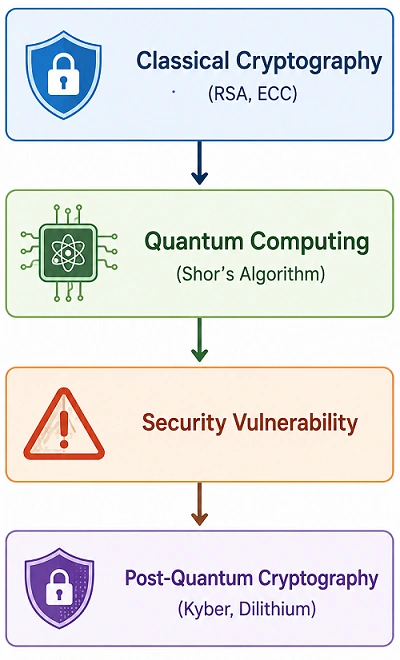
Classical cryptography has successfully protected digital systems for many years; however, its security assumptions are challenged by the rapid advancement of quantum computing. Algorithms such as RSA and ECC, once considered highly secure, may become vulnerable to quantum attacks through Shor's Algorithm, while symmetric encryption schemes face reduced security due to Grover's Algorithm. Therefore, the adoption of Post-Quantum Cryptography is becoming increasingly important to ensure the long-term security of digital communications and information systems.
Keywords: Cryptography, RSA, ECC, Grover's. Shor, Quantum Computing, Decrypt, Encrypt, PQC
Join the conversation! Your thoughts help the community grow.