

Introduction
- Cosmos DB maintains two extra replicas of a database apart from the primary database.
- All reads are distributed across three copies.
- All writes to the primary are replicated across two secondary replicas.
- The process of updating replicas takes time.
- If read request goes to replica yet to update, the client may get an older data or inconsistent data.
Consistency Models
Cosmos DB allows developers to choose between five well-defined consistency models along the consistency spectrum.
- Strong,
- Bounded staleness
- Session (Default Consistency)
- Consistent prefix
- Eventual
Strong Consistency
- This is the strongest form of the consistency.
- It ensures that the requested data is most recent.
- Read requests are guaranteed to return the latest version of an item.
- The cost of the read operation is higher in terms of RUs (Request Units).
- Performance is lowest in comparison to other consistency policies as read needs to wait until all writes are committed.
- It is useful in critical applications, like Stock Market, Banking, Airline Reservation.
Bounded staleness
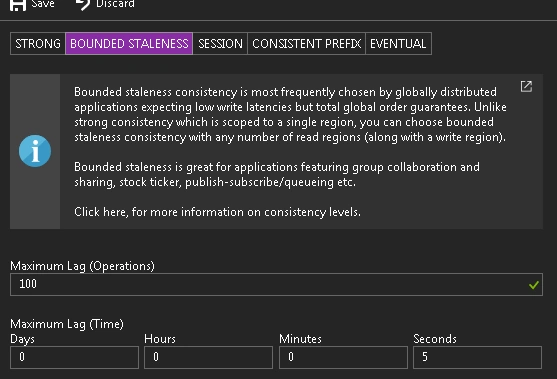
- A client might see old data but one can specify a limit for how old that data can be (e.g. 2 sec).
- It ensures all the updates on replicas happen in the order they are received.
- The "staleness window" can be configured in two ways: Maximum Number of Operations, Maximum duration.
- The cost of a read operation is lower than that in Strong Consistency if the request is within "staleness window".
- Performance is better than Strong Consistency when a request is within "staleness window".
Session
- Session consistency is scoped to client session.
- It is default consistency provided by Cosmos DB.
- It provided Read Your Own (RYW) guarantee.
- The client reads its own writes, but other clients reading this same might see older values.
- The cost of a read operation is lower than both the previous Consistency policies.
- Performance is much better than other two policies mentioned above.
Consistent Prefix
- This can not guarantee the freshness of data but makes sure that reads never see out of order writes.
- If the write is happening in order of A, B, C, then a client may read either A or AB or ABC and not the out of order.
- The cost of the read operation is lower than all three policies mentioned above.
- Performance is also better than other three policies.
Eventual
- Eventual consistency is the weakest form of consistency where a client may get the values that are older than the ones it had seen before.
- The client might see old data for as long as it takes a write to propagate to all replicas.
- Highest performance and availability is ensured but a client might sometimes read out-of-date information or see updates out of order.
How to set Consistency?
- Log in to Azure Portal.
- Go to Cosmos DB account.
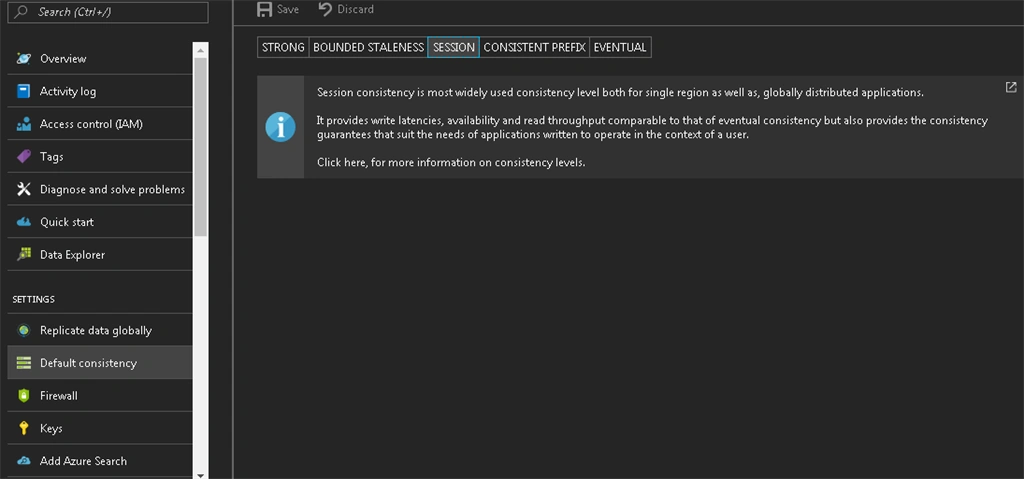
- Click on "Default Consistency" option.
- Set "Consistency" as per requirement.
- Click on "Save".
Join the conversation! Your thoughts help the community grow.