

CPU: Central Processing Unit.
GPU: Graphics Processing Unit.
TPU: Tensor Processing Unit.
LPU: Language Processing Unit.
Pre-requisite to understand this
Parallel Computing: Running many operations at the same time instead of one-by-one.
Matrix Multiplication: Fundamental operation behind neural network calculations.
Neural Network: Layered system that learns patterns from data.
Latency: Time taken to produce an output.
Throughput: Total computations completed over time.
Introduction
In AI systems, especially LLMs, different processors like CPU, GPU, TPU, and LPU are used depending on workload needs. A CPU handles general-purpose sequential tasks, while a GPU accelerates parallel computations crucial for neural networks. A TPU, developed by Google, is purpose built for tensor operations, making large scale AI training highly efficient. Meanwhile, an LPU, popularized by Groq, is optimized specifically for fast, real-time language model inference with minimal latency.
CPU Architecture
CPU architecture is designed for flexibility and control. The control unit directs operations step-by-step, making it ideal for sequential workflows. Data flows between memory and compute units in a tightly controlled loop. While it has limited parallelism, it excels in task switching and general-purpose computing. CPUs are essential for orchestrating AI pipelines and preprocessing data. However, they become inefficient for large-scale matrix computations required in LLMs. Their strength lies in versatility rather than raw AI performance.
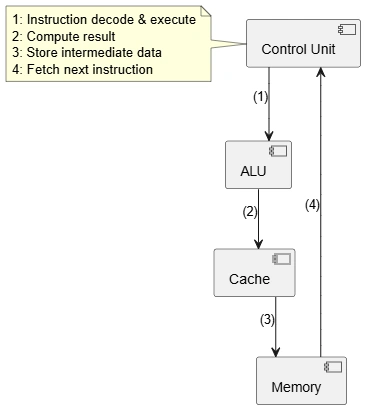
Sequential execution model
Strong control logic
Limited parallelism
Best for orchestration tasks
High flexibility
GPU Architecture
GPU architecture consists of thousands of smaller cores optimized for parallel execution. Instead of sequential instruction flow, GPUs process large chunks of data simultaneously. This makes them highly efficient for neural network training and inference. Shared memory allows fast communication between threads. GPUs are widely used in AI due to their balance between programmability and performance. They significantly reduce training time for LLMs. However, they consume high power and require careful optimization.
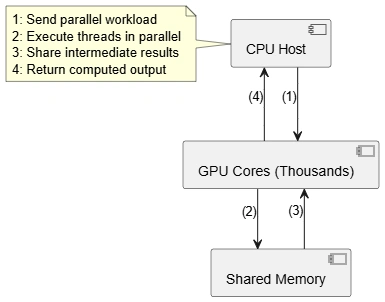
Massive parallel cores
Optimized for matrix operations
High throughput
Ideal for training LLMs
Requires parallel programming model
TPU Architecture
TPUs are specialized processors built specifically for tensor computations in deep learning. Their core component, the matrix unit, accelerates large-scale matrix multiplications efficiently. TPUs use high-bandwidth memory to handle massive datasets. They are tightly integrated with frameworks like TensorFlow. Compared to GPUs, TPUs offer higher efficiency for specific AI workloads. They are widely used in data centers for training large models. However, they are less flexible than GPUs for general tasks.
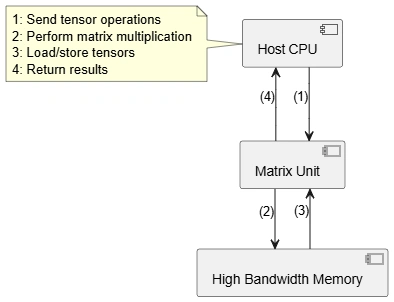
Designed for tensor operations
High efficiency for AI workloads
Uses matrix multiplication units
Integrated with TensorFlow
Less flexible than GPU
LPU Architecture
LPU architecture is optimized specifically for LLM inference workloads. It uses a deterministic execution model to ensure predictable latency. Unlike GPUs, LPUs focus on token-by-token processing rather than bulk parallelism. On-chip memory reduces delays caused by external memory access. This makes LPUs extremely fast for real-time applications like chatbots. They are not typically used for training but excel in inference scenarios. Their design prioritizes consistency and speed over flexibility.
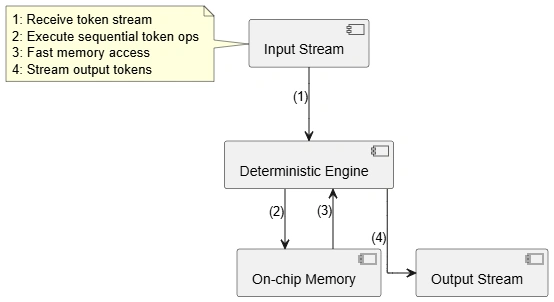
Optimized for LLM inference
Deterministic execution
Ultra-low latency
Efficient token streaming
Not ideal for training
Difference Table
| Feature | CPU | GPU | TPU | LPU |
|---|---|---|---|---|
| Purpose | General computing | Parallel computing | AI tensor ops | LLM inference |
| Processing Style | Sequential | Massively parallel | Tensor-optimized | Stream-based |
| Best Use Case | Control, preprocessing | Training & inference | Large-scale training | Real-time inference |
| Flexibility | Very high | High | Medium | Low |
| Latency | Medium | Medium | Low | Very low |
| Throughput | Low | High | Very high | High (optimized) |
| Power Efficiency | Moderate | High consumption | Efficient | Highly efficient |
| Example Companies | Intel, AMD | NVIDIA | Groq |
Summary
CPU, GPU, TPU, and LPU each play a distinct role in the AI ecosystem. CPUs provide control and flexibility, GPUs deliver powerful parallel computation, TPUs specialize in tensor-heavy deep learning tasks, and LPUs optimize real-time language model inference. Modern AI systems often combine these processors to balance performance, efficiency, and scalability depending on the stage of the machine learning pipeline.
Join the conversation! Your thoughts help the community grow.