
Data types provide a way to handle Data Elements. When you relate an element with a Data type you are giving a specific range of values to that particular Element. F# programming uses an Immutable Data Type. If you know the difference between String and StringBuilder in .Net than you can easily understood that a String is an immutable data type and StringBuilder is a mutable type. When you make changes in a string, each change causes a new Object. F# contains two types of Data Types as mutable and immutable types. Mutable data types (Fundamental Data Types) are the same as what .Net contains. The new data types that F# has are Immutable Types. F# is a strongly typed Language. Every expression, value and data element contains a well defined and valid type which is fixed at the time of source code compilation.
Fundamental Data Types
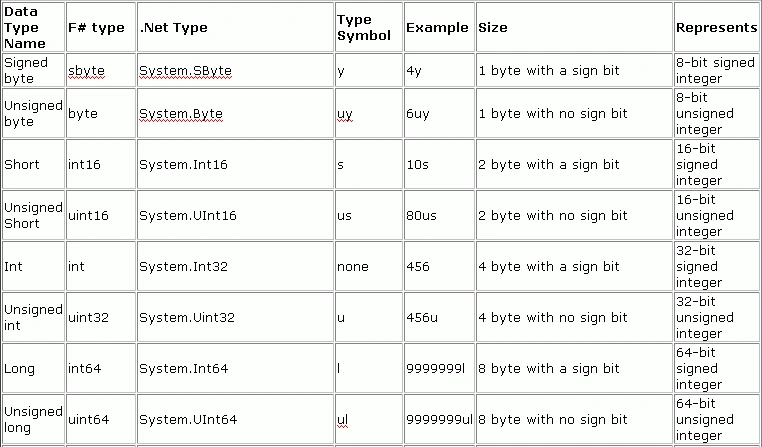
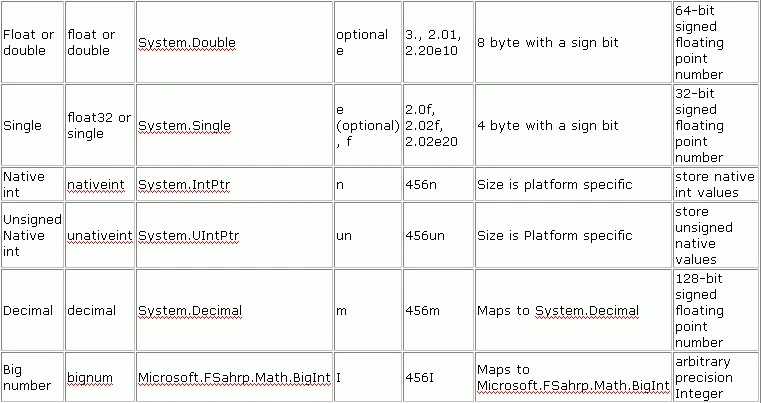
Immutability
Immutability means that the memory associated with an identifier, once assigned is fixed and can not be changed. F# is not a pure functional programming language and it enables value mutability by the mutable keyword.
If you want to define a type that is modifiable you can give the name of the identifier with mutable keyword.
let mutable a=5
You can change the mutable value by (<-) destructive assignment operator:
a <- 6
When you print the value of "a" it will print the changed value.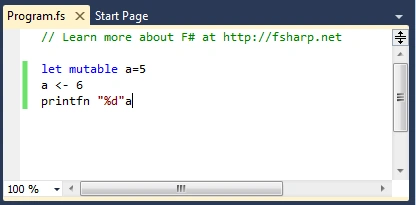
let mutable a=5
a <- 6
printfn "%d"a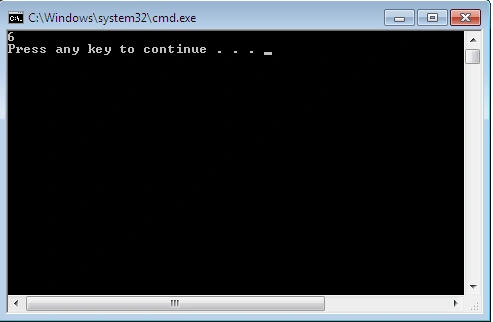
Immutable Data Types are
Tuples
Tuples are ad hoc data types that can be used to group two or more related values into a single Object. These are written as comma separated entities in F#. A Tuple is a simple type that groups multiple types of values. The length of the Tuple can be identified at the time of Compilation. Creating a Tuple value is very easy. You write a comma separated list of values enclosed in parentheses. On the first line we create a Tuple and assign it a tup value. Here we used the Type Inference mechanism of F#.
Example-
> let tup = ("Tuple Data Type!", 06)
val tp : string * int
Example-
> let tuple = (06, "Tuple Data Type");;
val tuple : int * string
> let (num, str) = tuple;;
val num : int
val str : string
Discriminated union
Discriminated unions are used to create well defined type hierarchies and hierarchal data types. This data type is used for showing a data type that can store one of several options. The example of a discriminated union is Abstract Syntax Tree. This data type is useful for heterogeneous data. This data type have a finite number of distinct alternative representations. F# discriminated unions are type safe and work with Pattern matching.
Example-
type area =
| Right
| Left
| Top
| Bottom
member this.ToLatin() =
match this with
| Right -> "Wand"
| Left -> "Coin"
| Top -> "Cup"
| Bottom -> "Sword"
> let card = Right;;
val card : Suit = Right
> card.ToLatin()
val it : string = "Wand"
> let card2 =Top
val card2 : Suit = Top
> card2.ToLatin()
val it : string = "Cup"
Records
F# record types are a simple named type. A Record is a group of variable that are considered as one entity. You can create one or more variables in a record. When you need to access the record you can access the complete record or its member individually. The syntax to create a record is:
type RecordName= { Members }
To declare members you will use the following syntax:
MemberName: DataType
Example-
type Student = { Rno : int; FName : string; LName : string; Gender : char }
Lists
Lists data types are used for storing a collection of values. A F# list is a typical linked list type. It can be either a empty list or a cell containing a value or a reference to the tail, which is itself a list. Lists in F# is an immutable and ordered series of elements.
Example:
let list456 = [ 4; 5; 6 ]
We can also define a list by putting Link Breaks between elements, in which a semicolon will be optional.
let list456 = [
4
5
6 ]
Now we are discussing example of some data types.
Byte-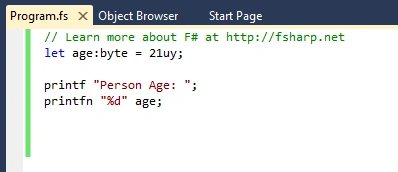
let age:byte = 21uy;
printf "Person Age: ";
printfn "%d" age;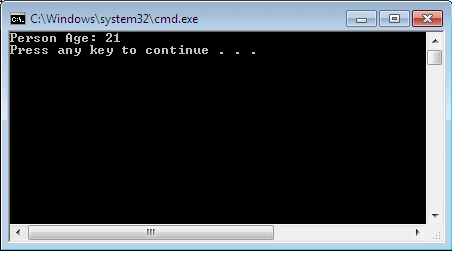
Number-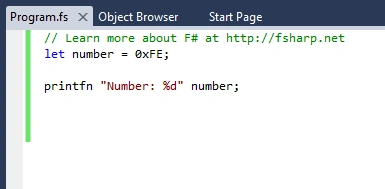
let number = 0xFE;
printfn "Number: %d" number;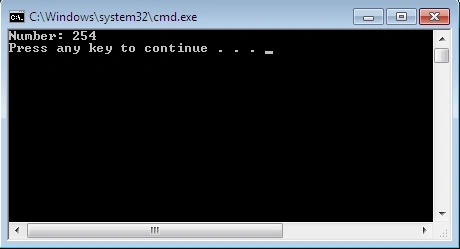
Signed Byte-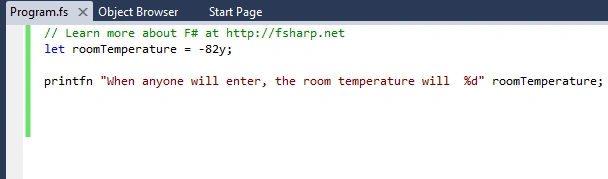
let roomTemperature = -82y;
printfn "When anyone will enter, the room temperature will %d" roomTemperature;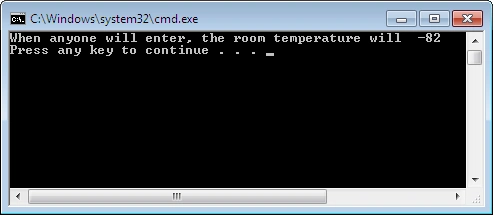
Summary
In this article I covered all mutable and immutable data types.
Join the conversation! Your thoughts help the community grow.