

Pre-requisite to understand this
LLM (Large Language Model) – A neural network model capable of understanding and generating human-like text.
Embeddings – Numerical vector representation of text used to capture semantic meaning.
Vector Database – A database optimized for similarity search on embeddings.
Semantic Search – Searching documents based on meaning instead of exact keywords.
Prompt Engineering – Structuring inputs to an LLM to guide its response.
Chunking – Splitting large documents into smaller segments before indexing.
AI Agent – A system that autonomously performs tasks using reasoning, tools, and LLMs.
Context Window – Maximum amount of text an LLM can process in a single prompt.
Introduction
Retrieval-Augmented Generation (RAG) is a design pattern used in modern AI systems and AI agents to improve the accuracy of responses generated by a language model. Instead of relying solely on knowledge stored inside the model during training, RAG allows the model to dynamically retrieve relevant information from external sources such as document stores, databases, or knowledge bases. This retrieved information is then added to the prompt given to the language model, allowing it to generate answers grounded in real data. In AI agents, RAG acts as a knowledge access layer that allows the agent to query enterprise data, documentation, or real-time information before generating responses.
What problem we can solve with this?
Large language models are powerful but have limitations. Their knowledge is frozen at training time and they may generate incorrect or hallucinated responses when asked about unknown or updated information. Organizations often need AI systems that can answer questions based on internal knowledge such as product manuals, policies, logs, or knowledge bases. RAG solves this challenge by connecting LLMs with external knowledge repositories. The retrieval step ensures that only the most relevant context is provided to the model, allowing it to generate responses that are both accurate and context-aware. This approach significantly improves trustworthiness and enables enterprise use cases where reliability and up-to-date information are critical.
Problems solved by RAG:
Knowledge freshness – Allows models to access newly added data without retraining.
Reduced hallucination – Grounding responses in retrieved documents improves accuracy.
Private data access – Enables AI agents to use proprietary enterprise data securely.
Scalability – Large document repositories can be indexed and searched efficiently.
Domain specialization – AI agents can become experts in a specific knowledge base.
Better explainability – Retrieved documents can be shown as evidence for answers.
How to implement / use this?
Implementing RAG involves creating two main pipelines: data ingestion and query-time retrieval + generation. In the ingestion stage, documents are collected, cleaned, split into chunks, and converted into embeddings. These embeddings are stored in a vector database that allows fast semantic similarity search. During query time, when a user asks a question, the system converts the query into an embedding and retrieves the most relevant document chunks. These chunks are appended to the prompt given to the LLM. The model then generates a response based on both the user question and the retrieved knowledge. In AI agents, this process is typically wrapped as a knowledge tool that the agent can call whenever it needs information.
Implementation steps:
Data ingestion – Collect documents from files, APIs, or databases.
Chunking – Split large documents into manageable pieces.
Embedding generation – Convert chunks into vector representations.
Vector indexing – Store embeddings in a vector database.
Query embedding – Convert the user query into an embedding vector.
Similarity search – Retrieve the most relevant chunks.
Prompt augmentation – Insert retrieved context into the LLM prompt.
Response generation – LLM generates a grounded answer.
Common frameworks used include LangChain, LlamaIndex, and vector databases like Pinecone.
Sequence Diagram
The sequence diagram illustrates how an AI agent processes a query using the RAG approach. The interaction begins when the user sends a question to the AI agent. The agent converts the question into an embedding representation using an embedding service. This embedding is then used to perform a similarity search in the vector database to retrieve the most relevant document chunks. Once the relevant context is retrieved, the agent constructs a prompt that includes both the user query and the retrieved documents. This prompt is sent to the language model, which generates a response grounded in the retrieved context. Finally, the AI agent returns the generated response back to the user.
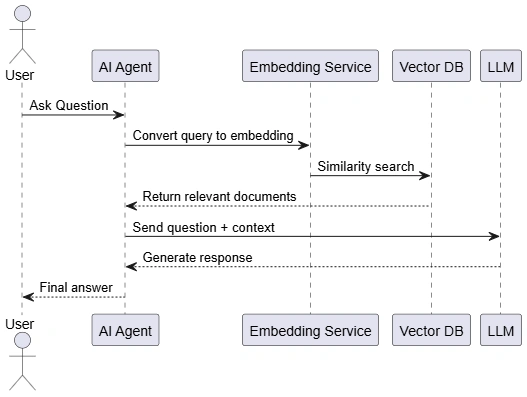
Sequence flow steps:
User Query – User asks a question to the AI agent.
Embedding Generation – Query converted into semantic vector representation.
Vector Search – System retrieves the most relevant document chunks.
Context Assembly – Retrieved documents are added to the prompt.
LLM Processing – Language model generates contextual response.
Response Delivery – AI agent sends answer back to user.
Component Diagram
The component diagram represents the logical architecture of a RAG-based AI agent system. The system consists of multiple components such as the AI agent orchestrator, retrieval module, embedding service, vector database, and LLM service. The AI agent acts as the central coordinator that receives user queries and triggers the retrieval workflow. The retriever module is responsible for converting queries into embeddings and searching the vector database. The vector database stores document embeddings generated during the ingestion pipeline. Once relevant documents are retrieved, they are passed to the LLM service, which generates a response using the provided context. This modular architecture enables scalability and easy integration with enterprise systems.
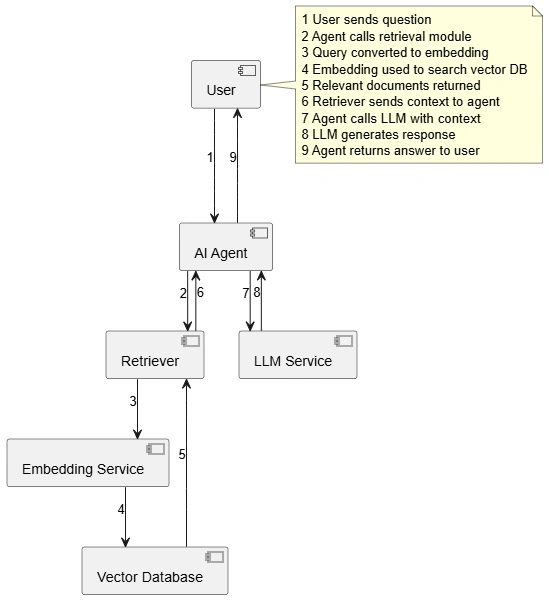
Component interactions:
User Interface – Entry point where users submit queries.
AI Agent – Orchestrates reasoning and tool usage.
Retriever – Handles search logic for document retrieval.
Embedding Service – Generates vector representations.
Vector Database – Stores embeddings for similarity search.
LLM Service – Generates the final answer.
Deployment Diagram
The deployment diagram illustrates how a RAG-based AI agent system can be deployed in a distributed environment. The client layer contains the user interface such as a chat application or web interface. The application server hosts the AI agent service responsible for handling queries and coordinating the retrieval process. A retriever service interacts with an embedding API to convert queries into vectors and perform similarity search against the vector database. The vector database stores embeddings generated from documents stored in a document storage system. The AI agent also communicates with an LLM API to generate final responses. This deployment model separates concerns across layers, enabling scalable cloud-native architecture.
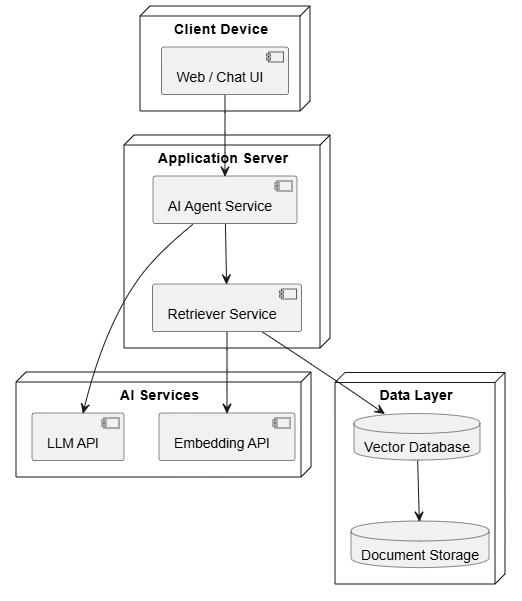
Deployment architecture roles:
Client Layer – Web or chat interface used by users.
Application Layer – AI agent service managing query workflow.
Retrieval Layer – Service responsible for semantic search.
AI Services Layer – External APIs for embeddings and LLM generation.
Data Layer – Storage for documents and vector embeddings.
Advantages
Improved accuracy – Responses are grounded in real documents instead of model memory.
Up-to-date knowledge – New information can be added without retraining the model.
Domain customization – AI agents can specialize in enterprise or domain data.
Reduced hallucinations – Retrieval ensures factual grounding.
Scalable architecture – Vector databases support large document collections.
Explainable results – Retrieved documents can act as references or citations.
Summary
Retrieval-Augmented Generation is a powerful architectural pattern that enhances the capabilities of AI agents by connecting language models with external knowledge sources. Instead of relying solely on the model's internal training data, RAG introduces a retrieval step that fetches relevant documents and uses them as context for generation. This architecture reduces hallucinations, enables access to private knowledge bases, and allows systems to stay updated without retraining models. By combining embeddings, vector databases, and LLMs within a structured pipeline, RAG enables AI agents to provide reliable, scalable, and domain-aware responses suitable for enterprise applications.
Join the conversation! Your thoughts help the community grow.