

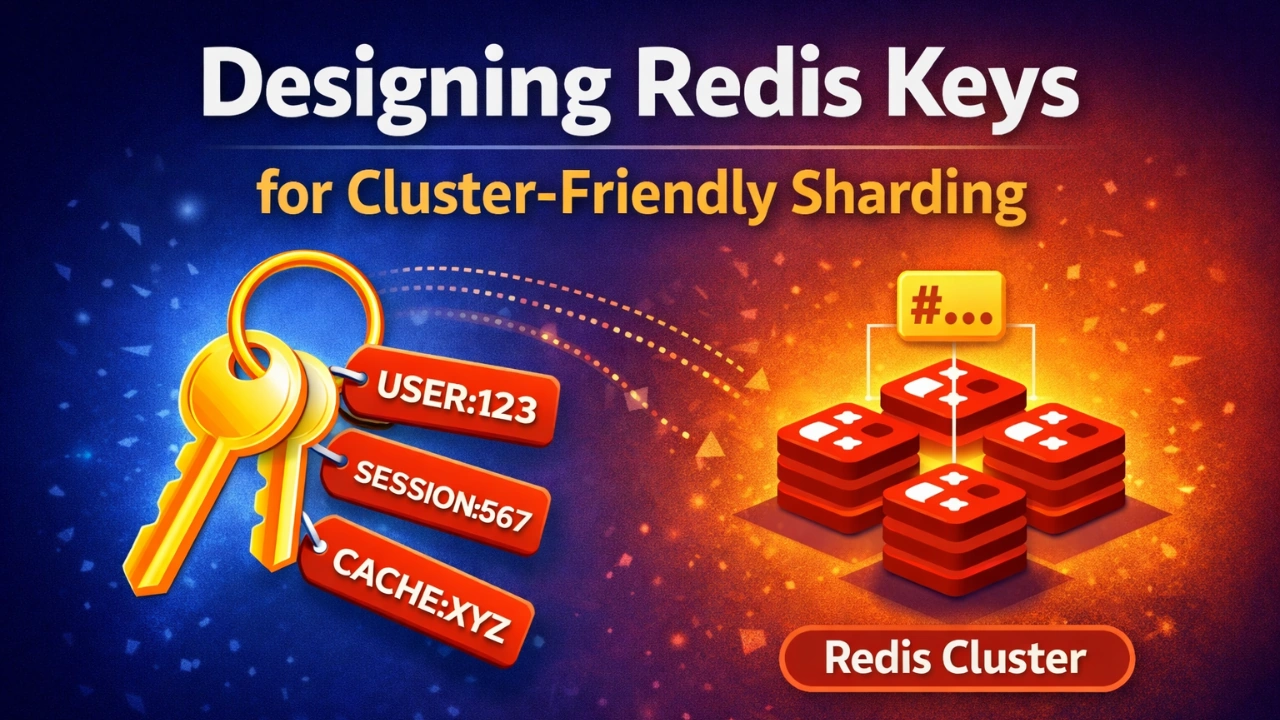
When teams move to Redis Cluster, most scaling problems do not come from Redis itself. They come from key design that was created for a single-node Redis and then reused without change.
Redis Cluster scales by sharding keys across nodes. If keys are not designed with sharding in mind, clusters develop hot shards, uneven load, and unexpected errors. At that point, adding more nodes does not help.
Key design is the difference between a Redis Cluster that scales smoothly and one that constantly fights itself.
Why Key Design Matters More in Redis Cluster
In a single Redis instance, all keys live in the same memory space. Poor key design may hurt organization, but it rarely breaks correctness or scalability.
In Redis Cluster, keys determine:
Which shard stores the data
Which CPU core executes the command
Whether operations succeed or fail
How evenly load is distributed
Once a cluster is live, changing key design is expensive. Clients must change, old keys must expire, and data may need migration. This is why cluster-friendly key design must be done early.
How Redis Cluster Distributes Keys
Redis Cluster divides the keyspace into 16,384 hash slots.
Each key is mapped to one hash slot using a hash function. Each hash slot is owned by exactly one master node.
When a client sends a command, Redis calculates the slot for the key and routes the request to the correct node. All performance characteristics flow from this mapping.
Good sharding happens when keys are evenly distributed across hash slots. Bad sharding happens when many keys map to the same small subset of slots.
The Goal of Cluster-Friendly Key Design
Cluster-friendly keys should achieve the following:
Even distribution across hash slots
Predictable access patterns
Minimal cross-slot operations
No single shard becoming a bottleneck
The goal is not perfection. The goal is avoiding pathological patterns that concentrate load.
Avoid Natural Hot Keys
Some keys are naturally popular.
Examples include:
homepage:cache
global:config
feature_flags:all
In Redis Cluster, a single hot key maps to a single hash slot and therefore a single shard. All traffic for that key hits one node.
If a key is accessed extremely frequently, it can saturate one shard even when the rest of the cluster is idle.
Hot keys should be identified early and treated specially, either by reducing access frequency, caching locally, or redesigning access patterns.
Use Namespaces That Promote Distribution
Namespaces help humans reason about keys, but they also influence distribution patterns.
A good namespace structure looks like:
domain:entity:identifier
Examples:
user:12345
order:98765
product:sku123
Identifiers with high cardinality naturally distribute across hash slots. This is desirable.
Avoid namespaces where the variable portion is small or reused frequently, as they tend to concentrate load.
Be Careful With Hash Tags
Redis supports hash tags, which force keys with the same tag to map to the same hash slot.
Example:
user:{123}:profile
user:{123}:orders
Both keys map to the same slot because of the shared tag.
Hash tags are useful when multi-key operations are required. They allow related keys to live together.
However, hash tags come with risk.
If too many keys share the same tag, or if the tagged entity is very active, a single shard becomes overloaded. This defeats the purpose of clustering.
Use hash tags only when absolutely necessary and limit their scope carefully.
Prefer Single-Key Operations
Redis Cluster performs best when most operations involve a single key.
Single-key operations:
Route to one shard
Execute quickly
Scale naturally as nodes are added
Multi-key operations require all keys to be in the same hash slot. If they are not, the operation fails.
Design APIs and access patterns so that most requests can be satisfied with one key lookup.
Avoid Cross-Entity Transactions
A common mistake is modeling Redis data like a relational database.
Examples include:
Updating multiple user records in one transaction
Performing cross-entity consistency checks
These patterns do not map well to Redis Cluster.
If your application relies heavily on cross-key transactions, cluster adoption will force painful redesign later. Redis Cluster rewards simple, independent data access.
Design for Even Write Distribution
Reads are usually cheaper than writes, but writes determine where load concentrates.
If all writes target a narrow key range, one shard becomes write-heavy. This can limit throughput even if reads are distributed.
Keys that receive frequent writes should include a high-cardinality component so writes spread across slots.
Examples include using user IDs, order IDs, or timestamps as part of the key.
Time-Based Keys and Sharding
Time-based data can be tricky.
Keys like:
metrics:2025-01-01
logs:2025-01-01
Concentrate all writes for a time window onto a small set of keys.
A better approach is to include both time and a distributed identifier:
metrics:2025-01-01:user:12345
logs:2025-01-01:service:api
This spreads writes while still allowing time-based aggregation.
Handling Aggregations in Redis Cluster
Aggregations across many keys often conflict with cluster constraints.
Instead of aggregating at read time, consider:
Pre-aggregating data during writes
Using background jobs for aggregation
Storing rollups per shard
This reduces cross-shard coordination and keeps hot paths fast.
Versioning Keys Without Breaking Sharding
Key versioning is essential, but it must be done carefully in Redis Cluster.
Versions should be added at the end of the key:
user:profile:123:v1
user:profile:123:v2
Placing version information at the end preserves distribution while allowing safe schema evolution.
Avoid placing version information inside hash tags, as that changes slot mapping and breaks grouping.
Testing Key Distribution Early
Before committing to a key design, test its distribution.
Generate a large sample of keys and observe how they map to hash slots. Many Redis clients and tools can help with this.
If a small number of slots receive a disproportionate share of keys or traffic, redesign before production.
Common Cluster Key Design Mistakes
Frequent mistakes include:
Overusing hash tags
Encoding state into key names
Creating low-cardinality keys for high-traffic data
Designing APIs that require cross-slot operations
Treating Redis Cluster like a single Redis instance
Every one of these mistakes leads to uneven load and scaling pain.
A Practical Design Rule
If a key design would create a hotspot on a single Redis instance, it will be worse in Redis Cluster.
Design keys so that traffic spreads naturally as usage grows.
Final Thoughts
Redis Cluster rewards simple, independent, and evenly distributed key access patterns.
Good key design makes scaling feel effortless. Poor key design makes every new node feel ineffective.
If you think you may need Redis Cluster in the future, design keys for sharding from the beginning. Even before clustering is enabled, those decisions pay off later.
Join the conversation! Your thoughts help the community grow.