
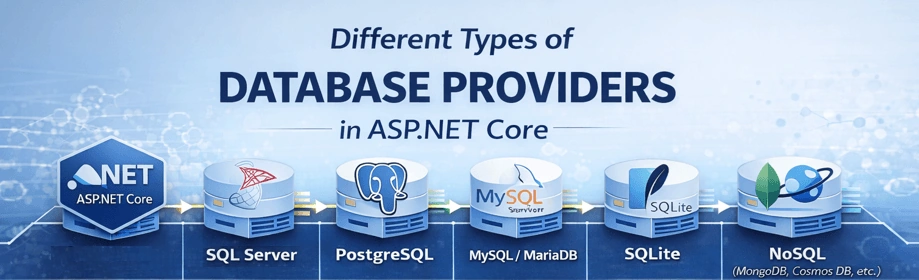
When building enterprise-grade applications in ASP.NET Core, choosing the right database provider is not just a technical decision — it directly impacts performance, scalability, maintainability, and cloud strategy.
In this article, we'll explore the different types of database providers available in ASP.NET Core, how they work internally, how to choose the right database provider, and when to use each — with real-world coding examples.
1. Understanding Database Providers in ASP.NET Core
ASP.NET Core itself does not talk directly to a database. Instead, it relies on:
ADO.NET providers
Entity Framework Core database providers
Micro-ORM providers (like Dapper)
NoSQL SDK providers
In-memory providers for testing
The abstraction layer allows you to switch providers without rewriting your business logic.
The most common abstraction used today is Entity Framework Core (EF Core).
2. Entity Framework Core Relational Providers
EF Core supports multiple relational database engines through pluggable providers .
2.1 SQL Server Provider
Package
Microsoft.EntityFrameworkCore.SqlServer
Best for
Enterprise systems
Azure-hosted apps
Microsoft ecosystem environments
Setup Example
Install package
dotnet add package Microsoft.EntityFrameworkCore.SqlServer
Register in Program.cs
    builder.Services.AddDbContext<AppDbContext>(options =>
options.UseSqlServer(
    builder.Configuration.GetConnectionString("DefaultConnection")));
Connection string ( appsettings.json )
    "ConnectionStrings": {
  "DefaultConnection": "Server=.;Database=AppDb;Trusted_Connection=True;"
}
Production scenario
Banking systems
ERP systems
Applications using SQL Server Always On
2.2 PostgreSQL Provider
Package
Npgsql.EntityFrameworkCore.PostgreSQL
Best for
Linux deployments
Cloud-native systems
Cost-optimized production environments
Setup Example
    dotnet add package Npgsql.EntityFrameworkCore.PostgreSQL

builder.Services.AddDbContext<AppDbContext>(options =>
options.UseNpgsql(
    builder.Configuration.GetConnectionString("PostgresConnection")));
Connection string
"PostgresConnection": "Host=localhost;Database=AppDb;Username=postgres;Password=pass"
Real-world use case
SaaS multi-tenant platforms
Kubernetes deployments
2.3 MySQL / MariaDB Provider
Package
Pomelo.EntityFrameworkCore.MySql
Setup
    builder.Services.AddDbContext<AppDbContext>(options =>
options.UseMySql(
    builder.Configuration.GetConnectionString("MySqlConnection"),
    ServerVersion.AutoDetect(
        builder.Configuration.GetConnectionString("MySqlConnection"))));
Best for
Hosting providers
PHP-to-.NET migration projects
2.4 SQLite Provider
Package
Microsoft.EntityFrameworkCore.Sqlite
Use cases
Desktop apps
Mobile apps
Lightweight internal tools
Example
    builder.Services.AddDbContext<AppDbContext>(options =>
options.UseSqlite("Data Source=app.db"));
Common in
Proof of Concepts
Edge deployments
3. In-Memory Provider (Testing)
Package
Microsoft.EntityFrameworkCore.InMemory
Important: Not a real relational database.
Used for
Unit testing
Integration testing
Example
    builder.Services.AddDbContext<AppDbContext>(options =>
options.UseInMemoryDatabase("TestDb"));
Example Test
    [Fact]
public void AddUser_ShouldSaveUser()
{
    var options = new DbContextOptionsBuilder<AppDbContext>()
        .UseInMemoryDatabase("TestDb")
        .Options;

    using var context = new AppDbContext(options);
    context.Users.Add(new User { Name = "John" });
    context.SaveChanges();

    Assert.Equal(1, context.Users.Count());
}
Use SQLite in-memory mode instead for realistic relational behavior.
4. NoSQL Database Providers
ASP.NET Core also supports NoSQL databases via dedicated SDKs.
4.1 MongoDB
Package
MongoDB.Driver
Setup
    builder.Services.AddSingleton<IMongoClient>(
new MongoClient(builder.Configuration["MongoSettings:Connection"]));
Repository Example
    public class UserRepository
{
    private readonly IMongoCollection<User> _collection;

    public UserRepository(IMongoClient client)
    {
        var database = client.GetDatabase("AppDb");
        _collection = database.GetCollection<User>("Users");
    }

    public async Task CreateAsync(User user)
    {
        await _collection.InsertOneAsync(user);
    }
}
Use cases
Event-driven systems
High write throughput
Flexible schema applications
4.2 Azure Cosmos DB
Provider
Microsoft.EntityFrameworkCore.Cosmos
Setup
    builder.Services.AddDbContext<AppDbContext>(options =>
options.UseCosmos(
    builder.Configuration["Cosmos:AccountEndpoint"],
    builder.Configuration["Cosmos:AccountKey"],
    databaseName: "AppDb"));
Best for
Globally distributed apps
Multi-region SaaS
5. Micro-ORM Providers (Dapper)
Sometimes EF Core is overkill.
Dapper works directly on ADO.NET providers.
Install
dotnet add package Dapper
Example
    using (var connection = new SqlConnection(connectionString))
{
    var users = await connection.QueryAsync<User>(
        "SELECT * FROM Users WHERE IsActive = @IsActive",
        new { IsActive = true });
}
Use cases
High-performance APIs
Read-heavy services
Reporting microservices
6. ADO.NET Native Providers
Low-level database access.
Example with SQL Server
    using SqlConnection connection = new SqlConnection(connectionString);
await connection.OpenAsync();

SqlCommand command = new SqlCommand(
    "SELECT COUNT(*) FROM Users", connection);

int count = (int)await command.ExecuteScalarAsync();
Best for
Extreme performance scenarios
Legacy migrations
7. Switching Providers Without Changing Business Logic
One of EF Core's biggest strengths is provider abstraction.
Example
Change
options.UseSqlServer(...)
To
options.UseNpgsql(...)
If your code avoids provider-specific features, everything works without changes.
Advice
Avoid raw SQL that ties you to one engine unless necessary.
8. How to Choose the Right Provider
Consider
Hosting environment (Azure, AWS, on-prem)
Licensing cost
Team expertise
Scalability requirements
Transaction complexity
Reporting needs
Cloud-native architecture
Enterprise rule of thumb
Traditional enterprise system → SQL Server
Open-source cloud-native → PostgreSQL
Document-driven → MongoDB
Globally distributed → Cosmos DB
High-performance microservice → Dapper
9. Production Best Practices
Always use connection pooling
Enable retry policies
Use migrations responsibly
Monitor slow queries
Avoid N+1 problems
Use async methods
Configure proper indexing
Example Enabling Retry Logic
    options.UseSqlServer(connectionString,
sqlOptions => sqlOptions.EnableRetryOnFailure());
Key Takeaways
Database providers in ASP.NET Core are not just interchangeable components — they define how your system scales, performs, and evolves.
The power of ASP.NET Core lies in its provider abstraction model. You can build your domain logic once and swap infrastructure as needed.
As architects and senior developers, our responsibility is not just to make it work — but to make it scalable, testable, and future-ready.
Happy Coding!
I write about modern C#, .NET, and real-world development practices. Follow me on C# Corner for regular insights, tips, and deep dives.
Join the conversation! Your thoughts help the community grow.