

Pre-requisite to understand this
Basic AI/ML concepts - Understanding models, inference, training, and evaluation
Microservices architecture - Independently deployable services communicating over APIs
APIs & messaging - REST, gRPC, event-driven systems
Cloud & containers - Docker, Kubernetes, scalability concepts
Enterprise software design - Loose coupling, high cohesion, scalability, resiliency
Introduction
Designing AI systems at an enterprise level requires flexibility, scalability, and long-term maintainability. As organizations adopt AI across multiple business functions, monolithic AI solutions quickly become rigid and expensive to evolve. Modular AI system design treats AI capabilities as independent, interchangeable building blocks such as data ingestion, feature engineering, model inference, and decision logic—allowing teams to assemble, replace, or reuse components without disrupting the entire system. This approach aligns AI development with modern enterprise architecture principles, enabling faster innovation while reducing operational risk.
What problem can we solve with this?
Traditional AI systems are often tightly coupled, where data pipelines, models, and business logic are intertwined. This makes upgrades risky, experimentation slow, and scaling costly. A modular AI architecture solves these issues by isolating responsibilities and enabling the independent evolution of AI components. Enterprises can experiment with new models, onboard new data sources, or change decision logic without rewriting the entire system. It also supports multiple AI use cases across departments using shared components.
Problems addressed:
Difficulty replacing or upgrading AI models
Slow experimentation and innovation cycles
Tight coupling between data, models, and applications
Poor scalability and reusability
High maintenance and operational costs
Vendor or technology lock-in
How to implement/use this?
Implementing a modular AI system starts with clear separation of concerns. Each AI capability—data ingestion, feature extraction, model inference, orchestration, and monitoring—is built as an independent service with well-defined APIs. Communication happens through synchronous APIs or asynchronous event streams. Containerization and orchestration platforms ensure scalability and fault isolation. Governance, versioning, and observability are added to manage enterprise-scale complexity. Over time, components become reusable assets across teams and projects.
Implementation steps:
Decompose AI workflow- Split data, model, and decision logic into independent modules
Define contracts- Use APIs/events with strict input-output schemas
Containerize components- Package each module independently
Use orchestration layer- Coordinate AI workflows dynamically
Enable versioning- Run multiple model versions side-by-side
Add observability- Monitor performance, drift, and failures
Sequence diagram
This sequence diagram illustrates how modular AI components collaborate during a prediction request. The AI Orchestrator acts as the coordinator, ensuring that each specialized service is invoked in the correct order. Each component performs a single responsibility and communicates through clearly defined interfaces. If a new model or feature logic is needed, it can be swapped without affecting other components. This design supports scalability, resilience, and rapid experimentation in enterprise environments.
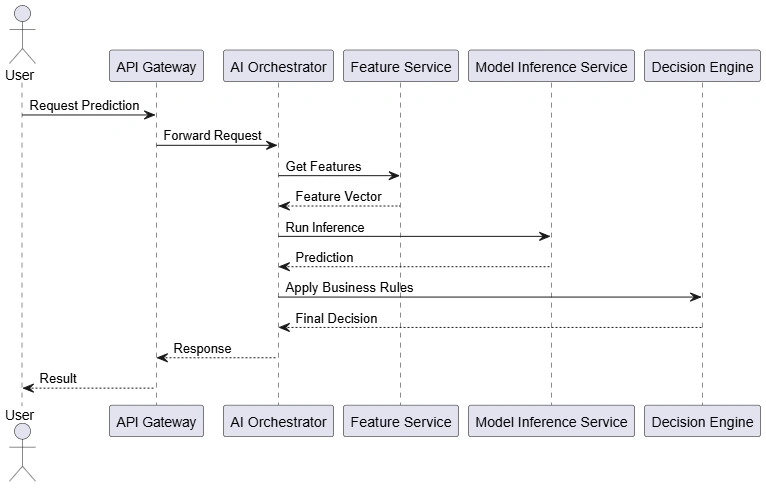
Key points:
Orchestrator controls flow- No hard coupling between services
Feature service is reusable- Shared across multiple models
Model service is replaceable- Swap models without changing clients
Decision engine is isolated- Business rules evolve independently
Component diagram
The component diagram shows the structural view*of the modular AI system. Each component represents a deployable and replaceable unit with a clear responsibility. The AI Orchestrator is the central coordinator, while other components remain loosely coupled. Monitoring is treated as a first-class component to ensure enterprise-grade observability. This architecture enables parallel development, independent scaling, and governance across teams.
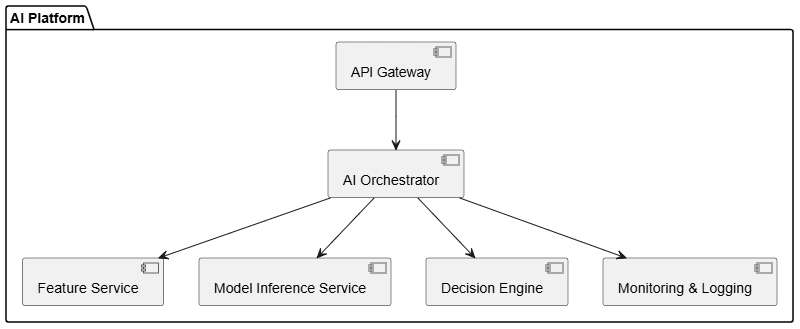
Key points:
Loose coupling- Components depend on interfaces, not implementations
Independent scaling- High-load services scale separately
Clear ownership- Teams own specific components
Enterprise observability- Monitoring embedded by design
Deployment diagram
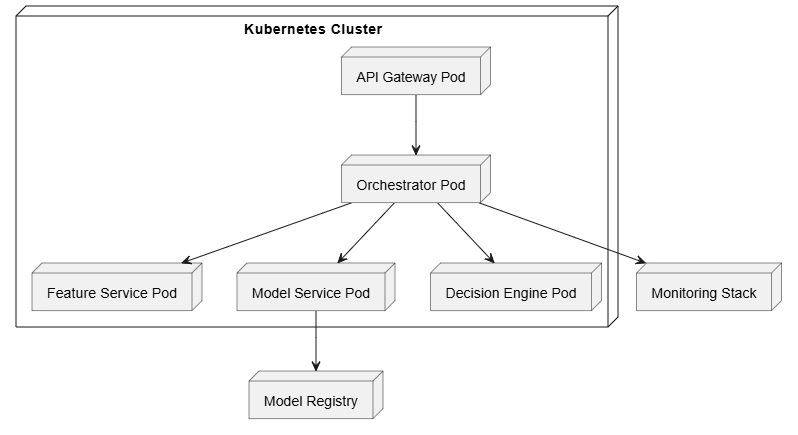
This deployment diagram shows how modular AI components are deployed in a cloud-native environment. Each component runs in its own container and can be scaled independently. Models are stored and versioned in a centralized registry, enabling controlled rollouts and rollbacks. The monitoring stack continuously tracks performance, errors, and model drift, ensuring production reliability at enterprise scale.
Key points:
Cloud-native deployment- Containers and orchestration
Independent scaling- Scale only what is needed
Model version control- Safe experimentation and rollback
Production-grade monitoring- Reliability and compliance
Advantages
High flexibility- Swap or upgrade AI components easily
Reusability- Shared services across multiple use cases
Scalability- Scale components independently
Faster innovation- Parallel development and experimentation
Reduced risk- Failures are isolated
Vendor neutrality- Avoid lock-in to specific AI technologies
Summary
Modular AI system design transforms enterprise AI from fragile, monolithic solutions into composable, scalable platforms. By treating AI capabilities as interchangeable building blocks, organizations gain the ability to innovate faster, reduce operational risk, and reuse investments across multiple business domains. With clear interfaces, orchestration, and cloud-native deployment, this architecture supports long-term evolution and aligns AI development with modern enterprise engineering practices.
Join the conversation! Your thoughts help the community grow.