

Image Source: Microsoft Announcements
Fabric IQ is a new “semantic intelligence” layer in Microsoft Fabric that connects your data, business meaning, and actions into one unified view of your organization. Instead of only storing data in lakes and warehouses, Fabric IQ helps describe what that data actually means in business terms like Customer, Order, Asset, or Contract and how these things relate and drive decisions. This makes it easier for both people and AI agents to ask questions and act using the real language of the business, not technical tables and columns.
What is Fabric IQ?
Fabric IQ is a new workload in Microsoft Fabric that sits on top of OneLake and builds a semantic layer over all your data sources. It lets you define a shared business model, called an ontology, that captures entities, relationships, rules, and goals across the company. IQ then links this business model to your analytical, operational, real-time, and geospatial data so everything is aligned to the same concepts.
With Fabric IQ, teams can model their business visually using no-code tools, so domain experts not just data engineers can shape and update how the business is represented as it evolves. The result is a live, unified view of how the organization runs that AI agents and analytics can use directly.
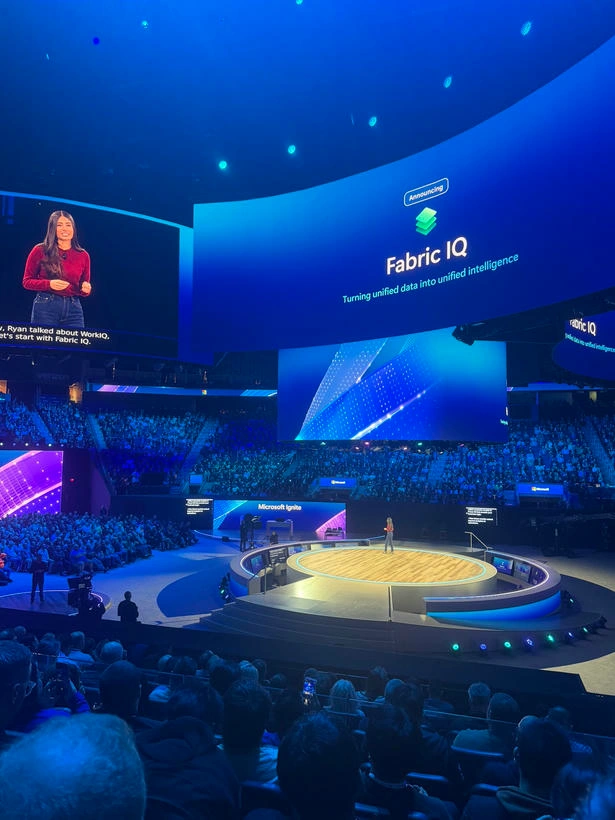
Image Source: Microsoft Announcements (x.com)
Key Capabilities of Fabric IQ
Fabric IQ combines five core capabilities into one semantic system that powers enterprise AI.
Ontology: A shared model of business entities (like Customer, Product, Shipment), their relationships, rules, and objectives.
Semantic model: Trusted BI definitions extended beyond reports into operations and AI scenarios.
Graph engine: A native graph that lets you traverse complex relationships and run multi-hop reasoning, such as tracing a cold-chain failure from sensor data back to impacted orders.
Data agents: “Virtual analysts” that answer business questions using the semantic layer instead of raw tables.
Operations agents: Autonomous agents that monitor live operations, reason about trade-offs, and take actions in real time to improve outcomes.
These pieces work together so that questions, reasoning, and actions are all grounded in a consistent, governed understanding of the business.
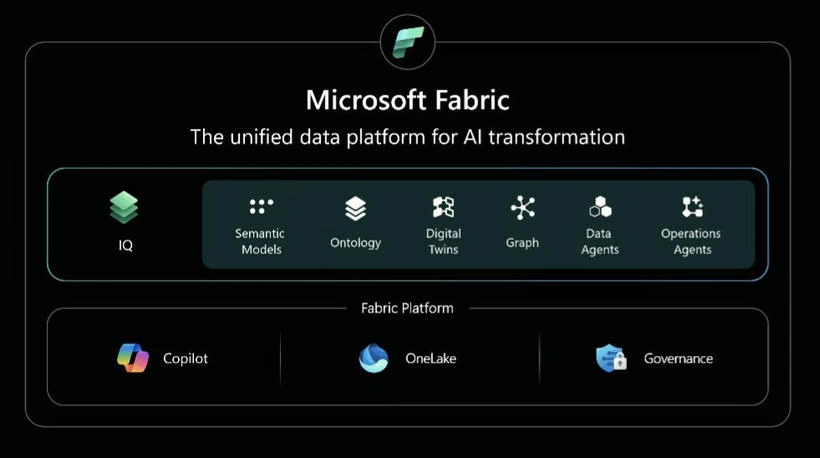
Image Source: Microsoft Announcements (x.com)
How Fabric IQ Works with Data
Fabric IQ connects to data already in OneLake—lakehouses, warehouses, eventhouses, and Power BI semantic models—and overlays them with business entities and relationships. Instead of navigating by schemas and tables, users and agents can navigate by concepts like “Open Orders in Europe with high risk” or “Assets nearing maintenance threshold.”
Because IQ is live, changes in data or business structure flow into the semantic graph automatically, keeping insights and decisions up to date. Rules can be defined so that events and actions (like a shipment delay or sensor alert) are recorded in real time and used by operations agents to trigger responses.
Fabric IQ + Foundry IQ + Work IQ
Fabric IQ is one part of Microsoft’s broader “IQ” story a shared intelligence layer across the stack.
Fabric IQ brings semantic intelligence and live business context over structured data in Fabric.
Foundry IQ provides a unified knowledge layer over documents, tickets, sites, and other unstructured sources for AI agents.
Work IQ in Microsoft 365 captures work patterns, collaboration signals, and user context from daily tools like Outlook, Teams, and Office apps.
Together, they give AI agents a 360° view: how the business is structured, what the documents say, and how people actually work. This unified context helps agents make decisions that are more accurate, explainable, and aligned with real operations.

Image Source: Microsoft Announcements
Why Fabric IQ Matters for Enterprises
Enterprises often struggle with conflicting definitions, duplicated logic, and brittle integrations across dashboards, models, and AI projects. Fabric IQ tackles this by enforcing a shared semantic backbone, reducing one-off models and one-off rules, and centralizing decision logic. Analysts and business users can collaborate with IT on the ontology, while IT focuses on security, approvals, and guardrails instead of rebuilding semantics in every project.
Conclusion
Industry observers highlight benefits like consistent semantics, fewer siloed solutions, and a shared decision layer that lowers maintenance as AI automation grows. By turning unified data into unified intelligence, Fabric IQ helps organizations move from just reporting on the past to continuously optimizing operations with AI that truly understands the business.
Join the conversation! Your thoughts help the community grow.