

Pre-requisite to understand this
Remote Code Execution (RCE): A vulnerability that allows attackers to run arbitrary code on a server.
Gen-AI Systems: Applications that use LLMs to generate text, code, or actions dynamically.
Prompt Injection: Malicious input crafted to manipulate an LLM’s behavior.
Tool / Function Calling: Mechanism where LLMs trigger external APIs, scripts, or commands.
Sandboxing: Isolating execution environments to limit damage from malicious code.
Zero Trust Architecture: Security model where no component is trusted by default.
Introduction
Remote Code Execution (RCE) is one of the most critical security risks in Gen-AI applications, especially those that allow dynamic code execution, tool usage, or OS-level commands. Gen-AI systems are uniquely vulnerable because they interpret natural language and may translate it into executable actions. If untrusted user input is not properly controlled, attackers can exploit the AI to execute malicious commands, access sensitive systems, or escalate privileges. Addressing RCE in Gen-AI requires a combination of architectural controls, strict validation, execution isolation, and policy-driven AI behavior. A secure-by-design approach is essential rather than relying on prompt-level safeguards alone.
What problem we can solve with this?
By fixing RCE vulnerabilities in Gen-AI systems, organizations can prevent attackers from abusing AI-driven automation to execute unauthorized code. This protects backend infrastructure, sensitive data, and downstream services from compromise. Without proper controls, Gen-AI agents can become an attack proxy that unknowingly performs harmful operations. Mitigating RCE also ensures compliance with security standards and builds trust in AI-powered platforms. It reduces blast radius during failures and prevents privilege escalation through AI workflows. Ultimately, it enables safe adoption of autonomous and semi-autonomous AI agents in production environments.
Problems addressed:
Unauthorized command execution on servers
Exploitation via prompt injection or tool misuse
Data exfiltration through malicious AI actions
Lateral movement inside internal networks
Privilege escalation using AI agents
Compliance and audit failures
How to implement / use this?
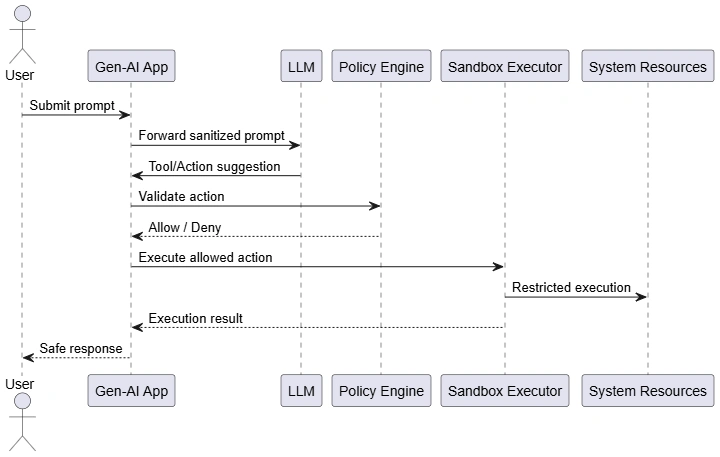
To prevent RCE in Gen-AI systems, execution must be treated as a highly privileged operation and separated from model inference. User inputs should never be directly mapped to executable commands. Instead, Gen-AI outputs must pass through strict validation, policy enforcement, and allow-lists before any execution occurs. Tools or functions exposed to the model should be minimal, deterministic, and non-Turing complete where possible. All execution must happen inside sandboxed, ephemeral environments with no persistent access. Observability and runtime monitoring are essential to detect abuse patterns early.

Join the conversation! Your thoughts help the community grow.