

Introduction
At Ignite, Microsoft unveiled Foundry IQ, a cutting-edge AI platform designed to help developers build intelligent agents that can seamlessly access, organize, and make sense of complex enterprise data. By simplifying how AI interacts with diverse and detailed information sources, Foundry IQ promises to transform the way organizations leverage knowledge for smarter, more responsive applications.

Image Source: Microsoft Ignite Announcements
Foundry IQ
Foundry IQ represents the convergence of Microsoft Cloud intelligence, your custom applications, and the web. This launch is part of Microsoft’s broader Cloud initiative to provide every organization with universal enterprise context. Work IQ from Microsoft 365 offers insights into organizational operations, Fabric IQ adds business meaning to Power BI data, and Foundry IQ centralizes and unifies knowledge access, ensuring every agent operates with the right contextual foundation.
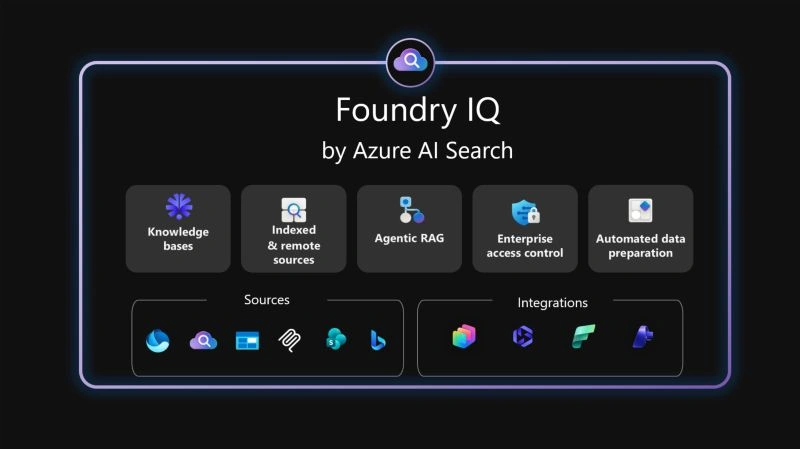
With Foundry IQ now in public preview, we’re introducing a new kind of unified knowledge layer for agents—a single endpoint that delivers richer context through automated source routing and advanced agentic retrieval, all while honoring user permissions.
Powered by Azure AI Search, this preview expands Microsoft Foundry with new capabilities that bring this knowledge layer to life:
Foundry IQ Knowledge Bases: Accessible in the new Foundry portal, these reusable, topic-focused collections ground multiple agents and applications through a single API. They simplify agent development by eliminating the need to stitch multiple data tools into every project.
Seamless access to indexed and federated knowledge sources: Agents can now reach both indexed and remote data. For indexed sources, Foundry IQ handles automatic indexing, vectorization, and enrichment for text, images, and complex documents.
Agentic Retrieval Engine: A self-reflective query engine built into knowledge bases that leverages AI to plan, search, and synthesize responses across sources, with configurable “retrieval reasoning effort.”
Enterprise-grade security and governance: Includes document-level access control, alignment with existing permission models, and flexible support for both indexed and remote data.
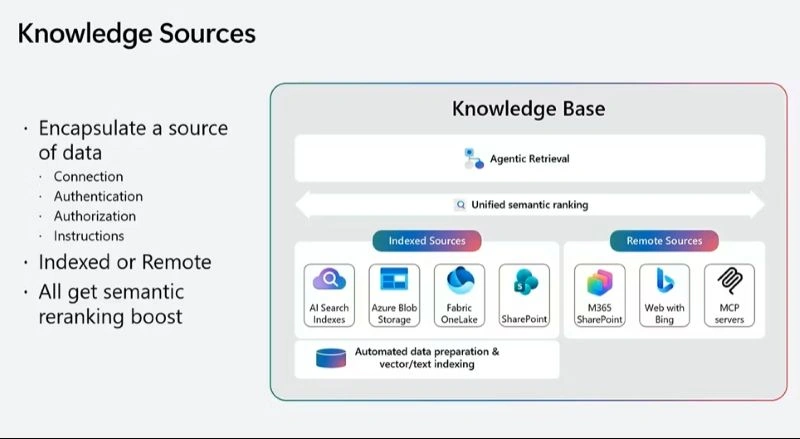
Image Source: Microsoft Ignite Announcements
Shifting from tailored data pipelines to reusable Knowledge Assets
Traditional RAG creates significant overhead for every new project. Each team has to recreate data connectors, chunking strategies, embeddings, routing rules, and permissions from the ground up. The result is a tangle of isolated, duplicated pipelines all attempting to solve the same core problem in their own silo: how to provide the model with the right context to respond effectively.
Foundry IQ moves that workload into centralized knowledge bases. Rather than embedding retrieval logic within every agent, you simply define a reusable, topic-focused knowledge base such as for employee policies, product documentation, or support content in the Foundry portal. Once created, multiple agents and applications can connect to it and share the same consistent grounding.
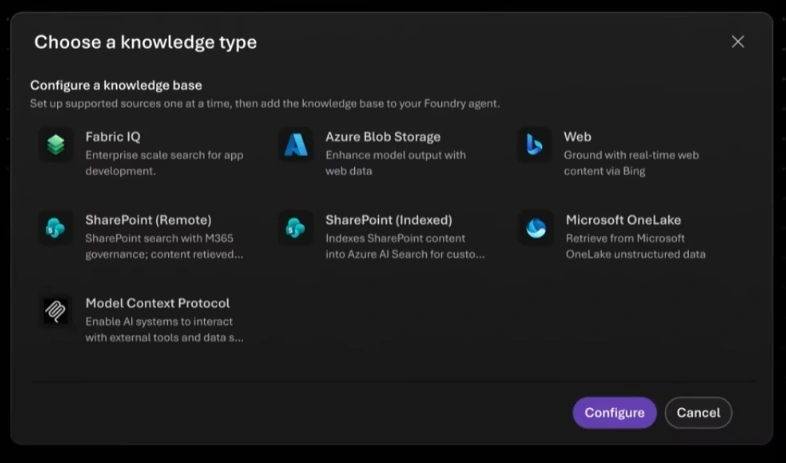
Foundry IQ unifies data from both indexed and remote knowledge sources including M365 SharePoint, Fabric IQ, OneLake, Azure Blob Storage, Azure AI Search indexes, the web, and MCP (in private preview) all feeding into a single knowledge base. Developers no longer must handle custom routing or tailor retrieval strategies for each source; the knowledge base provides a streamlined yet powerful endpoint that agents can query directly.
Agent Retrieval Engine
When an agent queries a knowledge base, the engine approaches retrieval as a reasoning process rather than a simple keyword search. It determines the best search plan, rewrites or breaks down the question when needed, gathers information from multiple sources, assesses whether the signal is sufficient, and iterates if required ultimately producing synthesized context for the model, complete with citations.
Retrieval reasoning effort
The retrieval reasoning effort setting lets you choose what to optimize for—quick, lightweight lookups at lower effort levels, or deeper, more thorough context gathering when accuracy matters. As the effort level increases, the engine relies more on agentic techniques like iterative search and more advanced planning across sources.
When we configure a knowledge base with multiple knowledge sources (up to 10) and test complex queries across different reasoning effort levels, we see performance improve at each step.
Minimal: Executes the caller’s query directly against all knowledge sources in parallel. For testing, we used a 5k-token output budget and applied the same answer-generation step used in higher reasoning levels—although Minimal itself does not currently support answer generation.
Low: Applies query planning and source selection, then federates the refined query across multiple knowledge sources. Low uses a 5,000-token budget for answer generation.
Medium: Builds on Low by adding query planning, source selection, and up to one reflective follow-up retrieval. Medium increases the answer-generation budget to 10,000 tokens.
End-to-end governance, deep observability, and trusted operations
Foundry IQ is built on an enterprise-grade foundation with Entra ID–based governance, honouring user permissions across all supported knowledge sources. For remote SharePoint sources, Microsoft Purview data classifications and sensitivity labels are preserved throughout both indexing and retrieval. Classified content stays properly tagged and governed as it flows into knowledge bases, and the Purview policies you’ve defined continue to apply when agents use that data for grounding. This effectively closes one of the major gaps in DIY RAG systems, where teams often must approximate or manually recreate security and policy logic in application code.
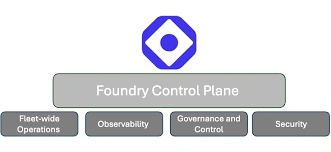
Foundry Control Plane
On top of this, Foundry IQ usage is fully monitored through the Foundry Control Plane. Central teams can view all agents, understand which knowledge bases they rely on, and track how they’re being invoked. They can also review traces and investigate cases where LLM judges’ flag ungrounded responses or when Microsoft Defender steps in to block harmful activity or attempted poisoning.
Summary
Foundry IQ marks a major step forward in how organizations build, manage, and scale intelligent agents with trusted enterprise knowledge.
By unifying retrieval, governance, and reasoning into a single platform, it removes the friction of traditional RAG and accelerates real-world AI adoption.
With centralized knowledge bases, advanced agentic retrieval, and strong security foundations, teams can innovate faster and with greater confidence.
As Microsoft continues to expand these capabilities, the path to building smarter, context-aware agents becomes clearer than ever.
I hope you enjoyed reading this article. Happy learning and reading! See you soon in the next article. Stay tuned for more insights and updates.
Join the conversation! Your thoughts help the community grow.