
Introduction
UiPath’s Document Understanding (DU) capability enabled organizations to automate document-intensive processes such as invoice processing, insurance claims, onboarding forms, and compliance documents. DU focuses on extracting structured information from unstructured or semi-structured documents using predefined, repeatable pipelines.
As enterprise automation matured, document processing scenarios became more complex. Organizations require greater intelligence, context awareness, and flexible human interaction, especially when dealing with low-confidence data, exceptions, and business decisions. To address these evolving needs, UiPath introduced IXP (Intelligent Experience Platform), which enhances how humans and intelligent agents interact with document automation.
Traditional Document Understanding (DU)
Document Understanding is built on a pipeline-based architecture, where each step is executed in a fixed sequence:
Document Classification: Identifies the document type using machine learning or keyword-based models.
Data Extraction: Extracts fields using ML extractors, Form Extractors, or rule-based approaches.
Validation: Uses Validation Station to allow human reviewers to correct or confirm extracted data.
Export: Sends the validated data to downstream systems for further processing.
This architecture is effective for predictable document formats and high-volume scenarios in which document structures do not vary significantly.
Limitations of the DU Approach
Despite being robust, the traditional DU approach has several limitations:
Validation screens are static and always presented in the same format
Human validation is required even for low-risk or high-confidence extractions
Limited ability to use business context during validation
Handling complex exceptions requires additional workflows
User experience is form-based rather than decision-oriented
These limitations can lead to higher manual effort, slower processing, and reduced automation ROI.
What Is IXP in UiPath?
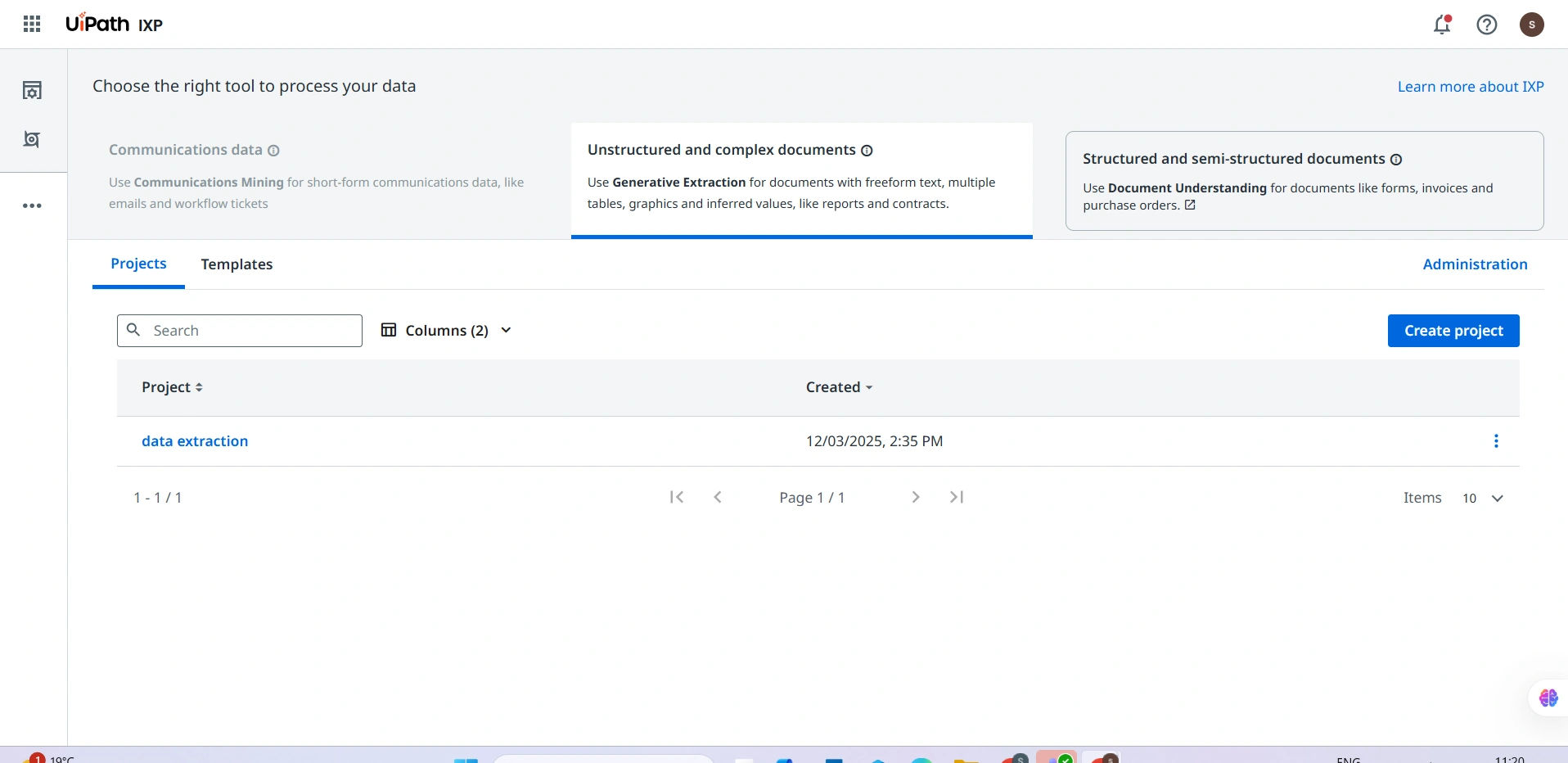
IXP (Intelligent Experience Platform) is UiPath’s experience-driven interaction layer designed to support intelligent, agent-based automation. Instead of relying on static validation screens, IXP enables context-aware and dynamic interactions between users, agents, and workflows.
IXP provides:
Intelligent human-in-the-loop experiences
Agent-assisted decision-making
Context-driven validation and approvals
Adaptive user interactions based on business rules and confidence levels
Importantly, IXP does not replace Document Understanding. It complements DU by improving how extracted data is reviewed, validated, and acted upon.
How IXP Enhances Document Understanding
When DU is combined with IXP, document automation becomes more intelligent and efficient:
Agents evaluate extraction confidence, document type, and business rules
Only critical or low-confidence fields are sent for human validation
Users are presented with contextual questions instead of full validation forms
Decisions and corrections are captured as part of the experience
Automation continues dynamically based on user responses
This approach significantly reduces unnecessary human intervention while maintaining accuracy and compliance.
DU vs IXP Comparison
| Aspect | Traditional DU | DU with IXP |
|---|---|---|
| Processing Model | Pipeline-based | Experience-driven |
| Validation Style | Static forms | Dynamic, contextual experiences |
| Human Effort | High | Reduced and targeted |
| Decision Support | Limited | Agent-assisted |
| Exception Handling | Workflow-driven | Context-aware |
| Flexibility | Medium | High |
Conclusion
Document Understanding continues to be the foundation for document extraction in UiPath. However, as automation scenarios grow more complex, a purely pipeline-driven approach is no longer sufficient.
IXP transforms DU into an intelligent, collaborative experience by introducing context-aware validation, agent-assisted decisions, and adaptive human interaction. Together, DU and IXP enable scalable, accurate, and future-ready document automation within the UiPath platform.
Join the conversation! Your thoughts help the community grow.