

Introduction
In this article, we learn some fundamentals of Python, like Identifiers, Reserved words, Comments, Multiline Statement, Quotation in python, Multiple statement in single line, Suites, etc.
Python Identifiers
Python Identifiers are smaller elements of a Python program. We can say that Identifiers are the name used to identify a variable, module, class, function, and other objects.
Rule for Identifiers
- Python Identifiers are stared with alphabet (a-z) or(A -Z) Or underscore ( _ )
- Python Identifiers are followed by any alphabet (a-z) or (A-Z) , number (0-9) and underscore(_)
- Python Identifiers does not start with digit(number (0-9)) and any special characters( @,% and $ etc.)
- Python Identifiers does not have any special characters (@,% and $ etc.)
Example
|
Identifiers name
|
Correct or incorrect
|
|
_name
|
Correct
|
|
_name1
|
Correct
|
|
name_
|
Correct
|
|
2name
|
Incorrect
|
|
name_lastname_1
|
Correct
|
|
@name
|
Incorrect
|
|
name@
|
Incorrect
|
|
Name
|
Correct
|
|
Name1
|
Correct
|
Python is case sensitive language. For example, in Python, CSHAPCORNER and csharpcorner both are different Identifiers (Shown in the picture below).
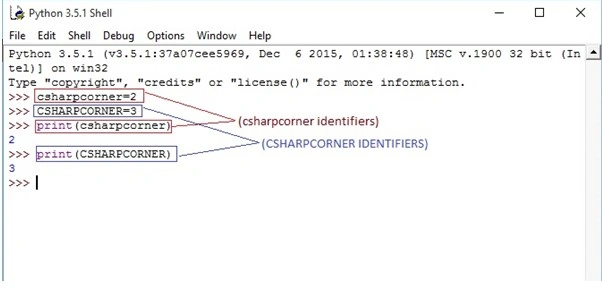
Names for Identifiers in Python
- In Python, class names should be started with an upper letter.
- Starting with an underscore means the identifier is private.
Python reserved word (key word)
Python keywords (reserved words) are words which is reserved by the Python and we cannot use as variables and constraints
Python keywords are listed below:
Join the conversation! Your thoughts help the community grow.