

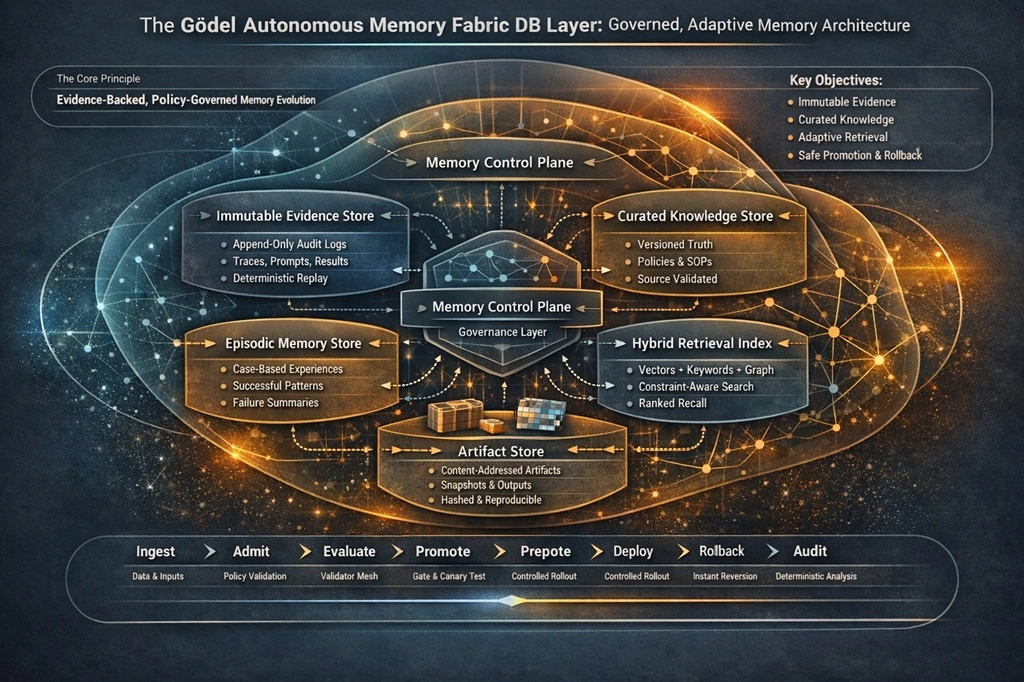
Modern agent systems fail for reasons that have very little to do with “vector search quality” and a lot to do with systems engineering: uncontrolled memory writes, missing provenance, non-repeatable runs, unsafe cross-tenant leakage, reward-driven drift, and “learning” that cannot be audited or rolled back. A self-learning vector database can improve recall, but it does not, by itself, create a production-grade substrate for autonomous continual-learning agents. The Gödel Autonomous Memory Fabric DB Layer is the response to that reality. It treats memory not as a single database feature, but as a governed, multi-store fabric with explicit operational semantics, provenance, and promotion controls, so autonomy can improve while remaining safe, explainable, and repeatable.
The central principle is simple: memory that influences decisions must be evidence-backed, policy-scored, and versioned. If a system cannot answer what it knew, why it knew it, when it learned it, and which rules allowed it to use that knowledge, then it is not a dependable autonomous system. The Autonomous Memory Fabric DB Layer is designed to make those answers cheap and deterministic.
What “Autonomous Memory Fabric” means in practice
A “fabric” is not a marketing word here. It is a specific architectural stance: memory is composed of multiple stores, each with a distinct correctness contract, read pattern, and write policy. Trying to collapse all memory into a single vector index or a single graph creates contradictions in guarantees. The requirements for immutable audit evidence are incompatible with the requirements for fast mutable ranking caches. The requirements for curated authoritative knowledge conflict with the requirements for opportunistic episodic memory. The Autonomous Memory Fabric separates these concerns so each store can be optimized without weakening the system’s integrity.
“Autonomous” adds a second, crucial constraint: memory is not only stored, it is actively formed, promoted, decayed, and governed by the system itself. In a traditional architecture, humans curate knowledge and the database simply stores it. In an agentic OS, the system is continuously generating new facts, new behaviors, and new learned associations. Without autonomy-aware control, those writes become systemic risk. Gödel’s design makes memory operations first-class runtime actions governed by policies, validators, and controlled promotion.
This separation also enables the most important capability that learning databases rarely deliver: controlled evolution. The system can adapt aggressively in low-risk layers (for example caching, reranking, short-lived episodic hints) while keeping high-risk layers (authoritative knowledge, cross-tenant memory, tool permissions) behind gates, approvals, and rollback.
The five-store fabric
The Gödel Autonomous Memory Fabric DB Layer is most naturally implemented as five cooperating stores, plus a control plane that governs them.
Evidence Store (append-only, immutable)
The Evidence Store is the flight recorder of the agentic OS. Every meaningful decision and effect is captured as an append-only event stream: prompts, intermediate plans, tool calls, tool outputs, validator results, policy decisions, model identifiers, runtime configuration, and emitted artifacts. Immutability is the point. You do not “update the past,” you create new events that supersede prior ones.
For enterprise realism, evidence events should be hash chained. Each event includes a hash of the previous event, creating tamper-evident lineage. That gives you non-repudiation and a credible audit trail without requiring exotic infrastructure. Multi-tenant partitioning is mandatory. Evidence must be segmented by tenant, workspace, and run so it is easy to apply retention policies and legal holds.
The Evidence Store is not optimized for recall. It is optimized for truth. In practice, it becomes the backbone for deterministic replay, incident response, compliance audits, and continuous improvement analytics.
The autonomy element appears here in how evidence becomes actionable: the system does not merely record traces. It uses traces as the primary substrate for continual learning proposals, validator training sets, tool reliability scoring, and runtime policy refinement. In other words, the Evidence Store is not passive logging. It is the data-plane for self-improvement.
Artifact Store (content-addressed, deduplicated)
Outputs and intermediate products belong in a content-addressed Artifact Store. Generated files, ZIP deliverables, JSON plans, compiled manifests, retrieval snapshots, and even tool outputs that are large or binary should be stored by content hash (for example SHA-256). The run then references these immutable blobs by hash.
This changes the economics of reproducibility. It becomes trivial to prove that two outputs are identical, to deduplicate storage across reruns, and to assemble complete “run bundles” that can be shipped, reviewed, and replayed. It also provides strong integrity guarantees. A hash-addressed object cannot be modified without changing its address, which forces versioning discipline.
In a mature implementation, artifacts are the primary unit of interchange between the runtime and the outside world. The agentic OS emits artifacts, and the evidence ledger describes how they were produced.
The autonomous advantage is that artifacts become policy-scored and promotion-aware. An artifact is not simply “stored.” It can be eligible for reuse, eligible for training, eligible for knowledge promotion, or marked as non-reusable depending on validators and policies. This turns artifact handling into a governed lifecycle rather than a dumping ground.
Knowledge Store (curated, authoritative)
A production system needs a place where “facts” and “approved content” live. This is not a vector dump of whatever the agent happened to read. It is a curated, versioned knowledge base with provenance and governance. Documents have sources, lifecycles, and status: draft, staged, active, deprecated, retired. Knowledge entries can be corrected without rewriting history by creating new versions and deprecating old ones.
The Knowledge Store is where policies, SOPs, architecture docs, product specs, and canonical project rules belong. It is also where derived knowledge can be promoted after passing gates. If the system “learns” a better instruction or a better design rule, that learning does not silently become truth. It is proposed, validated, and promoted into the Knowledge Store as an explicit versioned change.
This is where the Autonomous Memory Fabric becomes materially better than “self-learning databases.” It treats knowledge as an asset with governance, not as an emergent side effect of query logs.
In Gödel systems, autonomy means the system can propose knowledge improvements at scale. It can detect contradictions between documents, discover stale specs, propose updated standards, and automatically generate diffs or remediation suggestions. But the promotion of those changes is gated. Autonomy accelerates knowledge evolution, while governance prevents knowledge corruption.
Episodic Memory Store (case-based, bounded)
Episodic memory is where the system stores “what happened last time” in a usable form. It is not raw logs. It is compressed experience: successful patterns, failure modes, remediation steps, and outcome summaries. Each episode is evidence-linked. An episode without evidence pointers is a rumor.
Episodic memory must be bounded, decayed, and domain-scoped. Without bounding, episodic memory becomes a junk drawer that steadily pollutes retrieval and amplifies outliers. The Autonomous Memory Fabric uses explicit TTL and decay rules, and it scopes episodes to tenant, domain, workflow type, and policy bundle version. Episodes can be marked “known-bad” and excluded from retrieval influence while remaining in evidence for forensic analysis.
This store is where continual learning becomes operationally useful without requiring weight updates. Many real improvements come from better heuristics, better routing, better sequencing, and better failure recovery. Episodic memory is the substrate for those improvements.
Autonomy in episodic memory is expressed through selective remembering. The system learns what is worth remembering: which failures recur, which fixes generalize, which patterns are stable across time, and which are one-offs. It can automatically promote stable patterns into playbooks, while decaying noisy episodes. This creates a memory system that does not grow endlessly and does not collapse under its own accumulated anecdotes.
Retrieval Index (hybrid vector, sparse, graph)
The Retrieval Index is where you put fast recall structures: embeddings, sparse keyword indices, and graph adjacency used for associative expansion. This is the component most people call “the vector DB,” but in Gödel’s design it is intentionally not the system of record. It is a serving layer fed by curated content and governed policies.
Hybrid retrieval matters. Dense similarity is excellent for semantic recall, but sparse retrieval remains critical for exactness, code symbols, error messages, identifiers, and policy strings. A graph layer matters for relationship traversal, entity grounding, workflow dependencies, and long-range associations that embeddings alone can miss.
The important difference is how learning is handled. The Retrieval Index is allowed to adapt, but only under controls. Rankers, edge weights, caches, and learned association structures are versioned artifacts. Changes to retrieval behavior are promoted through gates, canaried, and rolled back.
Autonomy here means the system can dynamically shape the retrieval topology. It can learn which documents are consistently useful, which entities co-occur in successful outputs, which tool outputs correlate with correctness, and which chunks tend to trigger hallucinations. But unlike a purely self-learning DB, Gödel ties these adaptations back to validator signals, policy constraints, and evidence. Retrieval improvement becomes disciplined rather than emergent.
The Memory Control Plane
The fabric becomes a “Gödel” system only when you add the control plane. This is the missing piece in most “learning DB” narratives. The control plane is the governance and operations brain for memory. It is responsible for deciding what can be written, what can be used, and under which conditions memory can influence decisions.
Admission control for memory writes
Every write into the fabric is typed and justified. A write request includes the source run ID, tenant, sensitivity labels, proposed memory class, evidence references, and validator signals. The control plane uses this to enforce policy: low-confidence content cannot become knowledge, cross-tenant memory requires strict filters, restricted data cannot be embedded into shared indices, and “agent-generated facts” must be staged until validated.
This is where the system prevents the most common failure mode of autonomous agents: self-poisoning. Without admission control, agents will happily store incorrect inferences, then retrieve them later as “evidence,” creating a closed loop of escalating hallucination.
Autonomy is enabled safely by making writes conditional. The system can generate immense amounts of candidate knowledge and episodic updates, but only the fraction that meets correctness and policy thresholds is allowed to shape future behavior. This creates a self-improving loop without self-corruption.
Promotion gates and lifecycle states
Memory is not binary. It has lifecycle states. A realistic promotion model is staged, shadow, canary, active, retired.
Staged memory is stored but not used for decision-making. Shadow memory can be retrieved for evaluation but does not influence outputs unless explicitly requested. Canary memory influences a limited subset of workloads or tenants. Active memory is fully in use. Retired memory remains for audit and replay but is excluded from retrieval influence.
This lifecycle makes continual learning safe. It converts “learning” from a risky mutation into an engineered deployment process.
Autonomy becomes operational when the system can automatically propose promotions and demotions based on metrics. For example, a newly learned edge in the graph might remain in shadow mode until it improves validator success rates across a replay set. If it correlates with regressions, it is demoted automatically. Promotion gates become the “immune system” of autonomous memory.
Versioning and rollback as first-class operations
Any adaptive component that can change behavior must be versioned: retrieval policies, rerankers, graph edge weighting models, cache strategies, chunking rules, write filters, and summarizers. The control plane tracks which version was active for every run. If a regression occurs, rollback is immediate and precise.
Rollback is not an optional feature. It is the difference between a research toy and an enterprise system. A continual-learning system without rollback is operationally equivalent to auto-deploying code changes with no release controls.
Autonomous systems must drift by nature. Gödel’s answer is not to stop drift, but to contain it: every drift is a versioned change with a measurable blast radius and a deterministic undo path. That makes autonomy safe enough for production.
Typed learning, not vague learning
The most professional aspect of the Gödel Autonomous Memory Fabric DB Layer is that “learning” is not treated as magic. It is treated as a series of typed proposals that can be evaluated and promoted.
Examples of typed proposals include retrieval policy updates, graph edge promotion proposals, canonical episode proposals, tool reliability profile updates, entity disambiguation rule updates, and prompt template updates. Each proposal has required evidence pointers, expected metric improvements, and risk classification. This allows improvement to be analyzed, tested, and governed.
This is also how you align learning with enterprise goals. Instead of optimizing a single reward score, you optimize multi-objective metrics under constraints: correctness, safety, compliance, cost, latency, and completeness. Validators are not an accessory. They are the measurement layer that makes learning meaningful.
The autonomous advantage here is that the system generates these proposals continuously and at scale. It can mine traces for repeated patterns, detect failure clusters, and propose localized fixes rather than doing blanket training. Learning becomes incremental, explainable, and correctable.
Hybrid retrieval with constraints and evidence packaging
The retrieval pipeline in the Autonomous Memory Fabric is designed to be both powerful and defensible.
Candidate generation uses multiple channels: sparse retrieval, dense retrieval, and graph expansion. Then constraint filtering applies tenancy boundaries, classification labels, allowed sources, freshness, and policy constraints. Reranking uses learned rankers, but with penalties for sources correlated with validator failures, high cost, or low trust.
The distinctive step is evidence packaging. When a run uses retrieved material, the system freezes a snapshot of the retrieved context as an artifact and links it into the evidence ledger. That snapshot becomes the ground truth for replay. If someone asks why the agent made a decision, you do not reconstruct the context from a mutable index. You reference the frozen snapshot used at the time.
This single design choice eliminates a huge class of “I cannot reproduce it” failures that plague agent systems.
Autonomy is empowered here because the system can learn retrieval improvements without losing reproducibility. You can change the index tomorrow, but yesterday’s run still references yesterday’s retrieval snapshot. That allows continuous evolution without destroying auditability.
Multi-tenant safety and memory isolation
If the platform is multi-tenant, memory governance is the platform. The Autonomous Memory Fabric explicitly supports tenant partitioning, workspace scoping, and policy isolation. Shared memory exists only in forms that are safe: curated knowledge with strict provenance, or global models that have been approved for cross-tenant use. Episodic memory is tenant-scoped by default. Retrieval indices must enforce tenant filters at query time, not as an afterthought.
This is also where compliance becomes tractable. Sensitivity labels can propagate from evidence into memory. Restricted data can be stored in the Evidence Store for audit but excluded from embedding and retrieval. PII policies can be enforced at admission and again at retrieval. These are operational controls that real enterprises need.
Autonomy becomes realistic in multi-tenant systems only when isolation is structural. Gödel’s approach ensures that continual learning inside one tenant cannot implicitly train or influence another tenant unless explicitly allowed. This makes the system suitable for enterprise SaaS deployment.
How this outclasses learning vector databases
A learning vector database tries to improve retrieval quality by learning from queries and co-occurrence. That can be valuable. The Gödel Autonomous Memory Fabric DB Layer does not compete on a narrow metric like “recall at k” alone. It competes on system capability.
It provides immutable evidence with deterministic replay. It provides governed memory formation that prevents self-poisoning. It provides curated knowledge that can be trusted. It provides bounded episodic memory that improves behavior without drifting into noise. It provides hybrid retrieval that is constraint-aware and replayable. It provides promotion gates, rollback, and versioning for any adaptive behavior. It provides multi-tenant isolation as a structural guarantee, not a best-effort filter.
In practice, this means the system can run continuously, improve continuously, and still be auditable, controllable, and enterprise-safe.
Implementation posture
A realistic implementation does not require exotic technology, but it does require discipline. The Evidence Store can be implemented with an append-only table design, hash chaining, and partitioning. The Artifact Store can live on object storage with hash keys. The Knowledge and Episodic stores can be relational with versioned rows and lifecycle states. The Retrieval Index can be built using a combination of Postgres plus vector extensions, a dedicated ANN engine, and a graph store, or implemented as separate services behind a unified retrieval API.
The key is not which vendor you choose. The key is that the control plane enforces the contracts: admission, promotion, versioning, rollback, isolation, and evidence packaging. Without those, you have components. With those, you have a fabric.
The definition that belongs in your architecture spec
The Gödel Autonomous Memory Fabric DB Layer is a governed, multi-store memory substrate for autonomous continual-learning agents, composed of an immutable evidence ledger, content-addressed artifacts, curated knowledge, bounded episodic memory, and a hybrid retrieval index, all orchestrated by a memory control plane that enforces typed writes, promotion gates, versioning, rollback, and tenant-aware constraints.
That definition is not about branding. It is about the difference between an agent that sometimes improves and a system that can safely evolve in production.
Join the conversation! Your thoughts help the community grow.