

🌩️ What cloud native actually means when you are responsible for uptime
Cloud native is often described in marketing terms, but in engineering practice it simply means designing applications that assume failure, change, and scale are normal operating conditions rather than exceptional events. A cloud native application is not just deployed to the cloud; it is designed from the beginning to take advantage of cloud characteristics such as elastic infrastructure, ephemeral compute, managed services, and automated operations.
When building cloud native systems with .NET, you are optimizing for an environment where servers can disappear without warning, deployments happen frequently, traffic patterns fluctuate, and operational insight is mandatory rather than optional. This changes how you think about configuration, state, communication, error handling, and even logging. The goal is not theoretical purity but predictable behavior under real-world conditions.
Modern .NET, especially ASP.NET Core and the unified .NET platform, is extremely well suited for this style of application because it was designed from the ground up with cross-platform execution, containers, high concurrency, and observability in mind.
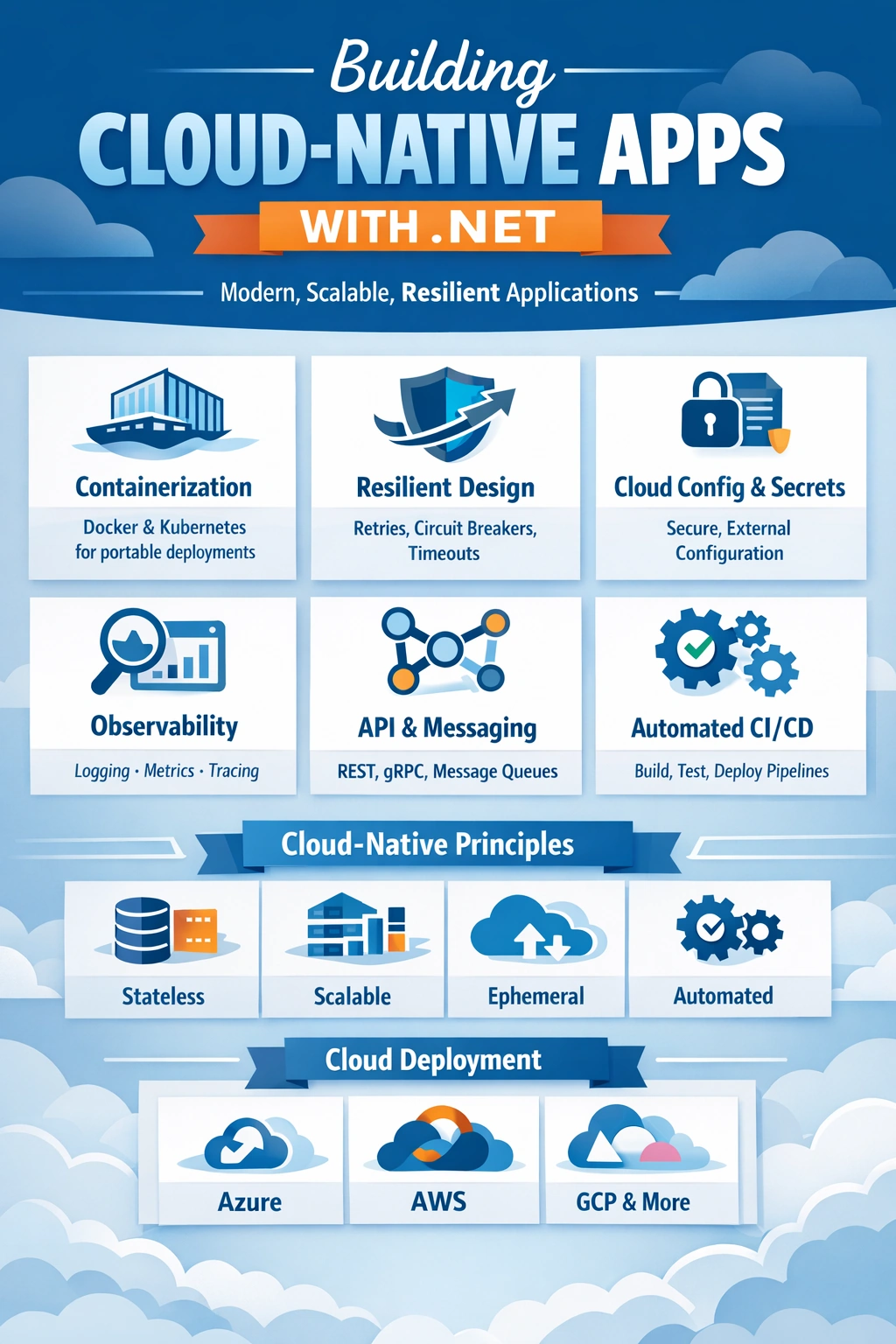
🧠 Cloud native is a set of behaviors, not a framework
One of the most common mistakes teams make is assuming that cloud native is something you “install” or “enable”. There is no single library that magically makes an application cloud native. Instead, cloud native is the result of consistent design choices across the entire lifecycle of an application, from how it starts, to how it handles failures, to how it is deployed and monitored.
A cloud native .NET application typically exhibits the following behaviors.
It starts quickly and deterministically.
It scales horizontally rather than vertically.
It treats infrastructure as disposable.
It externalizes configuration and secrets.
It communicates over the network defensively.
It exposes health, metrics, and traces.
It can be deployed repeatedly without manual steps.
Everything else is implementation detail.
🧱 The foundational architecture for cloud native .NET apps
Before choosing tools, you need to internalize a few architectural principles that drive all cloud native systems.
Statelessness as a default
In cloud environments, instances come and go. If your application stores critical state in memory or on local disk, you are setting yourself up for subtle and hard-to-diagnose failures. Cloud native .NET applications treat processes as stateless workers that can be replaced at any time.
State belongs in external systems such as databases, caches, message brokers, or object storage. Even session state in web applications is typically moved to distributed stores rather than in-memory constructs. This design allows horizontal scaling and enables safe restarts during deployments or failures.
Loose coupling through contracts
Cloud native systems are usually composed of multiple services, whether you call them microservices or not. These services should communicate through well-defined contracts, typically HTTP APIs, gRPC, or asynchronous messaging, rather than through shared databases or tightly coupled libraries.
In .NET, this often means clear separation between API projects, domain logic, and infrastructure concerns, with explicit DTOs and versioning strategies. Tight coupling makes independent deployment and scaling nearly impossible.
Automation over heroics
Cloud native systems assume automation at every stage. Builds, tests, deployments, scaling, and recovery should happen through pipelines and policies, not manual intervention. This influences how you design your application startup, configuration loading, and failure modes, because automation needs predictable behavior.
🐳 Containers as the default unit of deployment
Containers are not mandatory for cloud native applications, but in practice they have become the standard packaging mechanism because they provide consistency across environments and integrate naturally with orchestration platforms.
With .NET, containerization is straightforward because the runtime is cross-platform and optimized for container scenarios.
A typical cloud native .NET application is packaged as a container image that includes the application, its runtime dependencies, and minimal OS components. Multi-stage Docker builds are commonly used to keep images small and secure, compiling the application in one stage and running it in a lean runtime image.
Containers reinforce several cloud native behaviors. They encourage fast startup, discourage reliance on local state, and make scaling and rolling deployments easier. They also integrate naturally with orchestration platforms that manage scheduling, health checks, and restarts.
☸️ Orchestration and scheduling considerations
Once applications are containerized, orchestration platforms such as Kubernetes or managed cloud services handle scheduling, scaling, and lifecycle management. While your .NET code does not directly depend on Kubernetes, it should be written with orchestration in mind.
This means exposing health endpoints that accurately reflect readiness and liveness, responding correctly to termination signals, and starting reliably under constrained resources. ASP.NET Core provides built-in mechanisms for graceful shutdown, dependency injection lifetimes, and middleware composition that align well with these requirements.
It is important to design startup logic carefully because orchestration platforms may start multiple instances in parallel or restart them frequently. Long-running initialization tasks or blocking calls during startup can severely impact deployment reliability.
🔁 Resilience is not optional in distributed systems
In a single-process application, failures are often obvious and catastrophic. In distributed systems, failures are partial, intermittent, and often invisible unless you explicitly handle them.
Cloud native .NET applications must assume that network calls will fail, time out, or return unexpected results. This is not pessimism, it is realism.
Resilience patterns such as retries with backoff, timeouts, circuit breakers, and bulkheads should be applied consistently to outbound calls. In .NET, libraries and built-in HTTP client features make it possible to apply these patterns centrally rather than scattering defensive code throughout the application.
Equally important is knowing when not to retry. Retrying non-idempotent operations or retrying indefinitely can amplify failures rather than mitigate them. Cloud native design requires thoughtful error classification and clear policies.
📡 Communication patterns and service interaction
Cloud native systems communicate over the network, and network communication is inherently unreliable. Designing robust communication patterns is therefore critical.
Synchronous HTTP or gRPC calls are common for request-response interactions, especially in APIs and user-facing services. These calls should be designed to fail fast, propagate meaningful errors, and respect timeouts to avoid cascading failures.
Asynchronous messaging is often used for workflows, background processing, and decoupling services. Message queues, event streams, and pub-sub systems allow services to operate independently and absorb load spikes more gracefully.
In .NET, background processing is often implemented using hosted services, worker services, or message consumers that integrate with the same dependency injection and configuration infrastructure as web applications. This consistency simplifies operational concerns and testing.
🔐 Configuration and secrets management
One of the defining characteristics of cloud native applications is that configuration is externalized. Environment-specific values such as connection strings, API keys, feature flags, and tuning parameters should never be hard-coded or embedded in configuration files checked into source control.
Modern .NET provides a flexible configuration system that can aggregate settings from multiple sources, including environment variables, configuration files, and external configuration providers. This allows the same application image to be deployed to multiple environments with different behavior driven entirely by configuration.
Secrets deserve special attention. They should be stored in secure secret stores and injected into the application at runtime, never baked into images or code. This approach supports rotation, auditing, and least-privilege access, all of which are essential in production environments.
🔍 Observability as a first-class concern
You cannot operate what you cannot see. In cloud native systems, observability is not an afterthought but a design requirement.
A cloud native .NET application should emit structured logs, metrics, and distributed traces by default. Logs should be machine-readable and correlated across services. Metrics should expose key indicators such as request rates, error rates, and latency distributions. Traces should allow you to follow a request as it flows through multiple services.
Modern .NET integrates well with OpenTelemetry, which has become the standard for collecting and exporting observability data. By instrumenting applications consistently, teams gain deep insight into system behavior without relying on ad hoc debugging or guesswork.
Observability also informs design decisions. When developers know their code will be observed in production, they tend to write clearer error messages, expose meaningful health checks, and think more carefully about failure modes.
🧪 Testing in a cloud native world
Testing cloud native applications requires more than unit tests. While unit tests remain important for validating business logic, they do not capture the behavior of distributed systems.
Integration tests that validate service interactions, configuration loading, and startup behavior are critical. Contract tests help ensure that services evolve without breaking consumers. Load and stress tests reveal scaling characteristics and bottlenecks that are invisible in development environments.
In .NET, the ability to host applications in-memory for testing, combined with dependency injection and configuration abstractions, makes it possible to write realistic tests without excessive complexity. The key is to test the system as it will actually run, not just isolated components.
🚀 Deployment and release strategies
Cloud native deployments emphasize small, frequent, reversible changes. This is reflected in deployment strategies such as rolling updates, blue-green deployments, and canary releases.
A well-designed .NET application supports these strategies by starting quickly, handling parallel versions gracefully, and maintaining backward compatibility where necessary. Database migrations, schema changes, and API versioning must be planned carefully to avoid coupling deployments across services.
Continuous integration and continuous deployment pipelines automate the path from code commit to production, reducing human error and enabling rapid feedback. The application’s behavior under deployment conditions should be predictable and observable.
🧩 Platform accelerators and modern tooling
While cloud native principles can be implemented manually, modern tooling can significantly reduce friction. Platforms such as .NET Aspire aim to simplify local development, service composition, and observability for distributed .NET applications without locking teams into a specific cloud provider.
Similarly, application runtimes and sidecar-based platforms such as Dapr provide building blocks for state management, messaging, and service invocation that abstract common patterns. These tools are not mandatory, but they can accelerate development when used deliberately and with clear understanding of the trade-offs.
The key is to treat these tools as accelerators rather than crutches. Understanding the underlying principles ensures that your architecture remains sound even if tools change.
⚠️ Common pitfalls when building cloud native .NET apps
Many teams struggle with cloud native development not because the technology is difficult, but because assumptions from monolithic or on-premises systems are carried forward.
Common mistakes include treating containers like virtual machines, storing state locally, assuming network calls are reliable, logging only for humans rather than systems, and delaying observability until production issues arise.
Another frequent issue is over-engineering. Not every application needs dozens of services or complex orchestration. Cloud native does not mean unnecessarily complex. It means intentionally designed for the environment in which it runs.
🧾 Final guidance
Building cloud native applications with .NET is less about choosing the right framework and more about adopting the right mindset. Modern .NET provides excellent primitives for performance, scalability, observability, and deployment, but those benefits only materialize when the application is designed with cloud realities in mind.
Start by making your applications stateless, observable, and resilient. Package them consistently, deploy them automatically, and design for failure rather than perfection. Use tooling to accelerate development, but never substitute tools for understanding.
When done well, cloud native .NET applications are not just easier to scale, they are easier to reason about, easier to operate, and easier to evolve as requirements change.
❓ Top 5 FAQs: Building Cloud Native Apps with .NET
1. Do I need microservices to be cloud native with .NET?
No. Cloud native principles apply equally to well-designed modular applications. Microservices are a scaling and organizational choice, not a requirement.
2. Is ASP.NET Core required for cloud native .NET apps?
In practice, yes for web-facing workloads. ASP.NET Core was designed with cloud and container scenarios in mind and aligns naturally with cloud native patterns.
3. Can cloud native .NET apps run on any cloud provider?
Yes. Modern .NET is cloud-agnostic. The same application can run on Azure, AWS, GCP, or on-premises infrastructure with minimal changes.
4. How important is observability in cloud native systems?
It is critical. Without logs, metrics, and traces, diagnosing issues in distributed systems becomes guesswork and delays recovery.
5. Should I adopt Kubernetes from day one?
Not necessarily. Many teams start with managed platforms and graduate to orchestration when complexity and scale justify it. Cloud native is about readiness, not premature complexity.
Join the conversation! Your thoughts help the community grow.