

🧠 Security in .NET is a system, not a feature
If you want your .NET applications to be secure, you have to treat security like a cross-cutting engineering discipline that influences architecture, code, configuration, dependencies, CI/CD, and runtime operations, because most breaches are not caused by a single “bad line of code” but by a chain of small weaknesses that were never designed to resist real attackers.
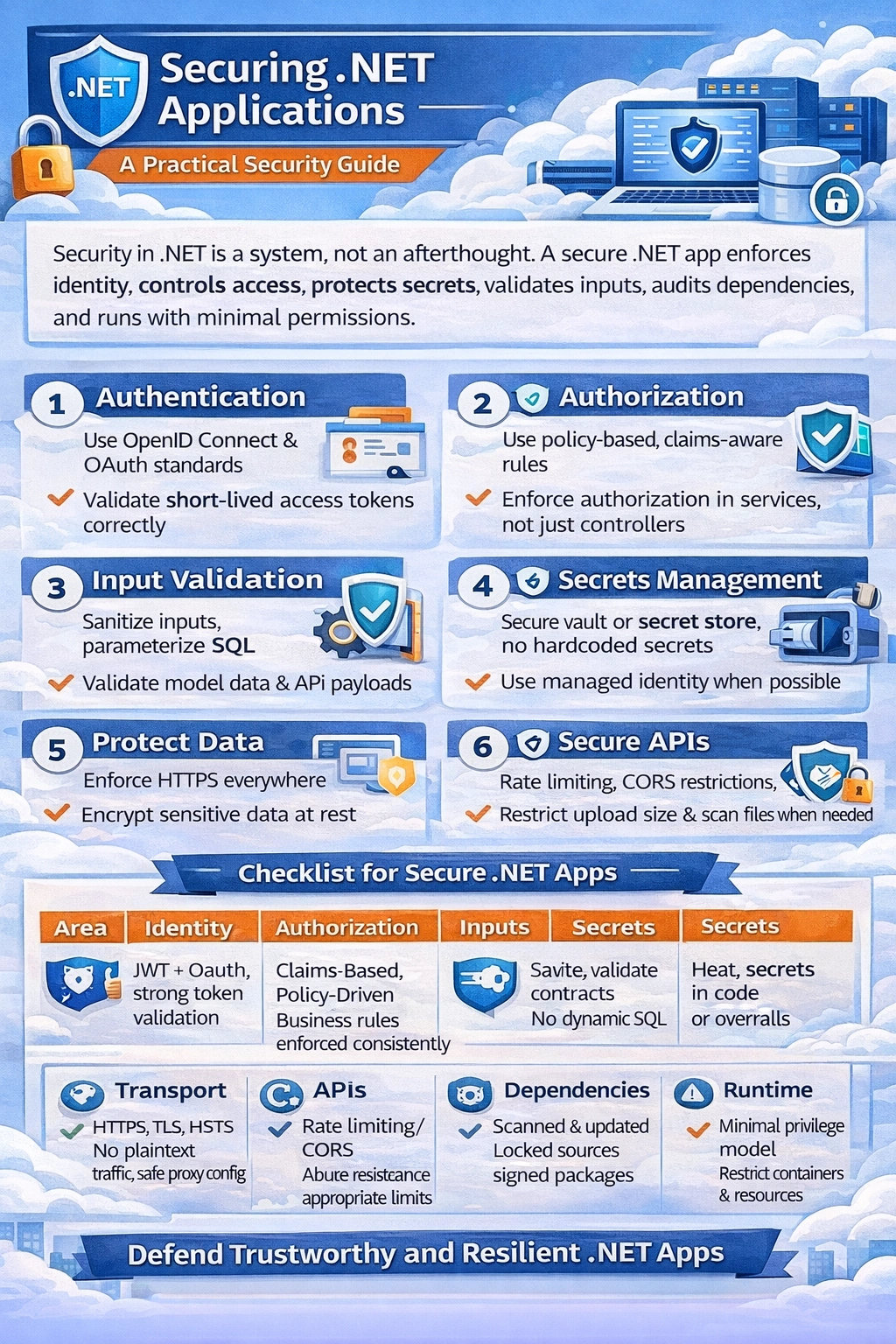
A secure .NET application is one where identity is enforced everywhere, secrets are handled correctly, inputs are treated as hostile by default, dependencies are continuously audited, and production environments are configured to reduce blast radius when something inevitably goes wrong.
🔐 1) Authentication done correctly, not just added
Authentication is the foundation, and in .NET the safest approach is to rely on industry-standard protocols rather than inventing custom schemes, which means you should generally use OpenID Connect for interactive sign-in and OAuth 2.0 flows for API access, whether you are using Entra ID, Auth0, Okta, Keycloak, or another identity provider.
For APIs, prefer short-lived access tokens, keep refresh tokens tightly controlled, and ensure you validate issuer, audience, lifetime, and signing keys, because weak token validation is one of the fastest ways to turn a “secure” API into an open door.
Practical guidance that holds up in production includes enforcing HTTPS everywhere, using secure cookie settings for browser apps, requiring MFA for privileged roles, and using conditional access policies where your identity platform supports them.
🛡️ 2) Authorization that matches your business rules
Most teams focus on authentication and then underbuild authorization, even though authorization is where real business risk lives, because the attacker who gets a token is not done, they are just getting started.
In ASP.NET Core, the recommended approach is to use policy-based authorization rather than scattering role checks throughout controllers, because policies scale better, are easier to audit, and allow you to enforce claims-based rules that map more naturally to business intent.
You should also get comfortable with the idea of defense in depth by enforcing authorization not only at the controller level, but also inside application services where the real business operations occur, because a security model that only exists in controllers is fragile and easy to bypass as code evolves.
🧪 3) Input validation and injection resistance by design
Never trust inputs, even if they come from internal clients, because internal systems are frequently compromised and used as launchpads.
For SQL injection, parameterization is non-negotiable, and you should avoid building dynamic SQL strings with user input even if you think you are sanitizing it, because sanitization approaches are notoriously brittle compared to proper parameterization.
For web applications, protect against XSS by relying on framework encoding by default and avoiding unsafe rendering practices, while for APIs you should treat validation as part of your contract by validating payload shape, length, and allowed values before you touch your business logic.
For model validation, do not stop at data annotations when you need deeper rules, because annotations catch structural issues but they rarely capture business-level constraints that attackers can exploit.
🧷 4) Secure secrets management, not “config with passwords”
Hard-coded secrets, secrets in appsettings files, secrets in source control, and secrets copied into build logs are still the most common reason small and mid-size systems get compromised, and the fix is not a complicated framework but consistent operational discipline.
In modern .NET deployments, secrets should come from a dedicated secret store and be injected at runtime, and you should use managed identity where possible so your application does not even need long-lived credentials for cloud resources.
If you are running containers, you should treat environment variables as a delivery mechanism, not a storage mechanism, which means your real storage should still be something like a secret manager or vault with access controls, rotation, and auditing.
🧾 5) Protecting sensitive data at rest and in transit
Data in transit must use TLS, and that means HTTPS everywhere, no exceptions, with HSTS enabled for web applications, because mixed security modes lead to downgrade attacks and subtle proxy misconfigurations.
Data at rest should be encrypted where appropriate, but encryption is not a substitute for access control, because an attacker who gets database access often also gets your encryption keys if you stored them incorrectly.
For sensitive application data that must be protected outside the database, use the built-in Data Protection APIs in ASP.NET Core rather than rolling your own crypto, because the real security work is not the algorithm choice but key management, rotation, and storage.
For passwords, never store them directly, always hash with a strong adaptive algorithm, and preferably delegate authentication to an identity provider so you avoid handling credentials entirely.
🌐 6) API security that survives the real internet
If you expose APIs publicly, assume they will be probed, scraped, fuzzed, and abused continuously.
You should implement rate limiting, request size limits, and timeouts to reduce denial-of-service risk, and you should also use proper error handling so you do not leak stack traces or internal system details that help attackers refine their approach.
CORS should be configured with explicit allowed origins and not left wide open, because permissive CORS is one of the fastest ways to accidentally enable cross-site data theft in browser-based environments.
If your API accepts file uploads, treat it as a high-risk surface, because file handling often becomes the entry point for malware, path traversal, or resource exhaustion attacks, which is why you should validate type, size, and storage location, and scan files where appropriate.
🧱 7) Dependency security and supply chain protection
Modern .NET applications are composed of dependencies, and attackers know that attacking your dependency tree is often easier than attacking your code.
Join the conversation! Your thoughts help the community grow.