

Large Language Models do not look up answers, reason like humans, or understand meaning. They generate responses through a precise statistical process that predicts language step by step. Once you understand this mechanism, many behaviors such as hallucinations, confidence without certainty, and fluent but wrong answers make sense.
Step 1 Tokenization
Everything starts with tokenization. When you type a prompt, the text is broken into tokens. A token can be a word, part of a word, punctuation, or even whitespace. For example, the sentence:
“How LLMs generate responses” is split into multiple tokens, not individual words.
This matters because the model never sees full sentences. It only sees sequences of tokens.
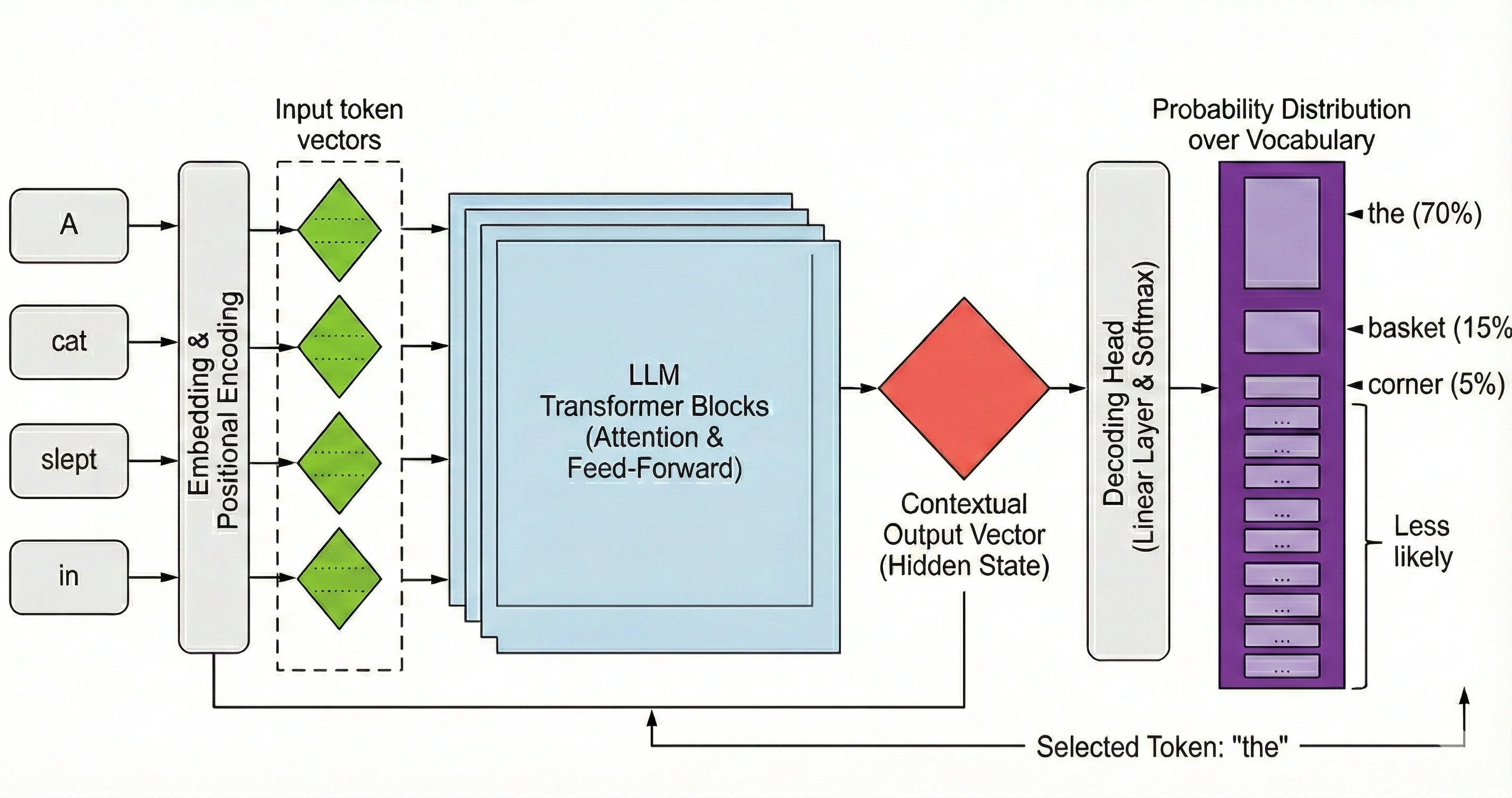
Let's take an example of the above image. The input text in ChatGPT could is, "A cat slept in" and the probability of next word, "the" is 70%. So the GPT-5 model behind ChatGPT will suggest word "the" and so on.
Step 2 Embeddings
Each token is converted into a numeric vector called an embedding.
Embeddings represent relationships between tokens based on how language is used. Tokens that appear in similar contexts have embeddings that are close to each other in high dimensional space.
At this point, there is no meaning or truth. There are only numerical relationships.
Step 3 Context Construction
The model builds a context window from:
The current user prompt
Previous conversation turns
System instructions and constraints
This entire context becomes the input. The model does not distinguish between important and unimportant text unless trained or guided to do so.
Step 4 Attention Mechanism
This is where transformer models differ from older approaches.
Using self attention, the model evaluates how strongly each token relates to every other token in the context. Some words influence the response heavily, others barely matter.
Attention does not mean focus or understanding. It is a weighted mathematical relationship.
This mechanism allows the model to handle long range dependencies such as references, pronouns, and structure.
Step 5 Next Token Prediction
This is the core of response generation.
The model calculates a probability distribution over all possible next tokens and selects one based on that distribution.
It does not select the correct token. It selects the most likely token given everything so far.
Once the token is chosen, it is added to the sequence, and the process repeats.
Token by token, the response emerges.
Step 6 Decoding Strategy
How the model chooses the next token depends on decoding settings.
Common strategies include:
Greedy decoding which always picks the highest probability token
Sampling which introduces randomness
Temperature which controls creativity
Top k and top p sampling which limit choices to the most likely options
These controls shape how deterministic or creative the output feels.
Step 7 Stop Conditions
The model continues generating tokens until:
It reaches a stop token
It hits a length limit
The system interrupts generation
At no point does the model step back and evaluate whether the answer is true.
Why Responses Sound Confident
LLMs are trained on massive amounts of well written text. They learn how explanations, arguments, and expert answers are structured.
As a result, they generate strong, authoritative and confident answers.
Why LLMs Sometimes Get Things Wrong
When the model has strong statistical signals, it performs well. When the signal is weak, ambiguous, or missing, it still generates a response. If they don't have correct answers, they still generate answers. This is where the problem lies.
LLMs may invent facts, assume missing details, and explain things that do not exist.
To learn more about how LLMs get wrong, read What are AI hallucinations.
What LLMs Do Not Do
LLMs do not verify facts or understand truth or what is wrong vs right, They don't reason about consequences. Any system that requires these behaviors must add external tools, grounding, validation, and human oversight.
Conclusion
The answers we get from LLM are not answers retrieved from knowledge or verified data sources. It is a statistically plausible continuation of text based on patterns learned during training. Understanding this single fact changes how you should design, deploy, and trust AI systems. As a developer, architect, or a decision maker, it is your responsibility to use LLMs wisely and place all guardrails for your users and customers.
Join the conversation! Your thoughts help the community grow.