

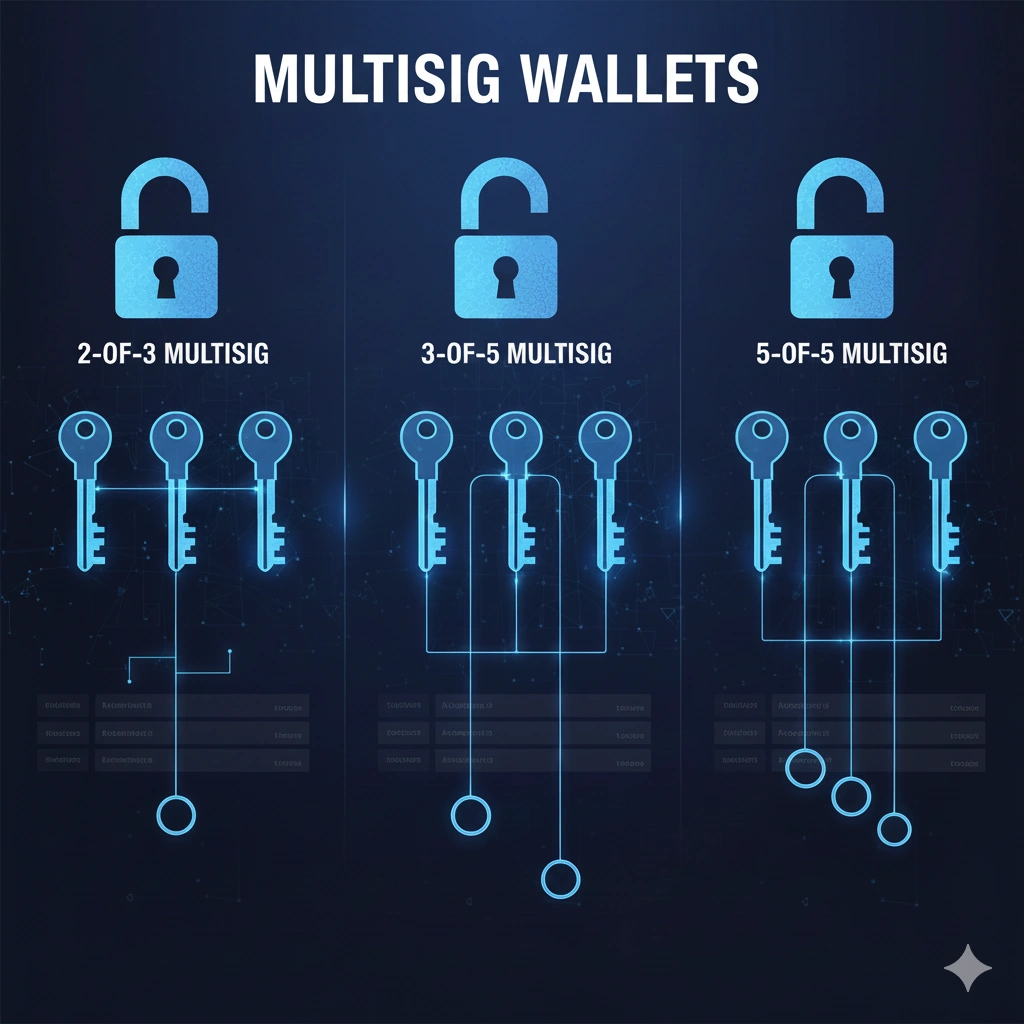
One of the first real design decisions when setting up a multisig wallet is deciding how many signatures are required to move funds.
Most teams start with numbers like 2-of-3 or 3-of-5. As treasuries grow and governance becomes more distributed, configurations like 5-of-7 also enter the conversation. Each option reflects a different balance between security, decentralization, and operational speed.
There is no universally correct answer. The right configuration depends on how much value the wallet controls and how the organization actually operates.
What These Numbers Really Mean
A multisig wallet has two variables. The total number of signers and the number of approvals required to execute a transaction.
A 2-of-3 multisig means there are three authorized signers and any two can approve a transaction.
A 3-of-5 multisig means five signers exist and at least three approvals are required.
A 5-of-7 multisig means seven signers exist and five approvals are needed.
The key idea is that no single signer can act alone, but the system continues to function if one or more signers are unavailable.
The Core Trade-Off: Security vs Day-to-Day Operations
Every increase in the number of required signatures improves resistance to abuse and key compromise. At the same time, it increases coordination overhead and slows execution.
Multisig design is not about maximizing security at all costs. It is about protecting against realistic risks while allowing the organization to function.
The most common failures in multisig setups come from ignoring how humans actually behave.
Why 2-of-3 Is the Default Starting Point
For early-stage startups, small teams, and young projects, 2-of-3 remains the most common and practical choice.
It prevents unilateral control while remaining easy to operate. One signer can be unavailable without blocking transactions. Decisions can still be made quickly, which matters when teams are small and moving fast.
A typical setup might involve a founder, a technical lead, and a foundation or board controlled address. This structure is simple, resilient, and easy to explain to investors.
For many projects, 2-of-3 is not just sufficient. It is optimal.
When 3-of-5 Becomes the Better Option
As teams expand and treasuries grow, concentrating power among two people may feel insufficient. This is where 3-of-5 becomes attractive.
A 3-of-5 multisig distributes authority more broadly. No small subset of signers can move funds without wider agreement. This makes sense for DAOs, protocol foundations, and projects managing significant capital.
The trade-off is coordination cost. Requiring three approvals introduces friction, but for larger treasuries, that friction is often intentional.
This configuration is widely used in DAO treasuries and protocol governance setups, often implemented using tools like Safe.
Where 5-of-7 Fits In
A 5-of-7 multisig is typically used when governance maturity and decentralization are explicit goals.
With seven signers, authority is spread across a broader group, such as core contributors, independent advisors, foundation representatives, or community elected members. Requiring five approvals ensures that decisions reflect strong consensus rather than a narrow majority.
This setup significantly reduces the risk of collusion or internal abuse, but it comes with real operational cost. Coordinating five people is meaningfully harder than coordinating two or three. Processes must be well defined, signers must be responsive, and governance discipline becomes critical.
5-of-7 is appropriate for large treasuries, long-term protocol funds, or organizations that prioritize decentralization over speed.
It is a poor choice for small teams or fast-moving startups.
Why 1-of-N Still Misses the Point
Some teams add multiple signers but require only one approval, effectively creating a 1-of-N setup. While this provides redundancy, it does not meaningfully improve security.
This is actually the worse combination among all. There are N number of point of failure. Any single compromised key can still drain the wallet. The primary benefit of multisig, shared control, is lost.
For treasury management, 1-of-N configurations should be avoided.
The Risk of Over-Engineering
At the other extreme, very high thresholds can create governance paralysis. If too many signers become unavailable due to travel, turnover, or key loss, the wallet can become unusable.
This is not a theoretical concern. It happens in practice.
Good multisig design assumes that keys will eventually be lost and people will eventually be unavailable. The configuration must tolerate that reality.
Practical Guidelines That Actually Work
While no single rule fits every case, some patterns are well tested.
2-of-3 works well for small teams and early-stage projects.
3-of-5 is a strong choice for DAOs and growing treasuries.
5-of-7 fits mature organizations with clear governance processes.
Avoid 1-of-N for anything that holds real value.
Avoid very high thresholds unless signer availability and rotation are actively managed.
The goal is not to pick the highest number possible. The goal is to pick a number that reflects how decisions are truly made.
Final Thoughts
Choosing the right multisig threshold is a governance decision, not just a technical one.
Multisig wallets exist to reduce single-person risk without freezing an organization. The best configuration is the one that protects funds while allowing the team to operate responsibly.
In practice, the difference between 2-of-3, 3-of-5, and 5-of-7 matters less than whether the setup reflects real-world behavior and clear accountability.
Join the conversation! Your thoughts help the community grow.