

Introduction
Modern Python web architectures intentionally separate responsibilities between web servers and application servers. This separation is not accidental, it is rooted in Unix philosophy, protocol design (WSGI/ASGI), and scalability concerns.
This article explains:
The conceptual difference
The protocol boundary (WSGI/ASGI)
How Python frameworks interact with servers
Why NGINX and Gunicorn exist as separate layers
Production architecture implications
Conceptual Separation in Python Ecosystem
Python web systems are designed around this layered model:
Client - Web Server - Application Server - Python ApplicationIn a typical deployment:
Client - NGINX - Gunicorn - Django/FlaskWhere:
Web Server = Handles HTTP traffic
Application Server = Executes Python code
Application = Business logic
What Is a Web Server in Python Architecture?
Exaomple:
NGINX
A web server is optimized for:
Handling TCP connections
Managing HTTP parsing
SSL/TLS termination
Static file serving
Load balancing
Reverse proxy
Rate limiting
Handling slow clients efficiently
Web Server Responsibility Layer
Network Layer
HTTP Layer
Security Layer
Traffic Management Layer
It does not execute Python code.
What Is an Application Server in Python?
Example:
Gunicorn
Uvicorn
An application server:
Loads Python runtime
Imports your application
Translates HTTP into WSGI/ASGI calls
Manages worker processes
Executes business logic
Returns responses
It is responsible for the application execution layer, not traffic control.
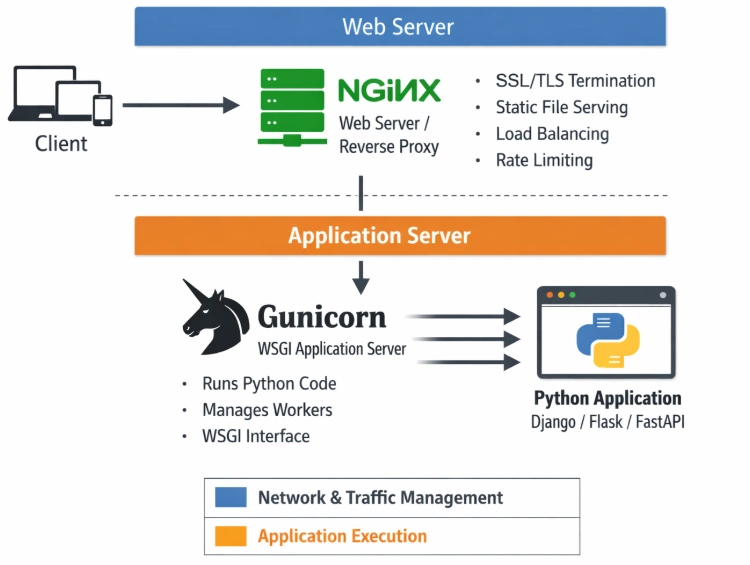
The Protocol Boundary: WSGI and ASGI
Python frameworks do not directly speak HTTP in production. They follow standardized interfaces:
WSGI (synchronous)
ASGI (asynchronous)
Example WSGI app:
def application(environ, start_response):
    start_response("200 OK", [("Content-Type", "text/plain")])
    return [b"Hello World"]
Gunicorn converts:
HTTP Request → WSGI Call → Python Function → HTTP ResponseThis protocol boundary is why Python separates web and application servers.
Why Python Separates These Roles
1. Performance Isolation
Web servers:
Optimized for I/O-bound tasks
Efficient connection multiplexing
Event-driven networking
Application servers:
Focus on CPU-bound business logic
Manage worker processes
Handle memory isolation
Separation prevents:
Slow Python code from blocking network layer
Network overhead from impacting Python execution
2. Unix Philosophy
Python ecosystem follows:
“Do one thing well.”
NGINX:
Does traffic management well.
Gunicorn:
Does Python execution well.
3. Scalability Model
With separation:
Scale Web Layer → Add more NGINX instances
Scale App Layer → Add more Gunicorn workers
Independent horizontal scaling becomes possible.
Architectural Comparison
Gunicorn Alone
Client → Gunicorn → FlaskGunicorn:
Handles HTTP
Executes Python
Works fine for:
Development
Internal tools
Low traffic apps
Production Model
Client - NGINX - Gunicorn (multiple workers) - Python AppHere:
| Layer | Responsibility |
|---|---|
| NGINX | Network efficiency |
| Gunicorn | Process management |
| App | Business logic |
Why Not Combine Them?
Some ecosystems embed runtime inside web server (like IIS in classic ASP.NET).
Python intentionally avoids that tight coupling because:
It keeps runtime independent
Works cross-platform
Fits containerized deployments
Encourages microservice architecture
This makes Python deployments cloud-native by design.
Modern Cloud Architecture
In Kubernetes or cloud:
Client → Cloud Load Balancer → NGINX Ingress → Gunicorn → AppOr even:
Client → Cloud Load Balancer → GunicornThe separation remains logical even if layers merge physically.
Key Takeaways
Web Server (NGINX)
Traffic management
SSL
Static content
Reverse proxy
High concurrency network handling
Application Server (Gunicorn)
Runs Python app
Implements WSGI
Manages workers
Handles request-to-function translation
Final Summary
Python treats web servers and application servers as separate architectural layers.
This separation:
Improves scalability
Improves fault isolation
Increases flexibility
Enables modern distributed systems
Gunicorn is an application server. NGINX is a web server. Together, they form a production-grade Python web stack.
Join the conversation! Your thoughts help the community grow.