

Introduction
The first thing we have to do before working on a Django web framework is to set up a Django development environment by installing pip, virtualenv, and Django 1.8 LTS(Long Term Support). Today, we will see how this is done on Ubuntu. Since all the Linux based OSs come with pre-installed Python on it with LTS(Long Term Support) version, we should not worry about Python installation. You can check your Python version on ubuntu from the terminal.
To open a terminal in ubuntu, hit Ctrl + Alt + t. This will open your terminal and now type "python" in it to see your Python version.

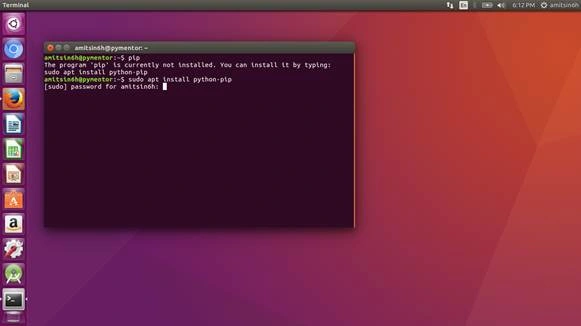


- Go to your home directory and create a folder and name it whatever you like, In my case, I have created a folder named venv.

- Now open terminal and cd into that folder( venv folder ) and type.
$ cd ven$ virtualenv django-venvThis command will create a folder named django-venv inside your venv folder, you can also change the name of the folder to whatever you want. This django-venv folder will contain the Python executable files and a copy of the pip library which you can use to install other packages. The name of the virtual environment (in this case, it is django-venv) can be anything; omitting the name will place the files in the current directory instead.
Activate your virtual environment
 Before installing Django we are required to activate our virtual environment for activating it follow the given steps,
- Open terminal type the following command.
$ source django-venv/bin/activateThis will activate our virtual environment. Now don’t close your terminal we will be installing Django.NOTE - Don’t forget to activate your virtualenv before working on Django.
Installing Django in Ubuntu
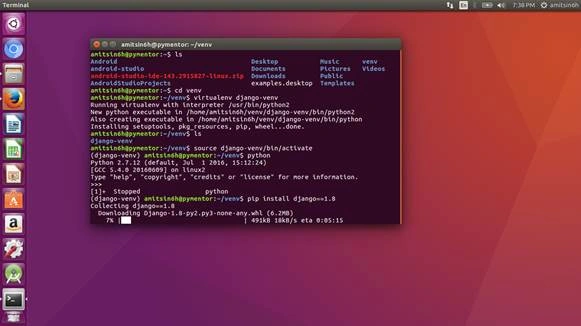 We will be installing django 1.8 its the LTS version. The reason to install this version is, there are lots of django modules which do not work well on all the django versions but all the django modules will be working great in LTS version of django, i.e,django==1.8
For installing django 1.8 we will use pip command as django is a python package. So, on the same terminal type the following command,
$ pip install django==1.8
This will install django 1.8. To check if your django has been installed or not type the following command to verify.
We will be installing django 1.8 its the LTS version. The reason to install this version is, there are lots of django modules which do not work well on all the django versions but all the django modules will be working great in LTS version of django, i.e,django==1.8
For installing django 1.8 we will use pip command as django is a python package. So, on the same terminal type the following command,
$ pip install django==1.8
This will install django 1.8. To check if your django has been installed or not type the following command to verify.
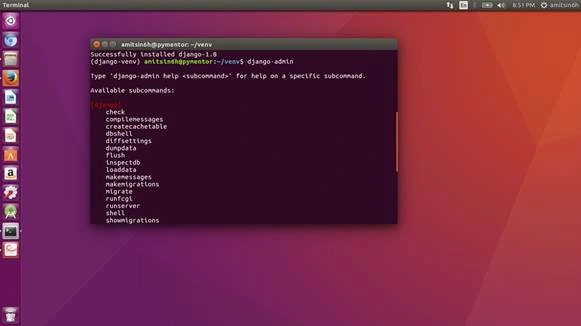 On terminal type
$ django-admin help
This will give you all django related commands. This means you have successfully installed django in Ubuntu and our django development environment is ready.
On terminal type
$ django-admin help
This will give you all django related commands. This means you have successfully installed django in Ubuntu and our django development environment is ready.
Koshila SenadhiraPosted Dec 1, 2022, 11:19 AM
Interesting Article!
Ankur VermaPosted Sep 29, 2016, 5:36 AM
Good