

Pre-requisite to understand this
Cybersecurity Basics: Knowledge of network security, intrusion detection, and log management.
Event Logs: Understanding event logs and how they are generated by network devices, servers, applications, and endpoints.
Network Architecture: Familiarity with the basic network infrastructure and how security data flows through a system.
Incident Response Process: Understanding how organizations react to security incidents and how they investigate attacks.
Introduction
Security Information and Event Management (SIEM) solutions provide organizations with a unified view of their information security posture by collecting, analyzing, and correlating data from various systems and applications. SIEM systems play a crucial role in enhancing security by aggregating event logs, detecting suspicious activities, and providing actionable intelligence for mitigating potential threats. They integrate data from a wide range of security tools like firewalls, intrusion detection/prevention systems, and other monitoring technologies to ensure rapid incident detection, response, and compliance with regulatory frameworks.
What problem can we solve with this?
SIEM solutions are designed to address several key challenges faced by organizations in maintaining robust cybersecurity. These challenges include the ability to detect potential security threats early, manage vast amounts of log data, and comply with legal or regulatory standards. SIEM can provide real-time alerts on security incidents, detect anomalies, and help organizations effectively respond to cyberattacks. Without a SIEM system, security teams often struggle with an overwhelming volume of data, leading to delayed threat detection and response.
Problems SIEM solves
Real-time threat detection: It can help identify malicious activities like hacking attempts or malware infections in real time.
Log management: SIEM centralizes logs from various systems to provide a unified view of the environment.
Compliance monitoring: It helps in meeting regulatory requirements (e.g., GDPR, PCI DSS, HIPAA) by tracking and reporting security events.
Incident response: Automates responses to specific threats and enables quick decision-making.
Root cause analysis: Helps security teams in tracing the origin and spread of security incidents.
Visibility across infrastructure: Provides a holistic view of the security landscape across various devices and systems.
How to implement/use this?
To implement SIEM, organizations typically follow a few structured steps. The first phase is the integration of data sources, where logs from various systems such as firewalls, servers, databases, and endpoints are forwarded to the SIEM platform. Next, the data normalization process ensures that the data from disparate sources is transformed into a common format for correlation and analysis. Threat intelligence feeds are often integrated to enhance detection capabilities, helping to identify known attack signatures and emerging threats. Once the system is set up, continuous monitoring, fine-tuning of rules and thresholds, and response workflows are implemented for effective operation.
Steps to implement SIEM:
Data Collection: Centralize logs from different sources like servers, firewalls, and endpoint devices.
Data Normalization: Convert logs into a standard format for easy correlation and analysis.
Threat Detection: Define detection rules, alerts, and thresholds to identify potential threats.
Incident Response: Create automated or manual workflows for responding to detected incidents.
Compliance Reporting: Set up periodic reports for compliance and audit purposes.
Ongoing Tuning: Continuously refine the SIEM system by adjusting detection rules based on new intelligence and emerging threats.
Sequence Diagram
User initiates interaction with the SIEM system. Various data sources like Firewall, Server, and Endpoint forward logs to the SIEM system. The SIEM system normalizes the incoming data, analyzes it for patterns or anomalies, and correlates the logs. If a potential threat is detected, the SIEM alerts the user and can provide a report.
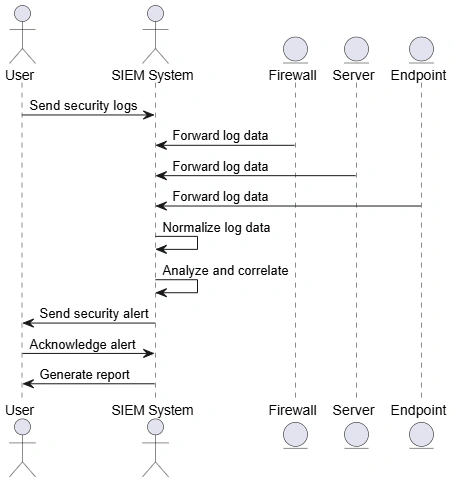
Key Points in Sequence Diagram
Log forwarding: Multiple sources push logs to the SIEM system.
Data normalization: The SIEM standardizes incoming logs for processing.
Alerting and reporting: The system generates alerts and compliance reports.
Component Diagram
Log Collector receives and gathers logs from different sources like firewalls, servers, and endpoints. Data Normalizer processes and converts logs into a uniform format. Correlation Engine analyzes the logs, looking for patterns that indicate security threats. Alert Manager generates and sends alerts based on the analysis. Report Generator creates compliance or incident response reports for stakeholders.
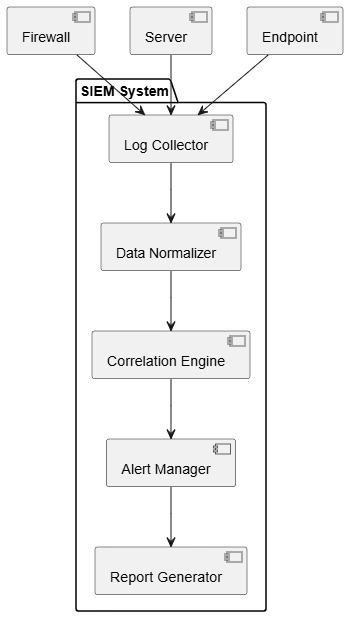
Key Points in Component Diagram
Modular design: Components are isolated to handle specific tasks.
Log sources: Logs from multiple sources are ingested by the SIEM system.
Alert and reporting: Automated response and reporting for security incidents.
Deployment Diagram
SIEM Server hosts all key components like log collection, data normalization, correlation, alerting, and reporting. Firewall, Server, and Endpoint represent the nodes where log data is generated. Each log-generating node sends logs to the Log Collector component on the SIEM Server.
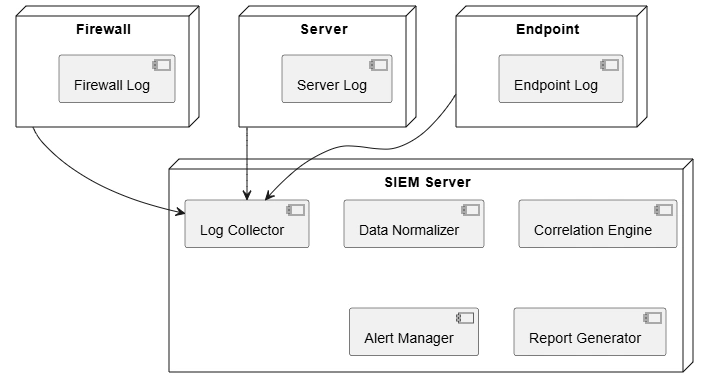
Key Points in Deployment Diagram:
Centralized SIEM Server: Houses all critical SIEM components.
Log forwarding: Logs are sent from network devices and endpoints to the SIEM server.
Advantages
Real-time threat detection: Immediate alerts allow for quick responses to potential threats.
Centralized visibility: Consolidates logs from all critical systems for easier monitoring.
Improved incident response: Automation and streamlined workflows improve response times.
Regulatory compliance: Helps meet legal and industry-specific security standards.
Scalability: Can be scaled to accommodate growing IT infrastructures.
Forensic analysis: Provides detailed logs for investigating security incidents.
Summary
SIEM solutions are essential tools in modern cybersecurity strategies, offering organizations an effective way to monitor, detect, and respond to potential security threats. They aggregate and analyze logs from various systems and devices, enabling real-time threat detection, streamlined incident response, and compliance with regulatory requirements. By implementing a SIEM system, organizations can enhance their security posture, improve operational efficiency, and reduce the risk of data breaches or cyberattacks.
Join the conversation! Your thoughts help the community grow.