Kubernetes  

Kubernetes Self-Healing Architecture

Pre-requisite to understand this

  • Containers: Lightweight units that package an application and its dependencies

  • Container Runtime (Docker): Software that runs and manages containers

  • Orchestration Platform ( Kubernetes): System that automates deployment and management of containers

  • Pod : Smallest deployable unit, can contain one or more containers

  • Health Checks : Mechanisms to detect if an app is running correctly

  • Node: A machine where containers are executed

  • Controller: Ensures desired state (number of replicas, etc.) is maintained

Introduction

A self-healing mechanism in containerized environments refers to the system’s ability to automatically detect failures and recover from them without human intervention. Platforms like Kubernetes continuously monitor the health of containers and take corrective actions, such as restarting failed containers, rescheduling them to healthy nodes, or replacing them entirely. This ensures applications remain available and resilient even in the face of failures like crashes, resource exhaustion, or node outages.

What problem we can solve with this?

Modern distributed applications are highly dynamic and prone to failures due to multiple dependencies, infrastructure issues, and unpredictable workloads. Without automation, engineers would need to manually detect and fix issues, leading to downtime and operational overhead. A self-healing mechanism eliminates the need for constant manual monitoring and intervention, ensuring systems can recover quickly and maintain service continuity. It also improves reliability and user experience by minimizing disruptions.

  • Prevents application downtime due to crashes

  • Eliminates manual intervention for restarts

  • Handles node failures automatically

  • Ensures desired state consistency

  • Improves system resilience and availability

  • Reduces operational overhead for DevOps teams

How to implement/use this?

Self-healing is typically implemented using orchestration tools like Kubernetes. You define the desired state (e.g., number of replicas) using objects like Deployments. Kubernetes continuously compares the current state with the desired state and takes action if discrepancies are found. Health checks (liveness and readiness probes) help detect failures early. If a container fails or becomes unresponsive, Kubernetes restarts it automatically. If a node fails, workloads are rescheduled to other nodes. This declarative approach ensures that the system always converges back to the intended state.

  • Define Deployment: Specify replicas and container configuration

  • Set Liveness Probe: Detect if container is unhealthy

  • Set Readiness Probe: Ensure traffic goes only to healthy containers

  • Use ReplicaSets: Maintain required number of instances

  • Enable Restart Policy: Automatically restart failed containers

  • Node Monitoring: Detect node failures and reschedule workloads
Sequence Diagram

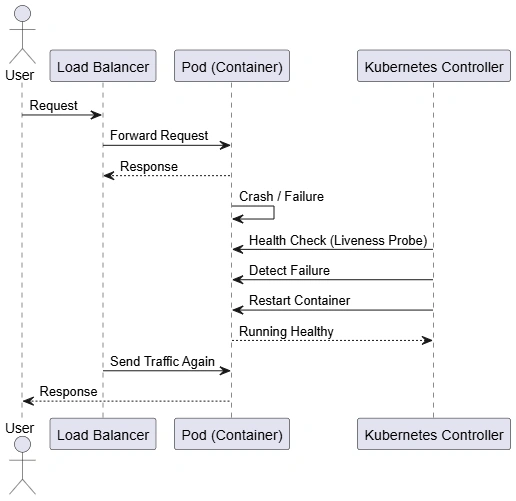
This sequence diagram shows how a request flows through the system and how failure is handled. Initially, the user request is routed through a load balancer to a running container. If the container crashes, Kubernetes detects the failure using health checks. Once the failure is detected, Kubernetes automatically restarts the container. After recovery, the container resumes handling requests without manual intervention. This continuous monitoring and corrective loop ensures high availability.

Seq
  • User Request: Initiates interaction with the application

  • Load Balancer Routing: Distributes traffic to containers

  • Container Failure: Simulates crash or unresponsiveness

  • Health Check Trigger: Kubernetes probes container health

  • Failure Detection: System identifies unhealthy state

  • Automatic Restart: Container is restarted instantly

  • Traffic Resumption: Application continues serving requests

Component Diagram

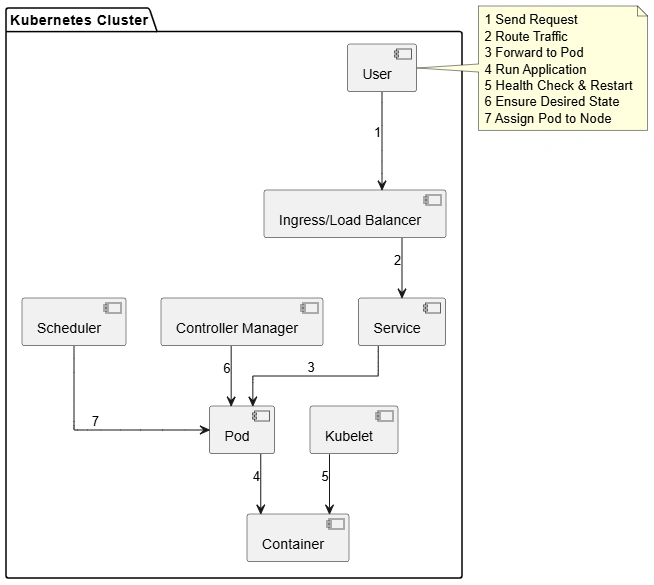
This component diagram represents the architecture involved in self-healing. The user interacts with the system through an ingress or load balancer, which routes traffic to services and pods. Pods host containers that run the application. The Kubelet monitors container health and communicates with the control plane. The Controller Manager ensures the desired number of pods is always maintained, while the Scheduler assigns pods to nodes. Together, these components form a feedback loop that detects failures and automatically restores the system.

comp
  1. Ingress/Load Balancer: Entry point for external traffic.

  2. Service: Routes traffic to appropriate pods.

  3. Pod: Logical unit containing containers.

  4. Container: Runs the actual application.

  5. Kubelet: Monitors container health and restarts if needed.

  6. Controller Manager: Maintains desired state (replicas).

  7. Scheduler: Assigns pods to available nodes.

Advantages

  1. High Availability: Applications remain accessible even during failures.

  2. Reduced Downtime: Automatic recovery minimizes interruptions..

  3. Automation: No manual intervention required.

  4. Scalability: Works seamlessly with dynamic scaling.

  5. Fault Tolerance: Handles both container and node failures.

  6. Operational Efficiency: Reduces DevOps workload.

Summary

The self-healing mechanism in container orchestration platforms like Kubernetes is a critical feature for building resilient and reliable applications. By continuously monitoring system health and automatically correcting failures, it ensures that applications remain available without manual intervention. Using constructs like Deployments, health probes, and controllers, Kubernetes maintains the desired state and recovers from unexpected issues efficiently. This capability is essential for modern cloud-native systems where uptime, scalability, and automation are key priorities.