

🚀 Introduction
Crypto has evolved far beyond simple “buy and hold.” Today, capital efficiency is everything. Every dollar wants to work harder, earn more, and stay flexible.
That’s exactly where liquid staking comes in.
At first glance, it sounds like magic. You stake your assets, earn rewards, and still use them elsewhere. But behind that simplicity lies a powerful financial primitive that is reshaping decentralized finance and, at the same time, introducing new layers of systemic risk.
If you’re building in Web3, investing in crypto, or designing token economies, this is not optional knowledge. This is core infrastructure.
🔍 What is Liquid Staking?
Liquid staking allows users to stake their crypto assets while maintaining liquidity through a derivative token.
Traditionally, staking works like this:
You lock your tokens
You earn rewards
You lose access to your funds during the lock period
With liquid staking:
You stake your tokens
You receive a liquid representation token
That token can be traded, lent, or used across DeFi
For example, when you stake Ethereum using Lido:
You deposit ETH
You receive stETH
Your ETH continues earning staking rewards
Your stETH can be used anywhere in DeFi
This simple shift unlocks an entirely new layer of financial flexibility.
⚙️ How Liquid Staking Works
Here’s the flow in simple terms:
You deposit tokens into a liquid staking protocol
The protocol stakes those tokens with validators
You receive a derivative token representing your staked position
Rewards are either reflected in token value or accrued over time
These derivative tokens become building blocks across DeFi.
💡 Why Liquid Staking Matters
1. Capital Efficiency
Your assets are no longer idle. They generate yield while still being usable elsewhere.
2. Composability
Liquid staking tokens can plug into lending protocols, yield farming strategies, and collateral systems. This composability is what makes DeFi powerful.
3. Accessibility
You don’t need to run validators or manage infrastructure. Platforms abstract that complexity.
🌐 Popular Liquid Staking Platforms
Some of the major players include:
Lido → stETH
Rocket Pool → rETH
Coinbase → cbETH
Binance → BETH
Each platform differs in decentralization, fee structure, and risk profile.
⚖️ Liquid Staking vs Traditional Staking
| Feature | Traditional Staking | Liquid Staking |
|---|---|---|
| Liquidity | Locked | Tradable |
| Rewards | Yes | Yes |
| DeFi Usage | No | Yes |
| Complexity | Low | Medium to High |
| Risk | Moderate | Higher |
⚠️ Risks You Cannot Ignore
This is where things get real. Liquid staking is powerful, but it introduces systemic risk layers.
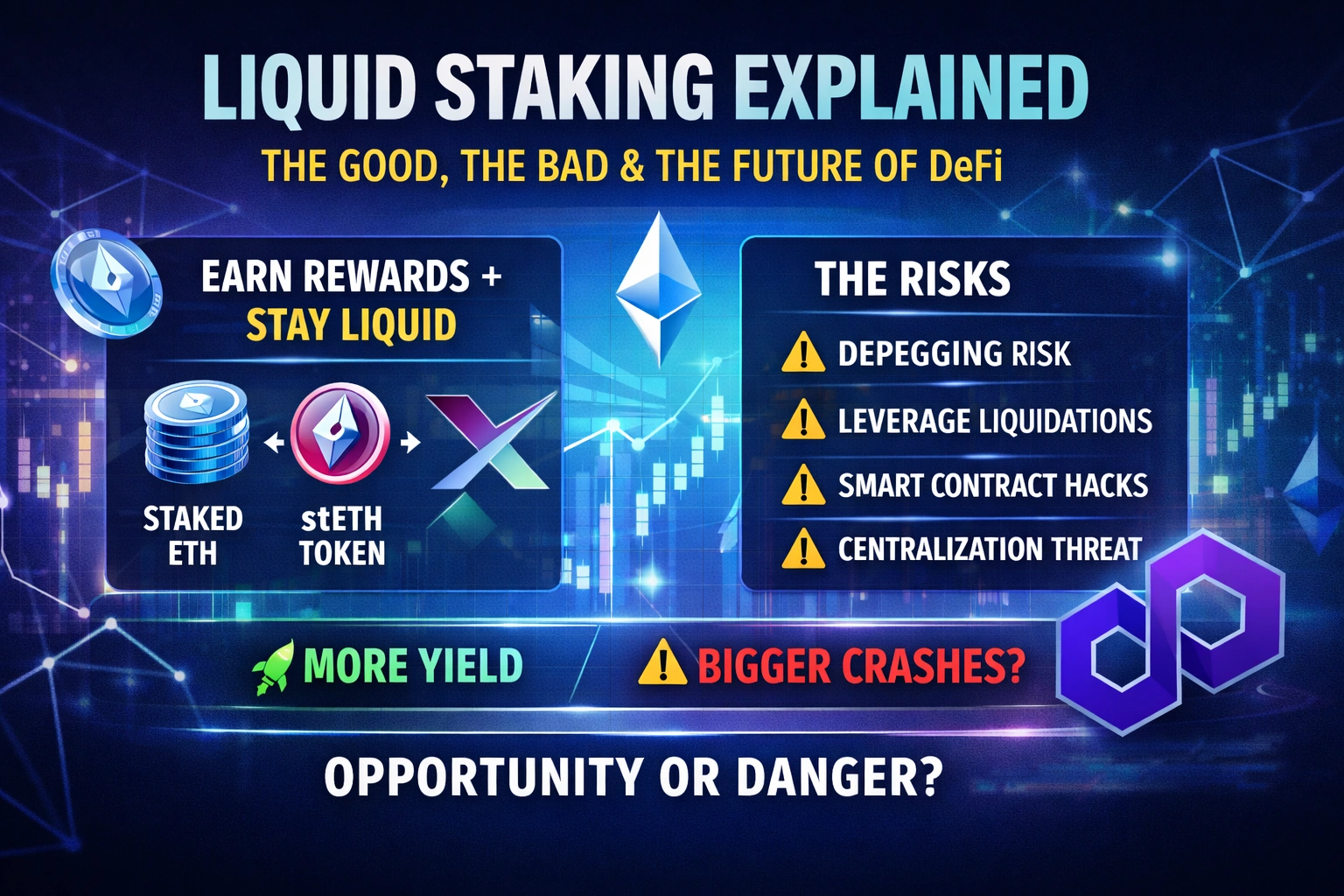
🔻 1. Depegging Risk
Liquid tokens like stETH can trade below ETH during stress. This happened during the 2022 market downturn when liquidity dried up and panic selling began.
🔻 2. Smart Contract Risk
These protocols rely on complex smart contracts. Any vulnerability can lead to loss of funds.
🔻 3. Leverage and Cascading Liquidations
Users often use liquid staking tokens as collateral, borrow against them, and reinvest for higher yield. When the market drops, collateral value falls, positions get liquidated, and forced selling accelerates the crash.
🔻 4. Centralization Risk
Protocols like Lido control a significant share of staked assets. That concentration introduces governance and systemic risks.
📉 Does Liquid Staking Make Market Crashes Worse?
The honest answer is yes, it can.
Not because it’s inherently flawed, but because it adds leverage layers, creates liquidity mismatches, and connects multiple protocols together.
In a bull market, this creates explosive growth. In a bear market, it creates cascading failures.
This is similar to traditional finance. More leverage leads to higher returns but also deeper crashes.
🔮 The Future: Liquid Staking and Beyond
Liquid staking is evolving fast.
The next wave is restaking, where staked assets are reused to secure multiple protocols simultaneously. This trend is being pushed by ecosystems like EigenLayer.
What this means:
More yield opportunities
More composability
More complexity and systemic exposure
🏗️ What Builders and Founders Should Think About
If you’re designing a token ecosystem, DeFi product, or platform, focus on risk management over hype, avoid excessive leverage loops, design stable peg mechanisms, and incentivize long-term holding.
Liquid staking should be treated as infrastructure, not just a yield feature.
🧾 Best Use Cases
Liquid staking makes the most sense for long-term crypto holders who want passive yield, DeFi users seeking capital efficiency, protocols building composable financial layers, and token ecosystems integrating staking rewards.
🧠 Final Thoughts
Liquid staking represents a major shift in how capital works in crypto.
It removes one of the biggest limitations of staking, which is illiquidity. But in doing so, it introduces a new challenge, systemic complexity.
Used wisely, it can unlock massive value. Used carelessly, it can amplify market instability.
The opportunity is not just in using liquid staking. It’s in building systems that make it safer, more resilient, and more sustainable.
If you're building in AI, Web3, or tokenization and want to design staking or yield systems the right way, this is exactly where strategic thinking matters.
Join the conversation! Your thoughts help the community grow.