
A list is an ordered collection of related values and is equivalent to a Linked List data structure used in many other Languages. F# lists are a simple collection type that is built into F#. F# provides the module Microsoft.Fsharp.Collections.List for common operations on Lists. This module is imported automatically by F#, so the List module is already accessible from every F# application.
F# lists are used in functional programming. Lists play an important role in Functional Programming. In functional programming (F#) lists are actually a linked list of the singly linked list variety. Lists can only contain members of the same type; you have the ability to create a list of an object type. Lists are a built-in data structure that is basically a concatenation of the Head and Tail. The head is the First element and the Tail is the remainder of the List.
An F# list can be an Empty List, a List with a value concatenated to it. A value can be concatenated to the front of a F# list using a built-in operator that consists of two colons (::), pronounced "cons". The following table showing a List being defined starting with an empty List on the First Row.
List related Language Constructs and Operators
| Expressions/Operator | Description | Example |
| [] | Showing an Empty List | [] |
| expr ::expr | " cons" an element with a List | 2 :: [3;4] |
| [expr;...;expr] | A List value | [3 ; 4 ; 5] |
| [expr .. expr] | A range of Integers | [1 .. 99] |
| [for Y in List -> expr] | A generated List | [for Y in 1 .. 99 -> Y * Y] |
| expr @ expr | Concatenates two Lists | [3 ; 4] @ 2 |
Empty List
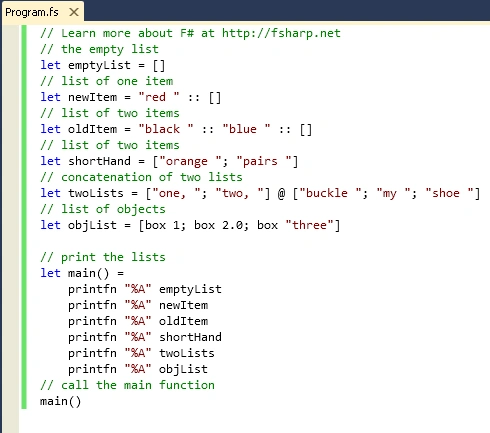
The very simplest List you can create or use is an Empty List, represented by empty square brackets.
let emptyList = []
// the empty list, head = tail = []
// By Default, the empty list is of type 'T
// If it contains an element, the list is of a fixed type
" cons"
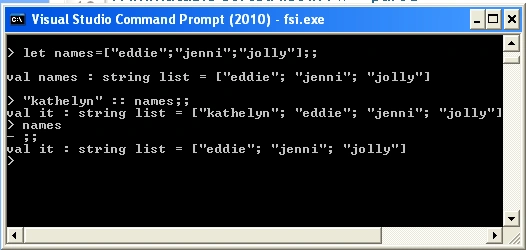
If you want to add an Element to the head or start of a list, you use the right associative cons operator(::). The List in which you want to add an element to can be empty or non empty.
//example "cons"
let list0 = []
let list1 = "colors" :: []
let list2 = "red" :: list1
let list3 = "blue" :: list2
let list4 = "black" :: "olive" :: "pink" :: []
Fixed value List
If you want to create a List that contains elements, then individual elements can be enumerated by a separate semicolon like below.
let names = ["angle"; "jhon"; "denni"]
// list with 3 string elements (head = angle, tail = denni)
concatenated List
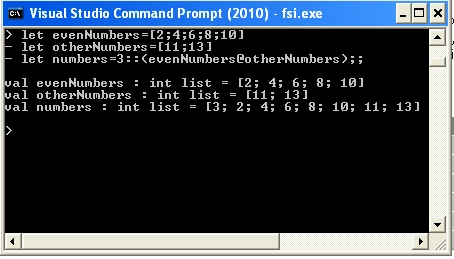
A new List can be built by two existing Lists by using @ operator to concatenate them together. You can concatenate like below.
let evenNumbers=[2;4;6;8;10] //separate List 1
let otherNumbers=[11;13] // Separate List 2
let numbers=3::(evenNumbers @ otherNumbers);; //concatenated List From 1 and 2
Ranges
Ranges can be defined in a list as in the following form:
[start_element..step..end_element]
Where start_element is the first element in the List step (it is optioanl) and it is a "Count By" parameter and the end element is the last value. Both Start and End elements will always display in the List that F# constructs, because both are inclusive elements.
// Ranges In List
let digits = [2..20]
let alphabet = ['D'..'S']
let mul3 = [4..4..132]
let evens = [0..2..28]
Generators
Another form of List comprehension used extensively in functional programming is Generators. Generators can be defined in the following form.
[for <identifier> in collection -> expr] or
[for <identifier> in collection do ... yield expr]
Rohatash KumarPosted Jul 14, 2011, 7:58 AM
Good Work. Keep it up