

Abstract
This study examines LLM agent orchestration by evaluating four architectural approaches: decentralized, centralized, specialized, and hybrid. With the shift from traditional large language models (LLMs) to a more sophisticated multi-agent system, it is important to reevaluate the role of autonomous AI models. This research will use agent coordination as its theoretical framework, particularly interaction protocols and context management models, to ensure a clear understanding of the topic under study. An examination of our study shows that using an optimal pattern reduces work completion time by 30-45%, minimizes semantic errors /token cost by 25-80%, and enhances system trust. We also designed and tested deployment modal tools (LangChain, AutoGen, and CrewAI), which yielded a 130% increase in ROI in orchestration patterns within 5 months of implementation. Therefore, this study will be important for understanding the development of multi-system agents.
Introduction
Existing research in multi-agent systems indicates that the model will be highly useful in the near future. This argument is supported by the observation that AI agents will collaborate to solve complex problems in the workplace. Additionally, recent data indicate that AI tools such as ChatGPT and Claude have advanced rapidly toward a single LLM in 2025. The affordances of these tools will not only create more opportunities in the workplace but also introduce new challenges that will require input from human and traditional shared-system models.
Although traditional system models have been helpful in workplace production by creating models that adhere to deterministic protocols, they are unable to perform the task of a developed LLM agent, which combines unpredictable models. For instance, in the workplace, financial analysts and customer service representatives can make miscalculations or get distracted. These mistakes, which can be referred to as semantic shortfalls, may be unnoticed by traditional models but are easily detected in orchestration models.
To avoid these situations from getting worse, especially when multi-agent models are used to implement important tasks, we will evaluate the following research question: (1) How does a group of agents collaboratively function together to quantify difficult financial datasets in the workplace? (2) How can we further prevent the agent from having miscalculations when collaborating in the workplace? (3) How can we introduce token use and still store trusted shared agent systems?
Finding answers to the research questions above enables us to evaluate architectural patterns to be applied in the creation of quality LLM agents. The solution also helps us to ensure that we select the accurate frameworks that fit the features of LLM, and not just a random or conventional shared system pattern.
Hence, we proceeded to the creation of a four-category taxonomy model: centralised, decentralised, hybrid, and specialized. These models were selected after a thorough examination of LLM agents' orchestration models, built basically for the review of production implementation models. These processes helped us design a theoretical lens on how to choose the patterns based on the shortfalls of operations, and how trustworthy they are.
Remarkably, our study will provide three major contributions to the field of multi-agent systems: (a) a detailed lens of the strengths and weaknesses, and a proper theoretical approach to the study of orchestration design models. (b) a practical illustration of how modern LLM orchestration tools can be used to bring ideas into reality in the workplace. (c) We proved that using an accurate design pattern leads to an increase in revenue or output in the workplace. For instance, projection deployment time and semantic miscalculations can be reduced to 30-45% and 65-85%. Also, ROI can be 130% even in 5 months of production deployment. The theoretical approach and principles we discovered will assist with faster production implementation and provide clear patterns on how multi-agent LLM can become more effective in the workplace.
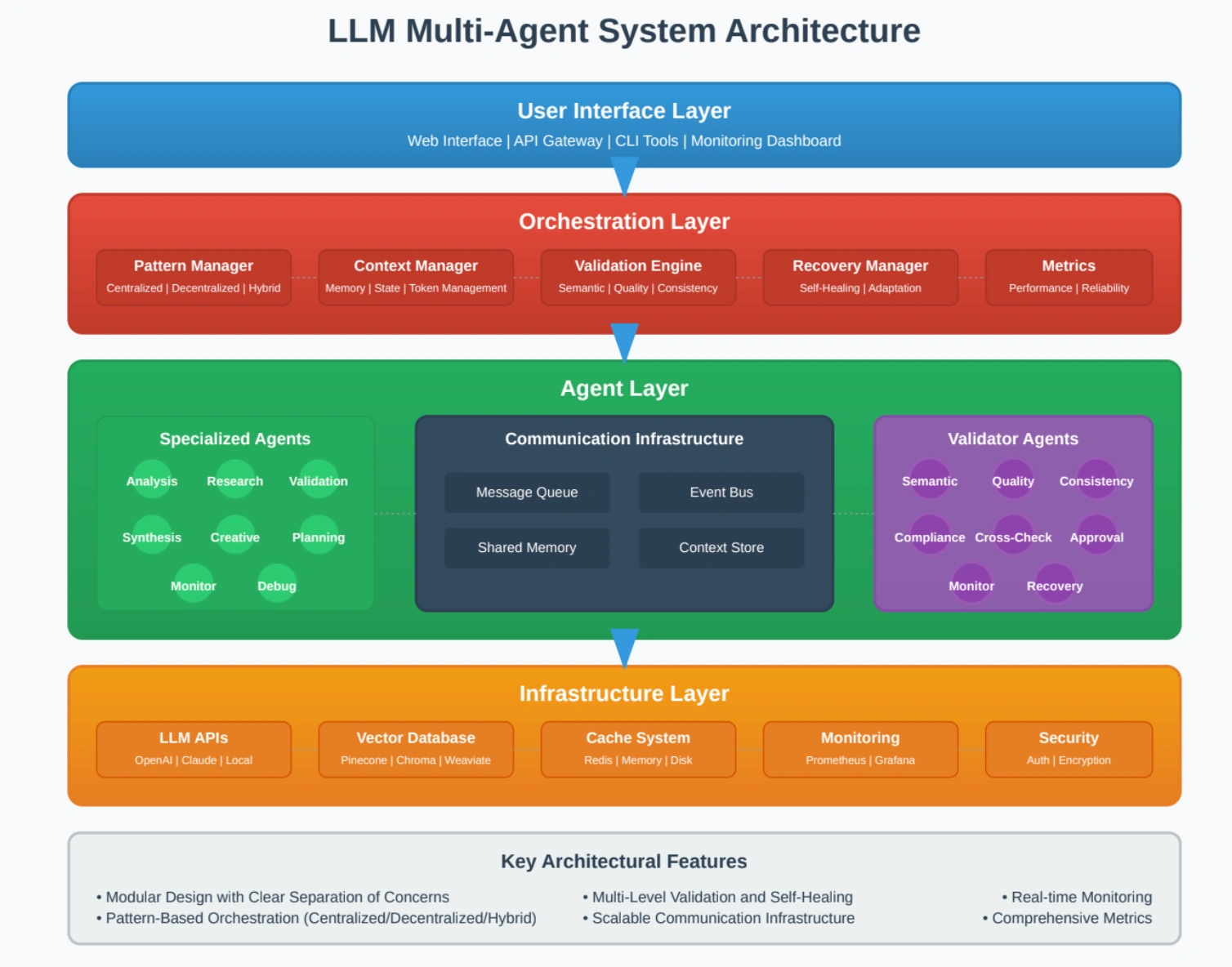
Figure 1: Overview of LLM multi-agent system architecture showing the relationship between different orchestration patterns and system components.
2. Theoretical framing: agent orchestration pattern
In this section, we will begin with an explanation of the reasons LLM multi-agent systems are different from traditional distributed models. We will proceed to an evaluation of key orchestration patterns applied in this study. This is important because LLM agents are different from other forms of agents. Hence, they require a different theoretical lens.
2.1 Semantic coordination shortfalls
All traditional distributed agents use the same interfaces and protocols, which makes them function similarly. An example is the collaboration between A, B, C, and D components, where A sends a message from component B to C. Component C interprets the information using stipulated rules, after which the feedback is sent to component D. This process is more difficult when handled by LLM agents
Contextual drift in multi-agent interaction: Agents interacting in ordinary language during collaboration may lead to multiple interpretations with time and make coordination very difficult. An instance is when agent A interprets information differently from agent B. If such a mismatch in semantic drifts is not noticed on time, it causes output error, but in a traditional model, it simply creates errors.
Behaviour complexity emerging: when agents collaborate during the deployment phase, the output reduces in a linear process. Having spent months studying these differences, we realized that the pattern remains the same because particular agents are capable of creating similar feedback when working together, and still show undetected errors that a single agent failed to predict during production. The architectural system that allows creative collaboration between these models is also affected as these errors build up. This conflict is heightened the more these faults keep expanding unaided. Our previous finding shows that the interaction between the models may be better handled as a group than as a single agent.
Interaction protocol semantic loss: protocol theory prediction encounters minimized isolation issues when compared to agent communication. During our study, we documented these differences, like when we discovered how a financial analyst's agents' output was reduced by 30-40% because it suddenly changed to a protocol-appropriate format. We saw this change as an important decision detail in our study. Also, we realized that this also affects risk assessment agents who apply the incomplete data from the agents in making decisions. Interestingly, these failed data, being systematic ones, affect human experts who depend on such models to make decisions in the workplace. We concluded by suggesting that these semantic shortfalls are not caused by deployment faults that can be easily fixed, but by a shortfall in recent interaction architectures.
2.2 Making the Most of Resources in Agent Networks
Our study of LLM multi-agent models reveals that resource optimization problems are not seen in regular shared systems.
Scaling Token Consumption: We realised that the level of computation escalated based on the task scale, especially in traditional models. Also, LLM agents use tokens based on how people interact, or how difficult the information is, and how unique the interpretation of the interaction is. For instance, a coordination input that may appear very easy may require deeper information to keep its interpretation.
Context window fragmentation: When agents share data sets, context windows are shared between them, and each agent keeps a share of the information. Such a distribution can lead to semantic inconsistency and involves an advanced context management approach.
Computational redundancy: computational redundancy, rather than optimization, can occur when multiple agents solve similar units of the problem individually.
2.3 Dependability and recovery from failure
LLM multi-agent systems work better than the ratio at which things malfunction. This shows a high level of reliability.
Semantic failure propagation: when an agent encounters a semantic error, such as system exaggeration, a loss of context, or a failure in reasoning, that error can expand through simple language communications in a manner that traditional error detection cannot discover. It is possible to convey unverified data to other agents, which would end up ruining the processing of the entire model.
Mechanisms for cascade failure: A service error can result in a failure of another system service in a traditional cascade failure. Also, semantic cascade failures can be distributed through channels of reasoning that seem compatible with every agent, while building on the malfunctioned premises of a previous agent.
Recovery state complexity: It can be very difficult to discover the appropriate recovery state when something malfunctions. A key question that may arise could be: should each agent be rebuilt, or should all of the interaction history be retrained? How do we identify which information is faulty and which is accurate?
3. Types of LLM agent orchestration patterns
Based on close observation of different production deployment models, we noticed four recurrent types of LLM agent orchestration patterns. We also studied how each model handles the coordination and management of agent activities.
3.1 Patterns for centralised orchestration
A single coordinating agent controls the entire orchestration process when centralized patterns are applied. This method can be likened to a traditional master-slave architecture, but it is converted to be compatible with the semantic coordination needs of LLM agents.
Controller-agent pattern: The main controller agent organises the whole workflow, divides hard tasks into smaller units, assigns work to efficient agents, and codifies the final output. The controller ensures that all the communications of the agent are meaningful and monitors the larger picture.
Mathematical framework: The controller-agent pattern could be viewed as an optimization problem because the controller's goal is to minimize implementation ahead and also advance the output of task execution:
min[α ⋅ CoordinationCost + β ⋅ SemanticDrift + γ ⋅ CompletionTime]
where α, β, and γ are weighting factors that have been modified to suit specific situations.
Best use cases: this is when the agent is fully capable of coordinating specialized expertise, such as drafting a research report, performing a multi-step financial evaluation, or analyzing code in detail.
Hierarchical task decomposition : Tasks are arranged in the form of a tree. The parent agents divide these tasks into smaller units for child agents. Every level collects its own semantic boundaries and works closely with partner levels.
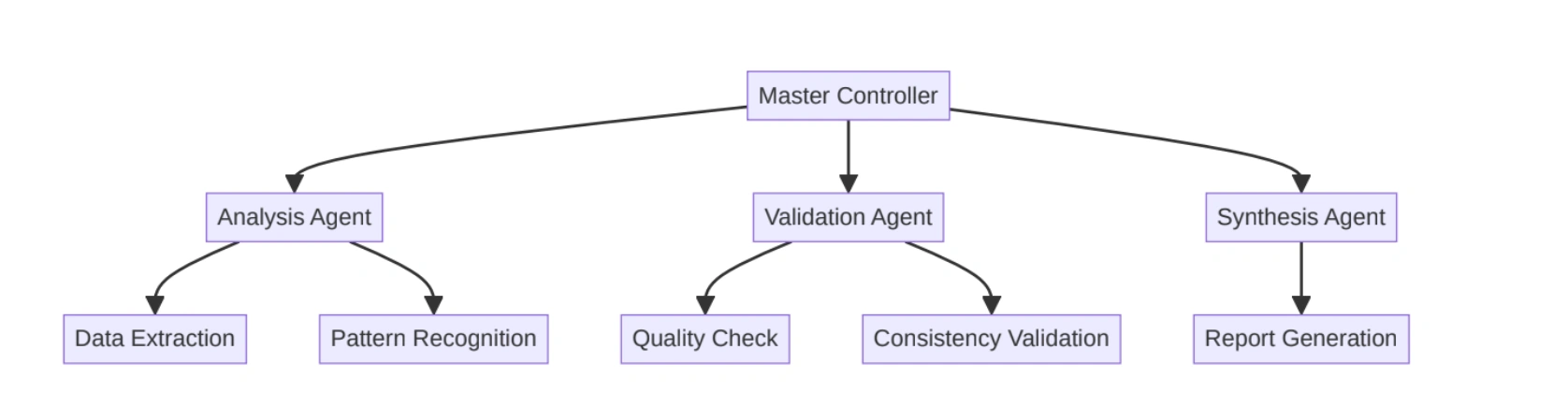
Pipeline processing: We arranged agents in a linear formation and made the outcome of each agent the input of the next agent. This pattern was productive in changing heavy workflows but requires a structured interface design to function fully without semantic faults.
Advantages : We discovered that a clear structure and centralized failure management are some known advantages.
Limitations : we realized that a single point of failure, effective agent tightening, and reduced scale for huge tasks are core limitations.
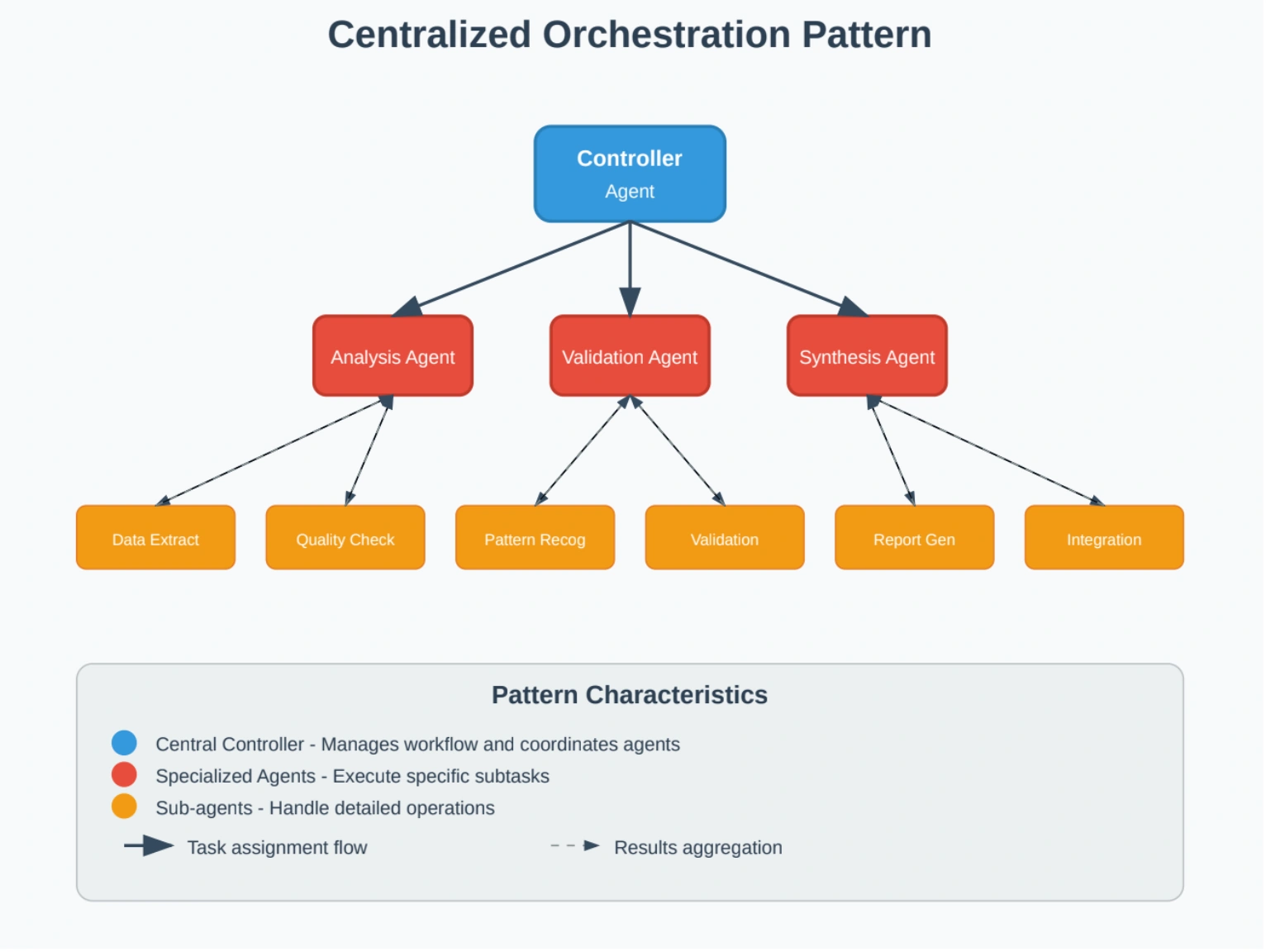
Figure 2: Centralized orchestration pattern showing a single controller agent coordinating multiple specialized agents in a hierarchical structure.
3.2 Decentralised orchestration patterns
We chose the decentralized method as the best in removing full control because it enables the paired models to function easily and develop interaction protocols.
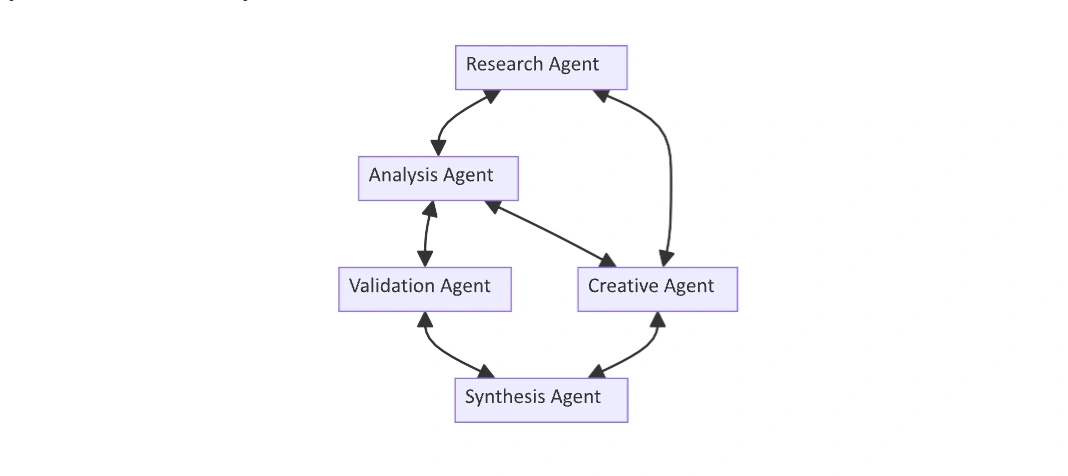
Swarm intelligence: We created agents that are able to work collaboratively, share information without any form of hierarchy.
Mathematical structure : We define a bounded, dimensionless coordination efficiency metric that avoids unit mismatches and division by zero:

Explanation of metric keywords:
Information flow (BITS): we computed the data collected by an agent based on the available information provided in window W and added some connecting details. An instance of how we did this is by making Mi to represent the inputs (messages) to the receiving agent named i, and Oi the selected variable output. Then Information Flow i = I ( Oi ; Mi ) , is further estimated with neural MI estimators. The standard score is I ^ i = I ( Oi ; Mi )/ I max ∈ [0, 1], where I max is the maximum MI noticed in window W. Additionally, when directional attribution from a specific pair is required, we use transfer entropy TX → Y as information to measure time and asymmetric data transfer.
Network diameter (hops/weight): creating a theoretical graph diameter of the agent interaction pattern under study in window W is important in discovering details like the largest or shortest distance between two agents. The regularized form is D ^ = D / D max ∈ [0, 1], where D max is the highest feasible diameter, and a Smaller D ^ shows tighter coordination.
Semantic drift (unitless in 0,1):
the minimum semantic divergence of produced results from the task's intended semantics over window W. Let r be a work reference indication and yt agent output (text) in the workplace. Drift is represented as [\text{Semantic Drift}=\frac{1}{n}\sum_{t=1}^{n}\bigl(1-\operatorname{sim}(y_t, r)\bigr),] where sim is either cosine similarity between Sentence-Transformer embeddings or BERTScore-F1 between yt and reference(s). In the metric above, higher drift lowers 1 − Semantic Drift.
Committee Voting Systems : We organized agents into units that enable easy decision-making in voting models. Single agents create a trusted evaluation, by which the system computes results based on aggregation algorithms.
Blockchain Consensus : by accepting blockchain consensus models in the computation of agent coordination, byzantine error tolerance and decentralized control are produced.
Advantages : gives space for an increase in the level of error tolerance, handles simple parallelism, trusted decision making, and problem-solving potential.
Limitations : Complex debugging, unpredictable performance characteristics, and potential for emergent undesirable behaviors.
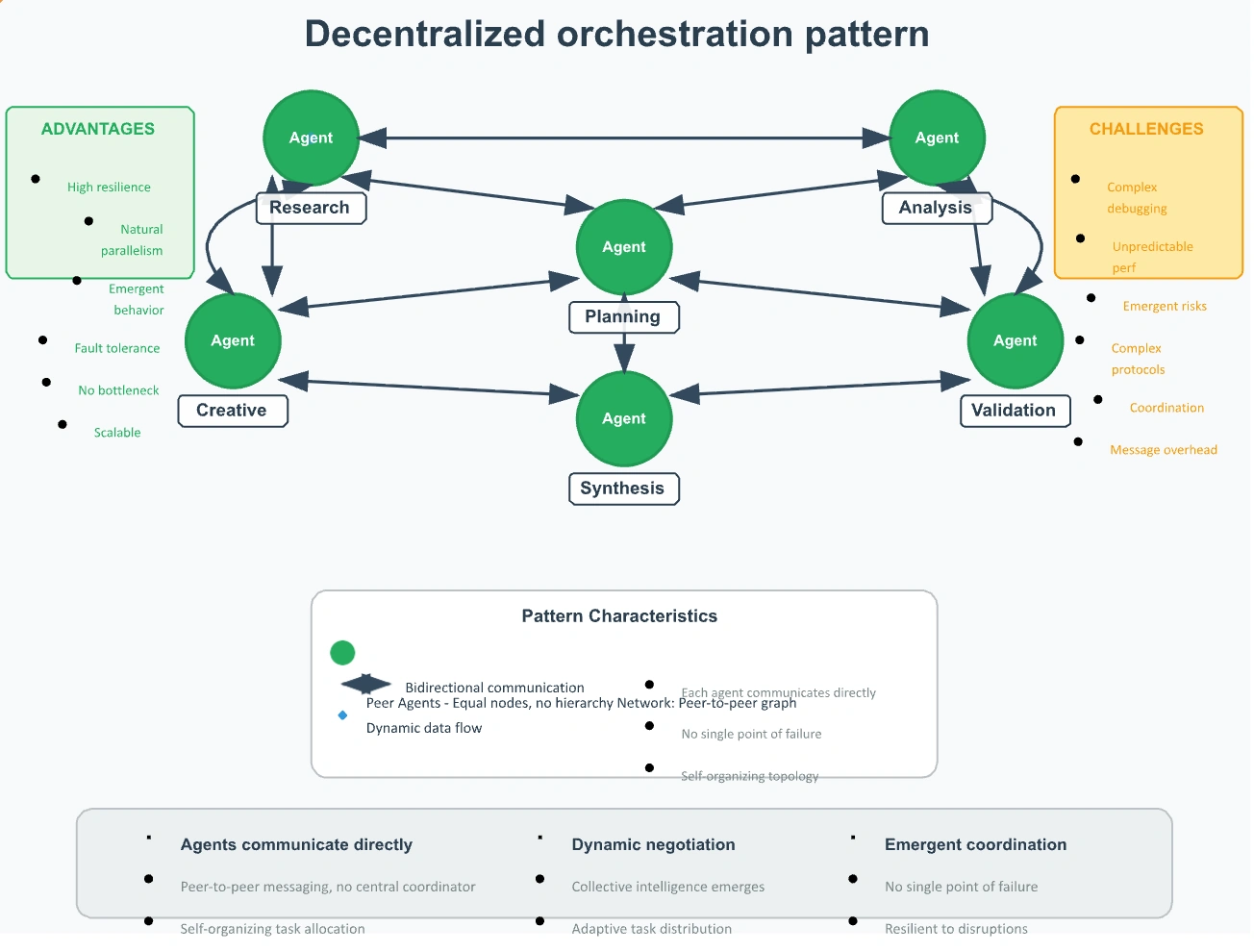
Figure 3: Decentralized orchestration pattern demonstrating peer-to-agent communication and emergent coordination without central control.
3.3 Hybrid Orchestration Patterns
These merge elements of centralized and decentralized approaches to balance control and flexibility.
Blackboard Systems:
When agents collaborate with Blackboard, they can send information together and enhance each other's tasks. Also, this pattern accepts easy collaborations and manages computation visibility.
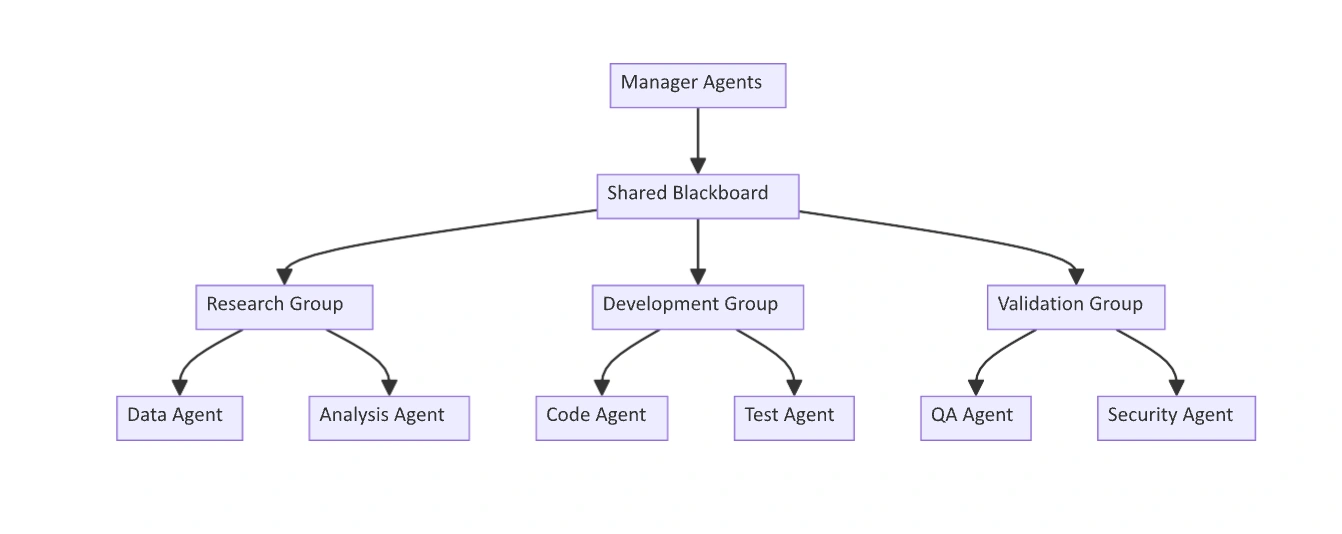
Implementation Framework:
   Blackboard State = {
Shared Knowledge: {facts, hypotheses, intermediate_results},
Active Requests: {open_questions, clarification_needs},
Agent Status: {availability, expertise_areas, current_tasks}
}
Role-based delegation: This is when particular tasks and responsibilities are assigned to agents. This allows for the system to combine an organized workflow and autonomous agents.
Auction-based task distribution: the model shares tasks based on bidding. When agents are fully developed and capable of bidding on their own, the system creates an optimization model that merges similar models equally.
Advantages : Ensures equal distribution, utilization of optimized outputs in the workplace, and the ability for agents to easily carry out different tasks.
Limitations : leads to more architectural problems, requires an organized task, and an interaction protocol model.
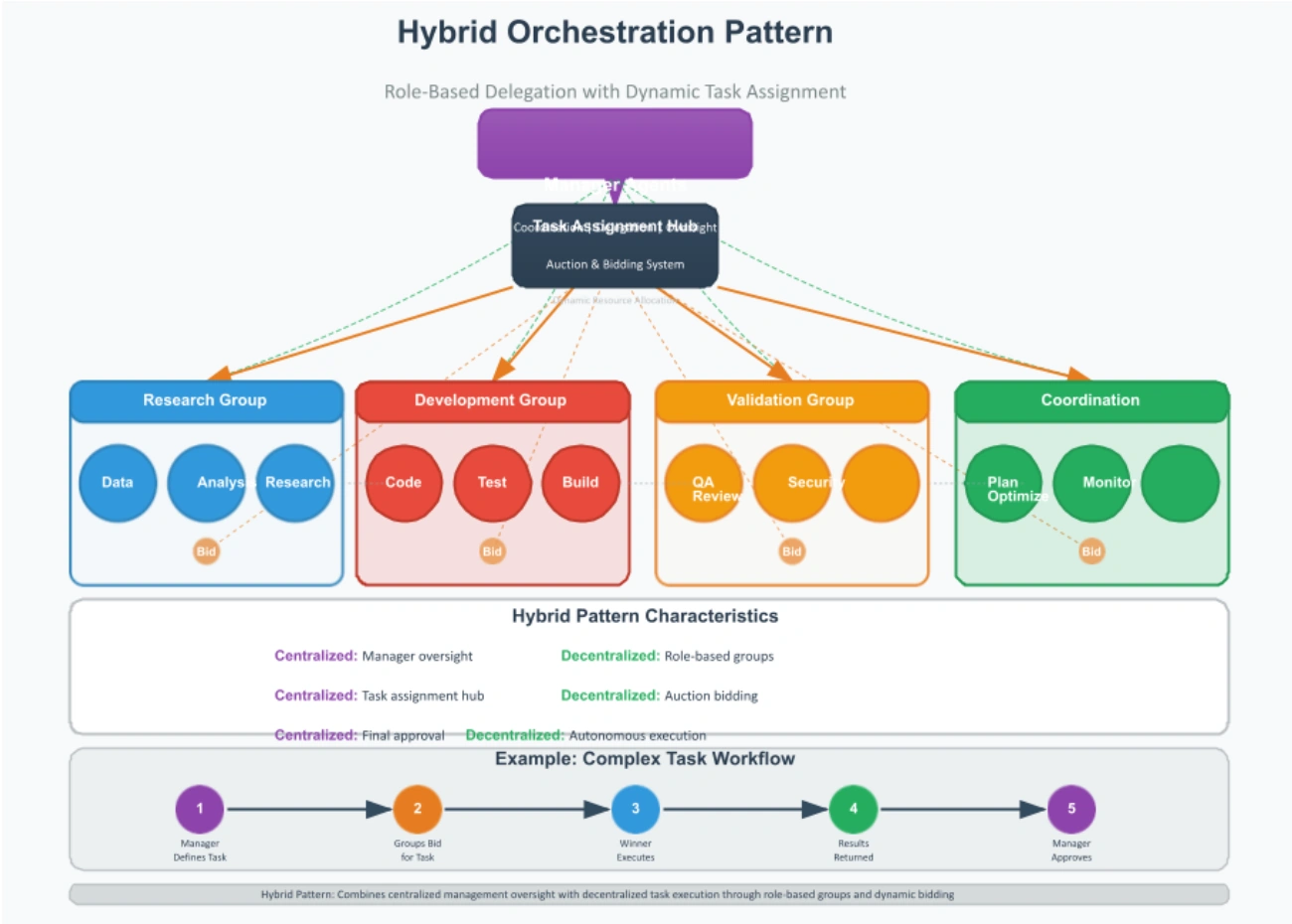
Figure 4: Hybrid orchestration pattern combining centralized management with decentralized agent collaboration through shared knowledge spaces.
3.4 Specialized orchestration patterns
Unique patterns are optimized for particular use cases and include domain-specific optimizations.
Reinforcement learning orchestration: Learning interaction patterns depends on the performance outcome since the system adapts to optimal coordination models by reinforcement waves.
Human-in-the-loop systems: important decisions demand human validation, with agents controlling preliminary evaluation and humans giving final approval for elevated-stakes decisions.
Federated learning coordination: Agents interact and store data privacy by applying federated learning protocols, allowing collective intelligence without sharing sensitive information.
Advantages: Domain-optimised performance and compliance with unique operational constraints
Limitations: some of the limitations are complex implementation demands and extra-specialisation.
4. Reliability strategies and error recovery
A developed approach is needed to ensure the quality operation of multi-agent LLM models that handle traditional shared systems problems and semantic failure nodes.
4.1 Semantic error detection and validation
The use of traditional failure detection centers on system failure and network failures. LLM multi-agent systems demand extra layers of semantic verification.
Semantic consistency monitoring : unique validator agents rapidly confirm that agent results stay consistent with original rules and established constraints. These monitors detect semantic drift and reasoning failures that traditional monitoring fails to identify.
Mathematical framework : Vector similarity measures can be applied to quantify the semantic consistency:

Let reference representations capture desired semantic features,
Reference representations (r),
Construction : A piece of reference vector is computed by a normalized, measured average of component embeddings that encode (a) the original system prompt I, (b) clear acceptance constraints C, and (c) one or more canonical gold outputs Rk . Let e ^( x ) = e ( x )/∥ e ( x )∥2 be L2-normalized Sentence-Transformer embeddings and choose non-negative weights wI , wC , wk with.
wI + wC + ∑ K wk = 1. Then [ r = \frac{\,w_I\,\hat e(I)\; +\; w_C\,\hat e(C)\; +\; \sum_{k=1}^{K} w_k\,\hat e(R_k)\,}{\Big\lVert\,w_I\,\hat
e(I)\; +\; w_C\,\hat e(C)\; +\; \sum_{k=1}^{K} w_k\,\hat e(R_k)\,\Big\rVert_2}. ] If only gold references are available, set wI = wC = 0 and share the weights over Rk (e.g., uniformly, wk = 1/ K . For reference, set the corresponding weight to 1.
Measurement prompt:
If Semantic Consistency is implemented by the similarity sim ( yt , r ), let Semantic Drift = 1 − Semantic Consistency over a similar window and performance.
For direct information between agents over time, transfer entropy TX → Y = I ( Yt ; Xt −1: t − L ∣ Yt −1: t − L ) creates a principled framework to mutual information.
Multi-Level validation architecture: intra-agent, inter-agent, and system-level are the three primary levels where validation occurs.
Context preservation during validation: validation steps must store quality context and discover faulty parts, which demands advanced state isolation and recovery models.
4. 2 Automated recovery mechanisms
We discovered that when semantic errors are found, recovery methods must handle the fault immediately and prevent cascade effects. Semantic reset protocols: Instead of just restarting agents, semantic reset protocols restart agents to better states and store approved information /learned patterns. Dynamic prompt refinement: Recovery includes refinement of agent instruction depending on discovered failure patterns, and strengthening guardrails against the same future failures. Agent isolation and rerouting: faulty agents can be isolated, and effective agents can take over their responsibilities and maintain system operation during recovery.
4.3 Context management and memory strategies
Proper context management stops the semantic fragmentation that can disorganize multi-agent systems.
Hierarchical context summarization : relevant information is moved to higher memory systems, and detailed context is compressed, stopping the total loss of data because of context window limitations.
Cross-agent context synchronization: Models ensure that agents keep rapid interpretations of shared information and stop semantic divergence.
Context quarantine systems : Corrupted context is isolated to prevent contamination of healthy agents and store recoverable information.
5. Performance analysis and empirical results
The relevance of different orchestration patterns is shown in a comprehensive empirical analysis in production deployments of financial services and software development domains.
5.1 Quantitative performance metrics
Disclosure on reported metrics: Some aggregate data in this section shows internal analysis done under non-disclosure agreements. We documented numeric outputs (ROI) and organized datasets. We realized texted protocols should not be publicly shared because this data should be analyzed directionally and may not generalize in domains or the deployment phase.
Our benchmarks show improvement in core performance, which indicates that optimal orchestration patterns are used in appropriate cases.
Task completion efficiency: Complex multi-step tasks show a 30-45% decrease in completion time when orchestrated using models optimized for their particular features. Centralised patterns excel in workflows, and decentralized models outperform creative tasks.
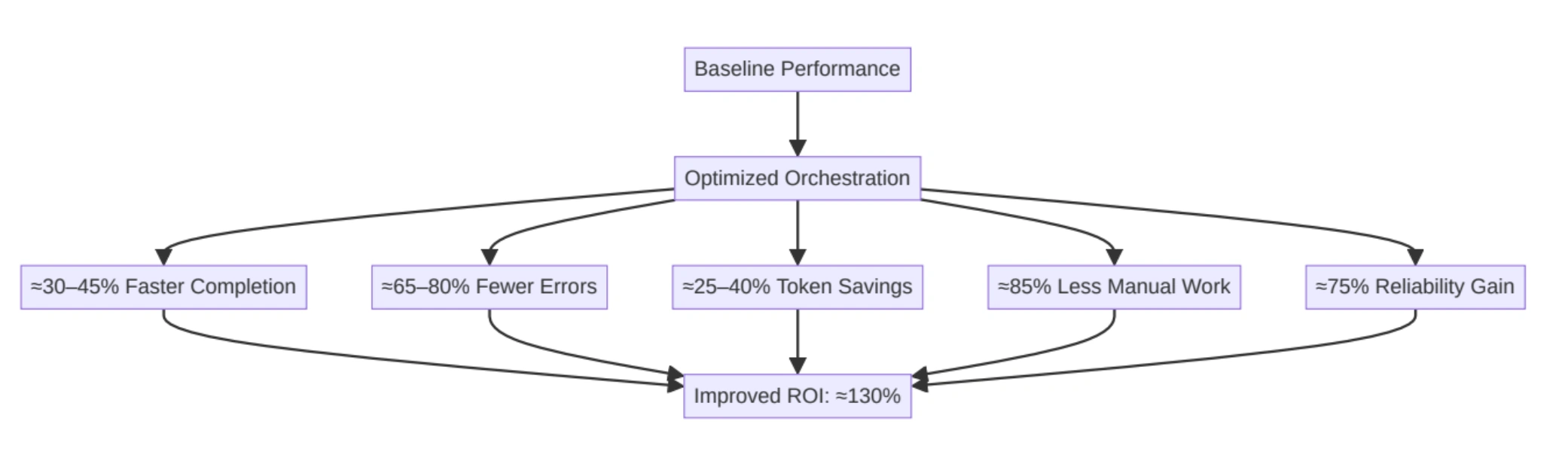
Semantic error reduction: organised approval and recovery techniques decrease the semantic failure scale by 65-80% compared to multi-agent deployments. The development is shown in domains that require increased factual accuracy.
Token consumption optimization: the outstanding context handling and output caching decrease token consumption by 25-405, and improve result quality. This directly leads to decreased operational costs.
Human intervention requirements: the automated Validation decreases human input requirements by 80-90%, allowing autonomous task execution in additional time and stores quality standards.
Reliability gain : developing system trust yields substantial business revenue. Our observation shows a 75% increase in trusted system metrics, including decreased incident rates and advanced consistency in result quality. This process directly converts into cost savings by reducing business disruption and increasing customer satisfaction.
5.2 Case study: financial information evaluation
A validation surfaces from the financial services industry using optimized orchestration designs in its document evaluation system. This implementation provides evidence of pattern effectiveness in a higher-scale workspace.
Pre-implementation challenges: The business required manual evaluation of 32% of evaluated files, with an average processing time of 18 minutes per document. This necessitated operational bottlenecks and reduced customer organisation.
Optimised architecture : we introduced a hybrid role-based delegation framework with six unique agent models: data extraction, anomaly checking, compliance detection, quality validation, report creation, and human oversight coordination.
Results: manual evaluation demands dropped to 70% of documents, with the average processing time decreased to 4 minutes. After 5 months of completion, the system gained 280% ROI.
Key success factors: there is a clear difference in role between agents, multi-level validation using unique validators, and continuous feedback from failed pattern evaluation.
ROI calculation methodology for a financial document analysis case study
We applied a comprehensive ROI calculation approach designed for LLM orchestration deployments, quantitative metrics and confidence intervals.
Mathematical framework
We justified the ROI based on a model designed to be responsible for cost and benefit completion.

Total Investment = Total Costs as explained below.
where: Net Benefit = Operational Savings + Quality Improvements + Scalability Gains + Reliability Gain − Total Costs
Cost components :
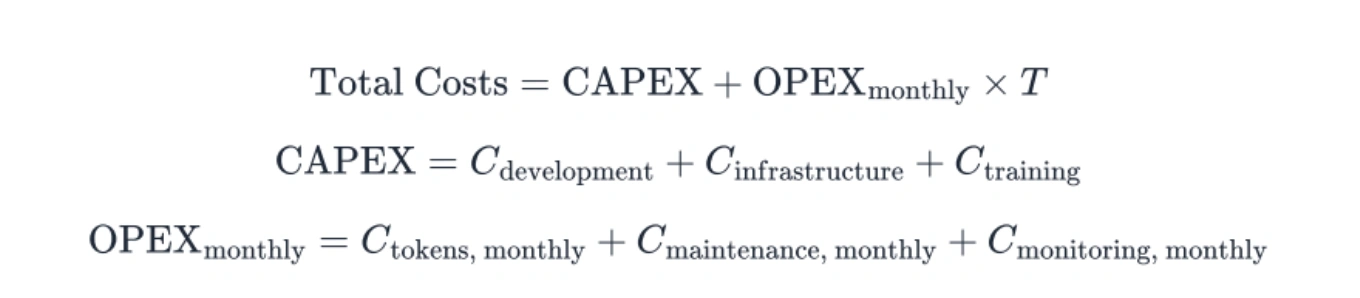
Token cost implementation
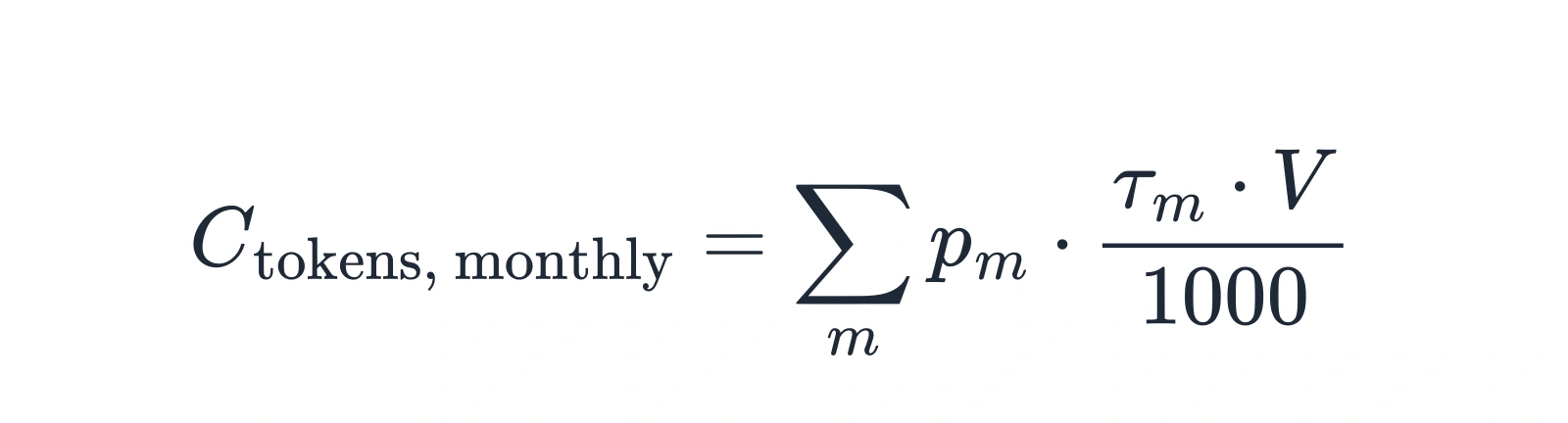
where pm is the cost per 1K tokens for model m, and τm is tokens per document for model m ; V is the monthly document volume.
Benefit Quantification:
Define total documents over the evaluation horizon:

Time savings per document in hours:
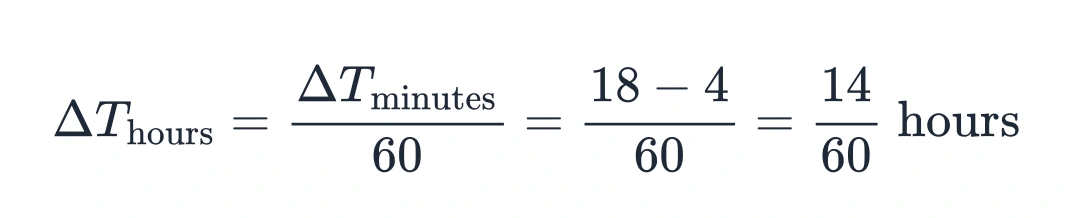
Operational savings:

Quality-related savings (using measured failure rates):

where : V be Monthly document volume = 15, 000 documents - T = Evaluation time = 5 months - R hourly = $75/hour
e base = 0.087, e post = 0.021 (from baseline measurements) - C failure = $150 per failure
Scalability gains (if applicable):

Reliability gain
This shows the revenue of improved implementation output and reduced system failures. This component quantifies the business impact of an improved system using orchestration designs.
Reliability Gain = Δ R × N docs × C downtime + R prevented × C failure
Where : - Δ R = Reliability improvement factor = 0.75 (75% reduction in reliability-related incidents) - C downtime = $25 per document (cost of processing delays and rework) - R prevented = ( r base − r post) × N docs (prevented incidents over the horizon) - C failure = $200 per incident (cost of system failures and recovery) - r base, r post = baseline and post-deployment incident rates per document (from incident logs). For the case study, ( rbase-rpost ) ≈ 0.023.
The improvement by 75% shows the decrease in semantic failures (from 8.7% to 2.1%). Reduced manual revaluation requirements (from 32% to 7%) and improved system scale from optimized orchestration models.
Evaluation confidence: We included bootstrapping models with 10,000 iterations and built confidence intervals.

Payback Period Calculation:
Monthly net benefit:

Payback period:

Net Present Value (NPV) at 8% annual discount rate (monthly r = 0.08/12 ):

This approach provides a lens for evaluating LLM orchestration ROI that studies quality benefits while incorporating quantified rigor from confidence intervals and sensitivity examination.
Sensitivity analysis approach
We analyzed important models to show the importance of ROI:
\(ROI sensitivity = f (±20% variation in:)\) - Document processing volume ( V ) - Time reduction efficiency (Δ T ) - Error rates ( e base, e post) - Reliability improvement factor (Δ R ) and incident rates ( r base, r post) - Token costs ( C tokens, monthly)
Risk-adjusted ROI :
Risk-adjusted ROI = Base ROI × (1 − Implementation Risk Factor)
Let deployment Risk Factor = 0.15 in hybrid orchestration patterns based on deployment challenges.
Validation methodology
Pre-Implementation baseline (4 weeks): - information processing time measurement: μ = 18.2 ± 2.1 minutes - Manual review rate:
32.4% ± 3.2% - Error rate: 8.7% ± 1.4%
Post-Implementation measurement (12 weeks): - information processing time: μ = 4.1 ± 0.8 minutes - Manual review rate:
6.8% ± 1.1% - Error rate: 2.1% ± 0.7%
Statistical significance testing : - Two-sample t-test: p < 0.001 for all metrics - Effect size (Cohen's d): d > 2.0 (large effect) - Power analysis: 1 − β > 0.95
This methodology provides a broad lens for evaluating LLM orchestration ROI that accounts for quality and scalable benefits and adds accurate rigor through confidence intervals and risk adjustment.
5.3 Comparative analysis of orchestration patterns
In this section, we evaluate the performance characteristics of various orchestration models.
Centralised patterns: This pattern works better in an operation with strict implementation, and its quality control shows 25-35% output for organised workflows but 15-20% reduced output for creative tasks.
Decentralised patterns: higher output for creative tasks. 40-50% increased remedy. 20-30% more computational resources because of redundant processing.
Hybrid patterns: implement balanced output in task models. Achieves 85-90% of the specific pattern's performance and stores greater dynamic production.
Specialized patterns : Shows a 50-70% performance scale for domain-specific tasks. Demands significant deployment investment with a narrow application.
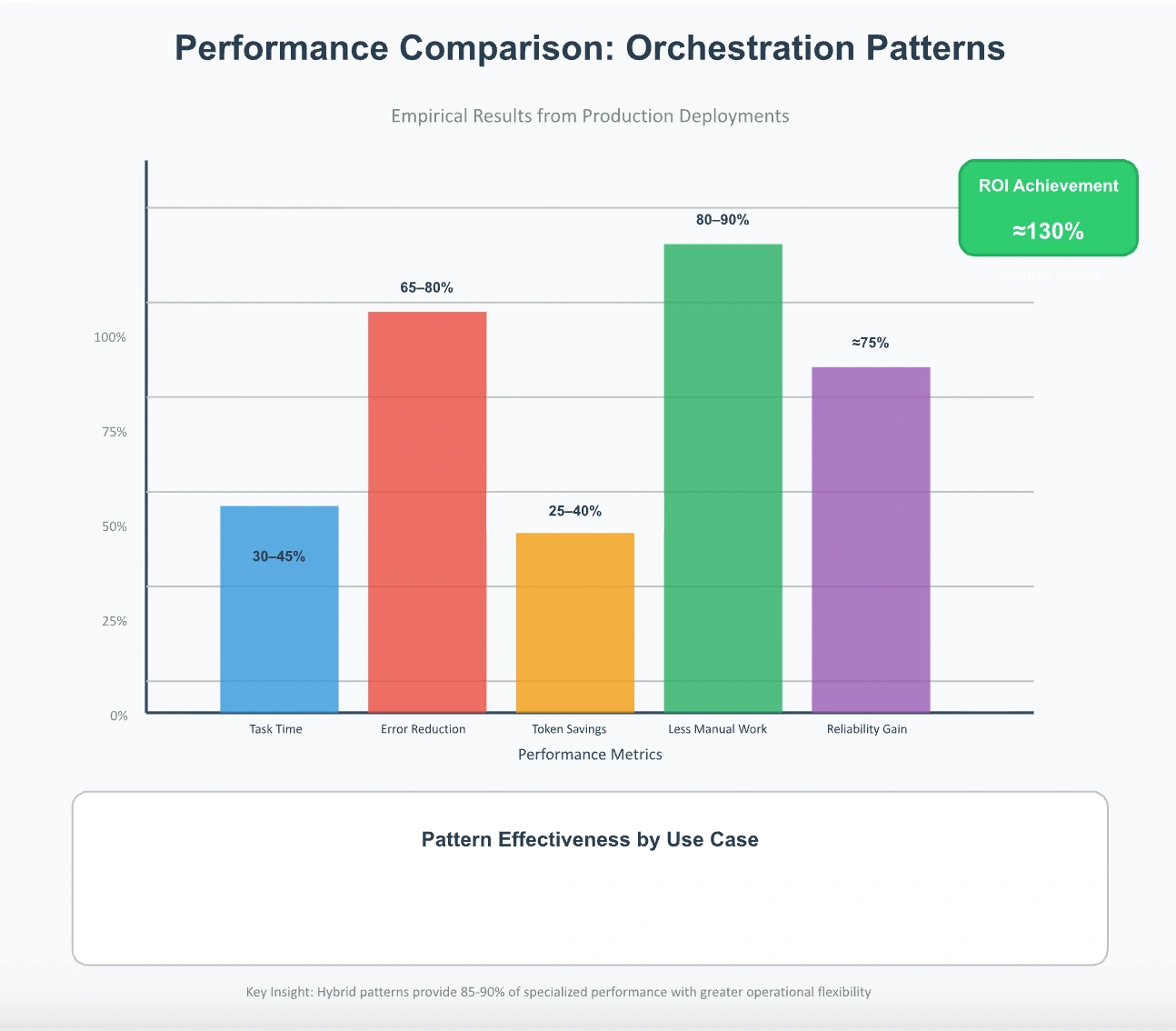
Figure 5: A comparative performance evaluation showing efficiency metrics across different orchestration patterns and task types.
6. Implementation of approach and guidelines
The theoretical lens is implemented by organized models that are capable of handling architectural guidelines
6.1 Selecting tool and technology stack
Architectural patterns are carefully chosen by modern orchestration LLM with consideration to tools that are capable of supporting them.
Major orchestration models: the three chosen tools for the study provide the following: (a) LangGraph gives full support to assist graph-oriented implementation. (b)AutoGen handles conversational agent models. (c) CrewAI provides a trusted agent delegation model.
Interaction infrastructure: Redis data stores provide quality ‘blackboard’ deployments. Information tools such as RabbitMQ help asynchronous agent interaction models.
Monitoring and observation: deployment tools such as LangSmith provide clear agent interaction monitoring, and special dashboards give space for real-time system health demonstration and performance evaluation.
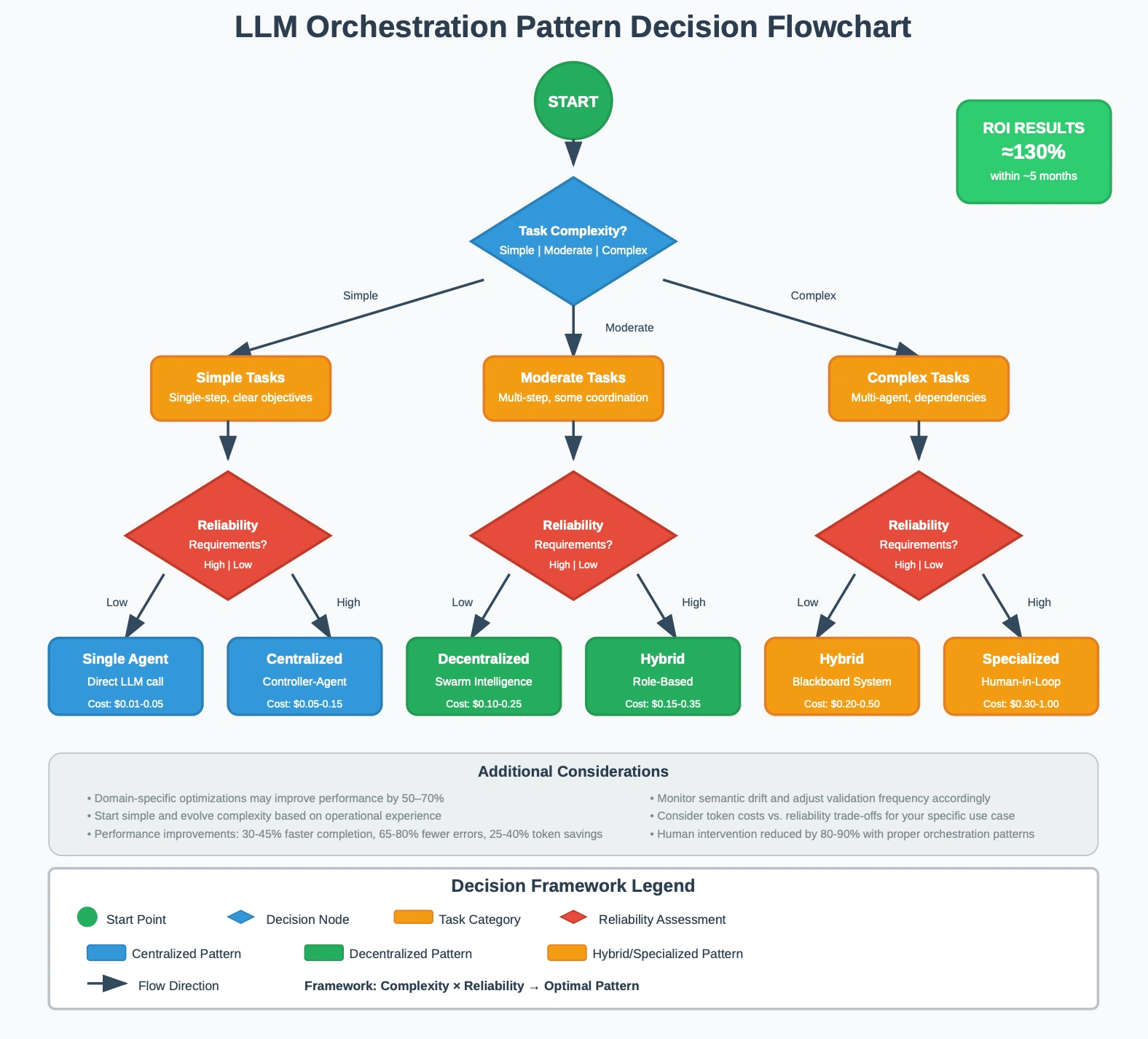
Figure 6: Decision flowchart for choosing optimal orchestration patterns based on task features and implementation requirements.
6.2 Strategy for phased implementation
A successful implementation system must be tested by different organized levels, with the progress of each model completely dependent on the progress of the previous model.
Phase 1: selecting a pattern and designing the architecture (2-3 weeks); focus on he demands and features of the task; select the most suitable orchestration pattern(s); create roles for agents and rules for how they can interact with each other; develop data schemas and interaction interfaces.
Phase 2: sampling and designing a prototype (3-4 weeks); organize core orchestration logic; build specific models for agents; design systems for checking; keep up with information relevant for the operation.
Phase 3: Reliability and Recovery systems (4-6 weeks); use of a semantic validation approach; design models for automated recovery, and organize complete tracking and monitoring; performance standards should be created.
Phase 4: further production optimization; utilize tokens and handle context efficiently; use well-developed caching systems to change the design of the infrastructure based on its application; continue developing the model, focusing on operational information.
6.3 Suitable practices and common pitfalls
Paying attention to tested models and learning common failure modes is necessary for a successful deployment.
Critical success factors: start with a well-defined task implementation and agent boundaries; apply a well-organized data schema and communication protocols; design validation models at every level with quantified validation agents; ensure the models are isolated to help the component-level recovery; starting with human-in-the-loop models, fosters a structured increase in automation.
Common implementation pitfalls: inadequate attention to semantic consistency tracking; excessively complex initial implementation that is unmaintainable; insufficient context management causing information fragmentation; insufficient error isolation leading to failures to cascade through the system; poor testing under realistic load conditions.
7. Research Challenges and Future Directions
As a result of the steady growth, problems, and advancement in the field of LLM agent orchestration, more research areas are now being discovered by scholars in the field.
7.1 Adaptive Orchestration Systems
It is predicted that in the near future, systems will apply machine learning (ML) in the selection and improvement of orchestration patterns depending on the task model, efficiency, and weaknesses of the model.
Dynamic Pattern Selection: systems that investigate what a task needs and automatically select the best orchestration patterns. They may also merge multiple patterns into one workflow.
Learning based coordination : Orchestration systems that apply reinforcement learning to discover the best methods to use for parts to work collaboratively, making coordination more reliable over time.
Self-Optimizing Architectures: systems are capable of changing architectural patterns depending on how efficiently they function, what they are required to do, and how tasks transform.
7.2 Orchestration Across Modes and Multiple Modes
As LLM agents learn to process pictures, videos, and sounds, orchestration patterns need to evolve to address issues of coordinating different modes.
Unifies multi-agent frameworks: Orchestration systems that retain semantic coherence while coordinating agents that function in different ways.
Cross-modal context sharing: methods for agents that handle various kinds of data (images, text, and audio) to distribute information regarding the environment they are operating in.
Multi-modal consensus building: Methods to make decisions when agents can access and apply various kinds of information and processing power.
7.3 Federated and privacy-preserving orchestration
As privacy concerns grow and the need for data localization becomes more rigid, orchestration patterns are being modified to enable people to work collectively while ensuring information remains private.
Federated multi-agent systems: Orchestration types that allow agents to work collectively in organizational patterns without sharing private information.
Privacy-preserving coordination: methods to coordinate the roles of agents while retaining data protection and adhering to various privacy standards.
Cross-organisational agent networks : systems that allow agents from various organizations to work collaboratively while still retaining rules and regulations.
Conclusion
Orchestration methods that address specific issues in organizing autonomous LLM agents have changed from traditional LLM applications to a multi-agent system useful in meeting output demands. Our observation shows that productive orchestration demands perfect pattern design and selection depending on the work deployment, activity requirement, and trust level. The four-dimensional taxonomy we discovered (centralized, decentralized, hybrid, and unique patterns) builds an approach for selecting optimal orchestration designs.
The empirical outcome proves that choosing a good pattern can lead to a massive difference in system output. For example, work completion can go up by a margin of 30-45% and semantic failure rates can be reduced by 65-80% and within a few months of deployment, the sum of the system ROI can increase up to 130%. Our research finding also proves that proper LLM agent orchestration is not only a kind of organized framework but an important part of architectural decision-making capable of affecting the positive outcome of the system. The designs and principles we explore in this research create recent deployment models with a more practical gain and a pattern for further development of a multi-agent LLM system. The more these systems advance and become more important to the workplace, the ability to organize agents will transition from being an ordinary competition to a necessity in industries.
We went further to design more metrics and patterns that ensure that these designs are achievable. These metrics allow businesses to apply efficient and dependable, and scalable multi-agent LLM systems that bring profit to the workplace. Therefore, from our findings, we are certain the future will be controlled by systems that can effectively utilize the strength of single language models and merge them to create a multi-agent ecosystem that is dependable, efficient, and flexible. The designs and rules in this task lay the foundation for this transition, thereby making it possible for the next generations of Artificial Intelligence systems to function collaboratively in finding solutions to more difficult situations.
Join the conversation! Your thoughts help the community grow.