

Artificial Intelligence is evolving faster than ever, and two powerful approaches have taken centre stage: MCP (Model Context Protocol) and RAG (Retrieval-Augmented Generation) . Both technologies help AI systems access external knowledge, but they work in fundamentally different ways.
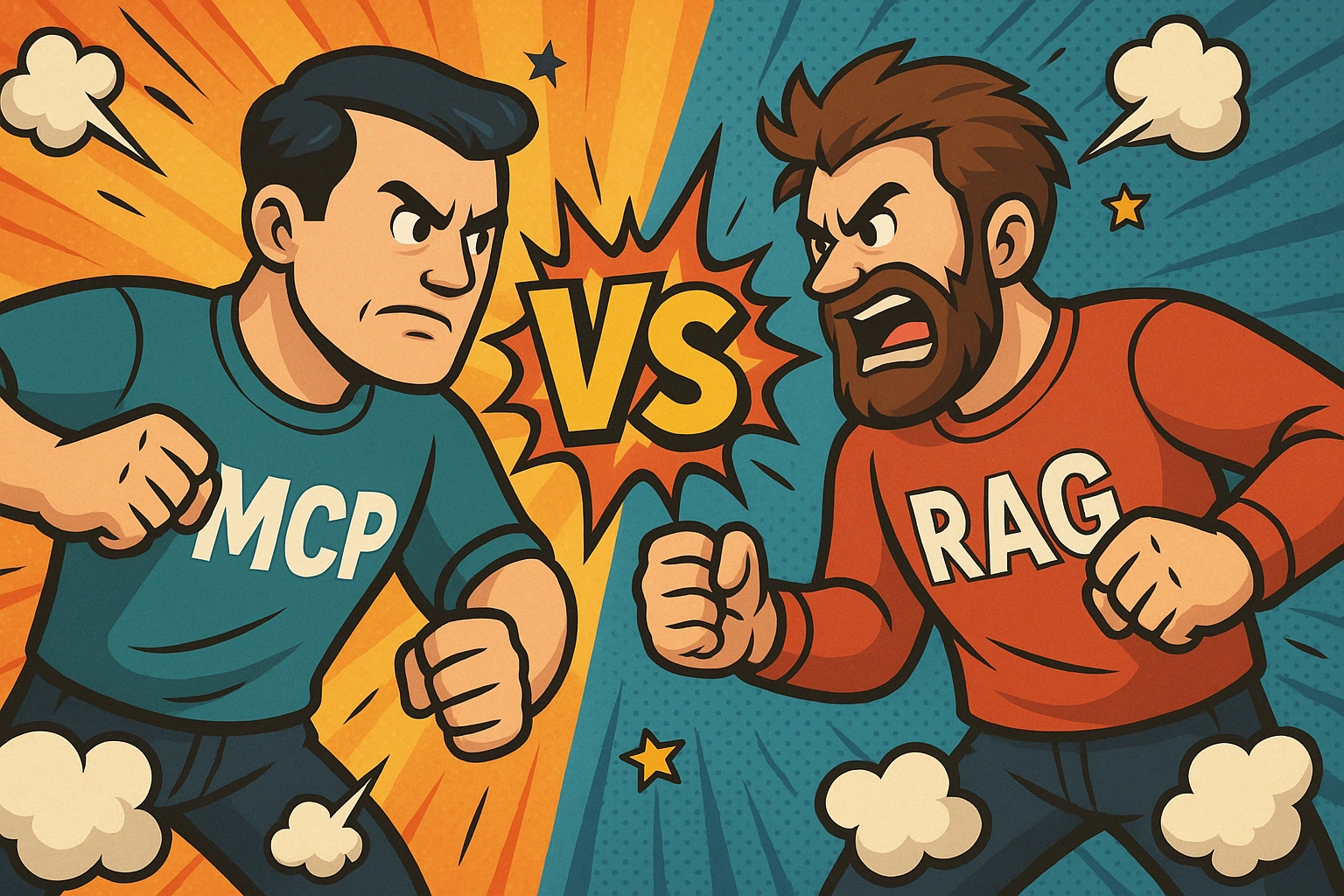
Think of it as a dramatic, action-packed cartoon fight between two champions battling to prove who’s better at powering innovative applications.
Let’s break this down with simple analogies , technical clarity , and real-world examples .
🧠 What is RAG?
RAG stands for Retrieval-Augmented Generation .
📌 In simple words:
RAG helps AI search your documents, databases, or APIs before responding .
It is like giving the model a library card and allowing it to look up facts on the fly.
👜 Non-Tech Analogy
Imagine a student during an open-book exam.
They don’t rely only on memory—they open textbooks, check notes, and then write the answer.
That’s RAG: search → read → respond .
💻 Technical Explanation
RAG works in three steps:
Chunking: Breaking data into small pieces.
Embedding: Converting each piece into a vector representation.
Retrieval: Finding the most relevant pieces when a query is asked.
Generation: The model uses retrieved text + its own capabilities to produce a final answer.
🔍 When to Use RAG
When you have documents
When data is frequently updated
When you want accurate, reference-based answers
For internal knowledge bases, support bots, enterprise search, RFP assistants
🚀 What is MCP?
MCP stands for Model Context Protocol , introduced to bring structured, secure plugin-like capabilities to AI models.
📌 In simple words:
MCP allows an AI model to talk to external tools, APIs, databases, or local systems in a trusted, controlled , and standardized way.
🧰 Non-Tech Analogy
Imagine an assistant who not only reads books but can also:
Operate your washing machine
Order food
Check your bank balance
Turn on the AC
Fetch files from your computer
That's MCP.
It gives AI superpowers by letting it safely interact with real systems, not just documents.
💻 Technical Explanation
MCP works using:
Servers → external systems (databases, APIs, file systems)
Clients → AI agents (ChatGPT, AI apps)
Tools → actions exposed (run queries, read files, create items etc.)
MCP enables:
Tool-calling
Custom workflow automation
Ability to execute structured commands
Safe sandboxes
🛠 When to Use MCP
✔ When building agentic AI apps
✔ When AI must perform tasks , not just answer questions
✔ For automation , workflow orchestration , and tool integration
✔ When connecting AI to real software systems (SAP, Jira, GitHub, Gmail, Databases)
💥 MCP vs RAG — Who Wins?
Just like in your cartoon fight image, both have unique strengths.
Let’s compare them with a simple metaphor.
⚔️ Non-Tech Analogy
Battle Between Two Heroes
| Hero | Specialty | Real-World Comparison |
|---|---|---|
| RAG | Knowledge Master | A student who studies hard and uses books to give correct answers. |
| MCP | Action Hero | A personal assistant who not only knows things but can actually do tasks for you. |
🟦 RAG = Thinker
🟩 MCP = Doer
They’re not enemies — they are teammates .
But for storytelling (and fun illustrations), their abilities feel like a battle of brains vs power .
⚙️ Technical Comparison Table
| Feature | RAG | MCP |
|---|---|---|
| Purpose | Enrich model answers with external knowledge | Let AI interact with external tools/systems |
| Data source | Mostly documents & text | APIs, databases, files, tools |
| Useful for | Q&A, enterprise search, chatbots | Automation, workflows, tool execution |
| Real-time operations | ❌ No | ✅ Yes |
| Handles structured data | Limited | Excellent |
| Needs embeddings/vector DB | Yes | No |
🏢 Real-World Use Cases
✔ Where RAG shines
Customer support chatbots
Enterprise search tools
Medical guideline assistants
Legal document Q&A
Internal knowledge systems (Confluence, SharePoint)
✔ Where MCP shines
AI that performs tasks (e.g., "create a JIRA ticket")
Email automation
File system operations
DevOps workflows
CRM/ERP integrations
Multi-step agent workflows
🎬 A Simple Real-Life Story (For Beginners)
Scenario: You're planning a birthday party
🟦 Using RAG
You ask: “What theme ideas can I use for a kids' party?”
RAG reads your “Party Ideas” PDF and gives suggestions.
🟩 Using MCP
You ask:
“Book a cake, create a shopping list, and invite 10 people.”
MCP:
Opens Zomato → orders cake
Creates a list in Google Keep
Sends invites via Gmail
This shows the key difference :
👉 RAG answers questions
👉 MCP executes actions
🤖 Why AI Needs Both
Modern AI systems aren’t just “chatbots.”
They are becoming agents capable of thinking, reasoning, and acting.
To build such a future AI:
We need RAG for accurate knowledge.
We need MCP for reliable actions.
Together, they create a supercharged AI ecosystem .
🏁 Conclusion
The battle between MCP and RAG isn’t about finding a winner — it’s about understanding their strengths.
RAG brings intelligence through document-based knowledge.
MCP brings capability through tool-based execution.
If RAG is the brain, MCP is the body that makes the brain’s ideas real.
Join the conversation! Your thoughts help the community grow.