

The conversation around AI agents has accelerated quickly. New frameworks, demos, and platforms appear almost every week, each promising automation, orchestration, and autonomous execution. Many of these systems are impressive. They can break tasks into steps, call tools, generate outputs, and complete workflows with increasing sophistication.
But there is still a major gap in most agentic systems.
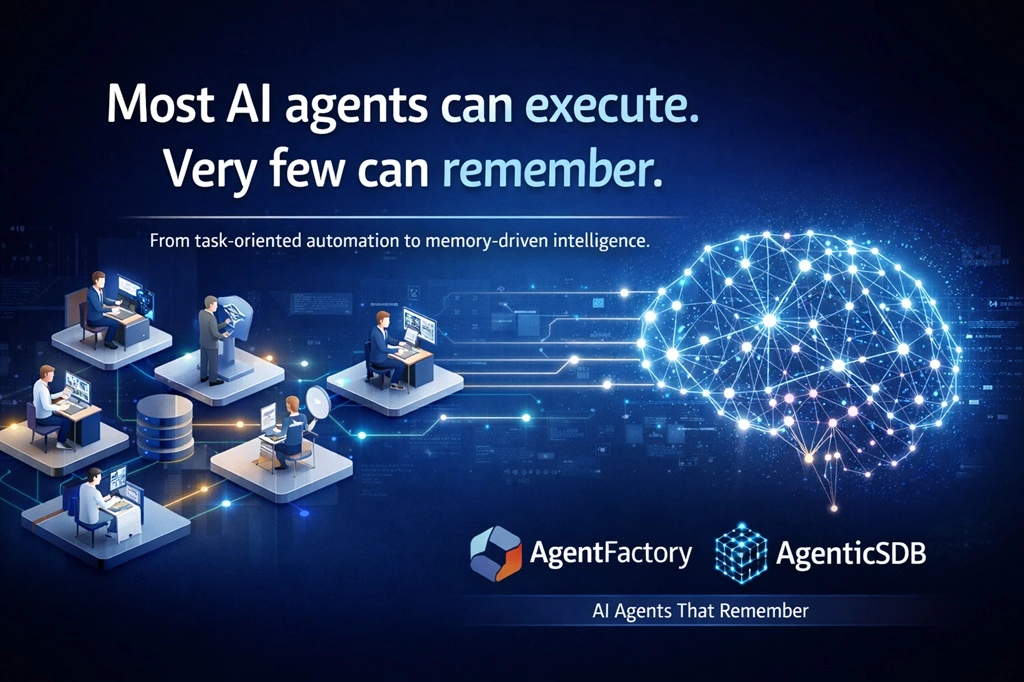
Most AI agents can execute. Very few can remember.
That distinction matters far more than it may seem at first. Execution is what gets attention in a demo. Memory is what determines whether an agentic system becomes genuinely useful in real-world environments.
In practice, enterprise work is not a sequence of isolated prompts. It is a continuous chain of requirements, decisions, revisions, defects, fixes, approvals, and lessons learned over time. Teams do not restart from zero every day. They build on prior knowledge. They reuse proven solutions. They avoid repeating the same mistakes. They operate with continuity.
If AI agents are going to move from novelty to infrastructure, they must begin to work the same way.
Execution Alone Is Not Enough
A task-only agent can appear productive in a controlled setting. Give it a clean input, a defined toolset, and a narrow objective, and it may perform well. But real production environments are rarely that simple.
Requirements evolve. Context accumulates. Architectural decisions made earlier affect implementation later. A QA finding should influence the next developer action. A previous bug fix may become relevant again in a future run. A clarification gathered by a business analyst should not disappear once a single session ends.
Without memory, agents often behave like temporary contractors with no institutional knowledge. They can work, but they cannot build continuity. Every task risks becoming another fresh start. Every run risks rediscovering the same lessons. Every team handoff risks losing context.
That is one of the main reasons many agentic systems still feel fragile in production. They can do things, but they do not yet retain enough of what matters.
Why Memory Changes the Equation
Memory transforms an agentic platform from an executor into a learning system.
When agents can retrieve relevant prior context, their outputs become more grounded. When they can preserve decisions, fixes, patterns, and quality findings, they become more aligned across roles. When they can reuse what worked before, they become more efficient and less repetitive.
This is especially important in multi-agent environments.
A Business Analyst may clarify requirements. An Architect may define structure. A Developer may implement. QA may identify gaps. UAT may surface new issues. In a traditional human team, these roles benefit from shared documentation, shared understanding, and historical awareness. In most AI systems today, that continuity is still weak or temporary.
Persistent memory changes that.
It allows the platform to carry forward useful knowledge across runs, across stages, and across roles. It creates the foundation for better consistency, better quality, and smarter remediation.
From Stateless Agents to Memory-Informed Teams
This is the direction behind integrating AgenticSDB into AgentFactory.
AgentFactory is designed around orchestrated AI teamwork across roles such as Business Analysis, Architecture, Development, QA, and UAT. It focuses on visible execution, structured collaboration, and guided delivery. But orchestration alone is only part of the equation.
AgenticSDB adds the missing layer: persistent, retrievable memory.
That memory can include requirement history, prior decisions, successful fixes, architecture patterns, remediation paths, defect patterns, and other forms of project intelligence that become valuable over time. Instead of forcing every run to begin as an isolated event, the platform can start to build continuity from what it already knows.
This does not mean storing everything indiscriminately. Useful memory is not just accumulation. It is selective, scoped, relevant retrieval. The value comes from surfacing the right prior knowledge at the right moment.
A developer agent should not be overwhelmed with noise. A QA agent should not receive irrelevant history. A BA agent should not ask users to restate things the system already knows with confidence. Good memory design is not about storing more. It is about making the platform more context-aware and more intelligent in how it retrieves and applies what it stores.
Where the Value Becomes Most Visible
The impact becomes especially clear in repair workflows.
One of the biggest limitations in many AI development systems is not initial generation. It is remediation. When things fail, weak systems fall back to broad retries, repetitive guesses, or noisy multi-file edits. They behave more like brute-force automation than careful engineering.
Memory makes better repair possible.
If a system can retrieve prior compile failures, known fix patterns, project-specific remediation history, or earlier successful approaches, it can respond more like a senior engineer who recognizes the shape of a problem. It can narrow the search space. It can prioritize likely root causes. It can avoid repeating unsuccessful attempts.
The same principle applies beyond repair.
Business Analysis becomes stronger when clarification history and scope decisions are retained. Architecture becomes stronger when previous patterns and tradeoffs are available for reference. QA becomes stronger when prior defects and validation trends can inform new reviews. Multi-agent collaboration becomes stronger when every role can access a shared layer of project memory rather than operating in isolation.
This is where agentic systems begin to mature.
Enterprise AI Needs Continuity
For enterprise adoption, this matters deeply.
Enterprises do not just need agents that can complete a task. They need systems that can operate with continuity, governance, repeatability, and contextual intelligence. They need AI platforms that become more useful over time, not systems that repeatedly reset their understanding.
They also need memory to be handled responsibly. It must be tenant-aware, scoped correctly, and designed to support separation of context across customers, projects, and workstreams. In an enterprise setting, memory cannot be an afterthought. It must be part of the architecture.
That is why the future of agentic systems is not just about more tools, more prompts, or more orchestration layers. It is about combining execution with context, continuity, and retrievable intelligence.
The Shift Ahead
The next wave of agentic platforms will not be defined only by what agents can do in a single run. They will be defined by what agents can carry forward across runs.
That is the real shift.
From stateless execution to stateful collaboration. From isolated outputs to accumulated intelligence. From temporary automation to systems with memory.
Most AI agents can execute. Very few can remember.
That is precisely why memory may become one of the most important architectural layers in the future of enterprise AI.
If we want AI teams that are more reliable, more aligned, and more effective over time, then execution is only the starting point.
Memory is what makes the system grow up.
Join the conversation! Your thoughts help the community grow.