

A prerequisite to understand this
To understand mTLS (Mutual TLS) clearly, you should be familiar with:
Client–server communication
HTTPS and TLS basics
Public/private key cryptography
Certificate Authority (CA)
X.509 certificates
No deep cryptography knowledge is required.
Introduction
mTLS (Mutual Transport Layer Security) is a security protocol in which both the client and the server authenticate each other using digital certificates before establishing a secure connection.
Standard TLS → server authentication only
mTLS → both client and server authentication
After successful authentication:
Communication is encrypted
Identities are verified
Trust is established mutually
What problem can we solve with mTLS?
1. Insecure Client Authentication API keys, passwords, and tokens: Can be leaked or reused. Are difficult to rotate safely mTLS replaces them with certificate-based identity.
2. Man-in-the-Middle (MITM) Attacks
mTLS ensures: Server authenticity and Client authenticity
An attacker cannot impersonate either side.
3. Zero-Trust Architecture :
No implicit trust based on network location.
Every request is authenticated and verified
4. Secure Service-to-Service Communication
Strong identity for each service
Reliable authorization decisions
About Certificates
What is a Certificate?
A certificate is a digitally signed identity document that binds an identity (service/user) to a public key
Certificate Components
Private Key (never shared)
Public Certificate
Common Name (CN)
Subject Alternative Names (SAN)
Issuer (CA)
Expiry date
Digital signature
Certificate Authority (CA)
Signs and validates certificates
Establishes trust
Can be public or private
Both client and server trust the same CA or trusted chain.
Trust Stores
A Trust Store is a secure repository of trusted Certificate Authority (CA) certificates.
Client trust store → trusted server CAs
Server trust store → trusted client CAs
A trust store does NOT contain private keys. It only contains, Root CA certificates and Intermediate CA certificates
The trust store is used to verify the identity of the peer during TLS or mTLS communication.
How to Implement This?
Create a Certificate Authority (CA)
Issue client and server certificates
Configure server to require client certificates
Configure client to present its certificate
Perform authorization based on certificate identity
Establish encrypted communication
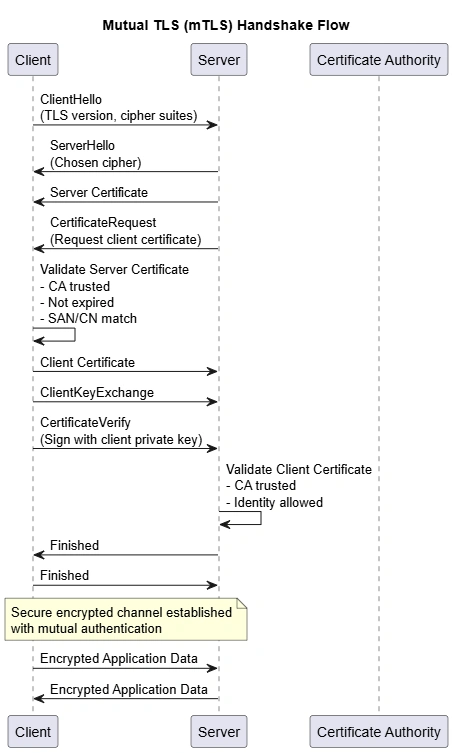
Identity & Authorization
After authentication:
Identity is extracted from certificate (CN, SAN, SPIFFE ID)
Authorization rules are applied (RBAC / ABAC)
Advantages
Strong mutual authentication
No shared secrets (passwords, API keys)
End-to-end encryption
Resistant to MITM attacks
Ideal for zero-trust networks
Suitable for microservices and internal APIs
Summary
mTLS = TLS + Client Authentication.
mTLS can be understood as TLS with added client authentication, where both the client and the server verify each other’s identity using digital certificates rather than relying on passwords or shared secrets. Trust is established through a Certificate Authority (CA) that both parties recognize, ensuring that only valid and authorized identities can communicate. Once verification is complete, all communication is fully encrypted and identity-aware, allowing systems to make secure authorization decisions based on cryptographic identity. Because of these properties, mTLS serves as a foundational building block for zero-trust architectures and secure service-to-service communication, especially in modern distributed and microservices-based systems.
Join the conversation! Your thoughts help the community grow.