

Introduction
In this article, we will discuss multiple exceptions in Java 7. It's a new feature released by Java 7 to improve performance. First, we discuss exceptions and exception handling and after that multiple exception in Java 7.
Exception in Java
In terms of dictionaries, an exception is an abnormal condition. When an error occurs within a method, the method creates an object and hands it off to the runtime system. The object, called an exception object, contains information about the error, including its type and the state of the program when the error occurred. Creating an exception object and handing it to the runtime system is called throwing an exception.
In Java, an exception is an event that disrupts the normal flow of a program.
When we execute our program, sometimes an error is generated for some of the reasons given below, when this error is generated during execution it is called an exception. The exception can occur:
- When the user has entered incorrect data or we can say invalid data.
- When we opened a file that's needed in the program but can't be found.
- Sometimes when the network connection is lost during the execution of the program.
To understand exceptions in Java, you need to understand the two categories of exceptions; they are:
- Checked Exception (also called a compile-time exception)
- Unchecked Exception (also called a run-time exception)
Checked Exception
It is also called a compile-time exception since they occur during compilation of the program. For example, sevletException, ClassNotFoundExp, NoSuchFieldException etc.
Unchecked Exception
It is also called a run-time exception since they occur during run-time. Such an exception is not checked at compile-time, in other words, NullPointerException, OutOfMemoryError, etc.
Example
- public class RunTimeExcpn
- {
- public static void main(String[] args)
- {
- String str = null;
- int len = str.length();
- }
- }
Output
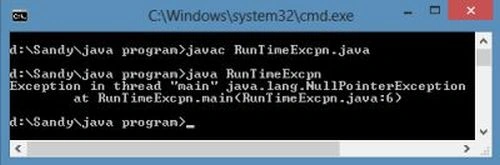
Now the subject arises of how to overcome this problem of exception, for that Java provides am exception handler technique. Now we discuss exception handling in Java.
Exception Handling in Java
It is a powerful feature provided in Java. It is a mechanism to handle run-time errors so that the normal flow of the program is maintained.
Exception handling consists of the following five keywords:
- Try
- Catch
- Finally
- Throw
- Throws
Now, we show an example for exception handling:
- class Demo
- {
- public static void main(String args[])
- {
- try
- {
- int data=50/0;
- }
- catch(ArithmeticException e)
- {
- System.out.println(e);
- }
- System.out.println("remaining code");
- }
- }
Output
In this program, an arithmetic exception occurs that is sometimes called "divide by null error" problem, for handling this exception we use a "try-catch block". In the try block, we write the code where the problem occurs and in the catch block, we catch the exception as determined by its type. In this program the arithmetic exception is generated so we use a catch(ArithmeticException e) statement to maintain the flow of the program.
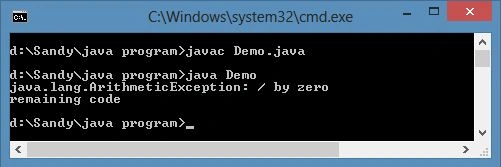
We are not going into the details of Exception Handling; our topic is "multiple exceptions in Java 7". So for discussing our topic we take a short look at "exception" and "exception handling" in Java.
Multiple Exception in Java 7 new concept
It provides a way of "Handling More Than One Type of Exception". Java 7 made it possible to catch various exceptions in the same catch block that is not possible in prior versions of Java. This is also known as multi-catch.
In prior versions of Java:
Join the conversation! Your thoughts help the community grow.