

Object lifetime is the time when a block of memory is allocated to this object during some process of execution and that block of memory is released when the process ends. Once the object is allocated with memory, it is necessary to release that memory so that it is used for further processing, otherwise, it would result in memory leaks. We have a class in .Net that releases memory automatically for us when the object is no longer used. We will try to understand the entire scenario thoroughly of how objects are created and allocated memory and then deallocated when the object is out of scope.
The class is a blueprint that describes how an instance of this type will look and feel in memory. This instance is the object of that class type. A block of memory is allocated when the new keyword is used to instantiate the new object and the constructor is called. This block of memory is big enough to hold the object. When we declare a class variable it is allocated on the stack and the time it hits a new keyword and then it is allocated on the heap. In other words, when an object of a class is created it is allocated on the heap with the C# new keyword operator. However, a new keyword returns a reference to the object on the heap, not the actual object itself. This reference variable is stored on the stack for further use in applications.
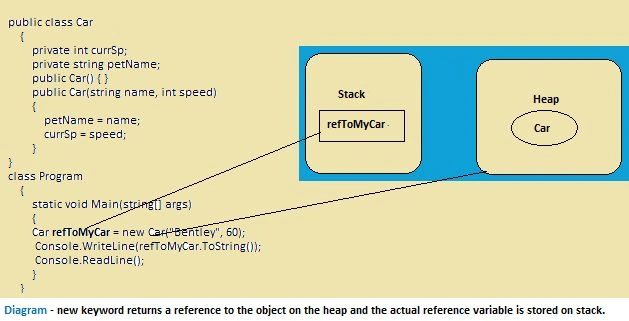 When the new operator is used to create an object, memory is taken from the managed heap for this object and the managed heap is more than just a random chunk of memory accessed by the CLR. When the object is no longer used then it is de-allocated from the memory so that this memory can be reused.
The key pillar of the .NET Framework is the automatic garbage collection that manages memory for all .NET applications. When an object is instantiated the garbage collector will destroy the object when it is no longer needed. There is no explicit memory deallocation since the garbage collector monitors unused objects and does a collection to free up memory that is an automatic process. The Garbage Collector removes objects from the heap when they are unreachable by any part of your codebase. The .Net garbage collector will compact empty blocks of memory for the purpose of optimization.
The heap is categorized into three generations so it can handle long-lived and short-lived objects. Garbage collection primarily occurs with the reclamation of short-lived objects that typically occupy only a small part of the heap.
Generations
There are the following three generations of objects on the heap:
When the new operator is used to create an object, memory is taken from the managed heap for this object and the managed heap is more than just a random chunk of memory accessed by the CLR. When the object is no longer used then it is de-allocated from the memory so that this memory can be reused.
The key pillar of the .NET Framework is the automatic garbage collection that manages memory for all .NET applications. When an object is instantiated the garbage collector will destroy the object when it is no longer needed. There is no explicit memory deallocation since the garbage collector monitors unused objects and does a collection to free up memory that is an automatic process. The Garbage Collector removes objects from the heap when they are unreachable by any part of your codebase. The .Net garbage collector will compact empty blocks of memory for the purpose of optimization.
The heap is categorized into three generations so it can handle long-lived and short-lived objects. Garbage collection primarily occurs with the reclamation of short-lived objects that typically occupy only a small part of the heap.
Generations
There are the following three generations of objects on the heap:
- Generation 0: Newly created objects are in Generation 0. These objects on Generation 0 are collected frequently to ensure that short-lived objects are quickly collected and the memory is released. Objects that survive Generation 0, the collections are promoted to Generation 1. Most objects are reclaimed for garbage collection in Generation 0 and do not survive to the next generation.
- Generation 1: Objects that are collected less frequently than Generation 0 and contains longer-lived objects that were promoted from Generation 0. Objects that survive Generation 1, collection are promoted to Generation 2.
- Generation 2: Objects promoted from Generation 1 that are the longest-lived objects and collected infrequently. The overall strategy of the garbage collector is to collect and move longer-lived objects less frequently.
The garbage collector cleans up managed resources automatically since the managed code is directly targeted by the CLR. But when the object uses unmanaged resources like database connections or file manipulation, that needs to be released manually and this can be done by a finalize method.
We use the destructor method using the (~) sign in our code to destroy the objects and this destructor is converted into a finalize method (check in the compiled code). This is known as a finalization process. If we are implementing Finalize(), we do not have control since when this method should be called the garbage collector takes care of this on its own. In the finalization process, there are two collection cycles to completely release the object's memory. During the first collection pass, the object is flagged for finalization. After the finalization occurs, the garbage collector can reclaim the object's memory and the memory is released.
There is another method, Dispose(), that releases managed and unmanaged resources explicitly. This method is the single method in an IDisposable interface and can be used to release unmanaged resources manually.
I have written another article on the IDisposable pattern in which we would have a clear picture of the difference between Finalize() and Dispose ().
Meesala HarikaPosted Mar 23, 2023, 8:49 AM
Good explanation
Kaushal PareekPosted Aug 1, 2018, 12:54 AM
Nicely explained. thanks
Sarbeswar SahooPosted Dec 27, 2016, 2:18 AM
Nice article and implementable
Sanjay SabariyaPosted Jun 27, 2016, 1:50 AM
Great article. it is very useful for me.
Mahendra GapatPosted May 17, 2016, 8:40 AM
its very useful article
Jimit GandhiPosted Apr 16, 2016, 10:40 AM
Good article...
Mohsin AzamPosted Oct 17, 2015, 12:41 AM
nice one
Nihal AhmedPosted Aug 19, 2015, 7:07 AM
Nice share.
Abhishek MalakarPosted Aug 18, 2015, 4:58 PM
Good one, Thank You!!
Shridhar SharmaPosted Aug 18, 2015, 1:26 PM
nice
Chervine BhiwooPosted Aug 18, 2015, 11:23 AM
Thanks for sharing
Vipul MalhotraPosted Aug 18, 2015, 10:12 AM
nice Article
Sibeesh VenuPosted Aug 18, 2015, 8:14 AM
Nice Share
Sumit JoshiPosted Aug 18, 2015, 7:36 AM
Thanks for sharing
Rahul PrajapatPosted Aug 18, 2015, 7:32 AM
Nice article..
Karthikeyan KPosted Aug 18, 2015, 5:39 AM
Good one...Thanks for sharing
Sanjukta PearlPosted Aug 18, 2015, 5:31 AM
lot of thanks to all :)
Narasimha Reddy ChennupalliPosted Aug 18, 2015, 5:30 AM
Nice one
Nilesh JadavPosted Aug 18, 2015, 5:15 AM
Nice share mam
Vaikesh K PPosted Aug 18, 2015, 4:37 AM
Great one :)
Rajeesh MenothPosted Aug 18, 2015, 4:28 AM
Good One
Sanjukta PearlPosted Jul 17, 2015, 4:53 AM
Thank you all :)
Pankaj BajajPosted Jul 16, 2015, 8:59 PM
Gud one Sanjukta,, Great Start and Keep writing..
Santhakumar MunuswamyPosted Jul 16, 2015, 4:01 PM
Welcome
Santhakumar MunuswamyPosted Jul 16, 2015, 4:01 PM
Good Start
Santhakumar MunuswamyPosted Jul 16, 2015, 4:00 PM
Good Article! Thanks for sharing
Gopi ChandPosted Jul 15, 2015, 12:37 PM
Great
Sibeesh VenuPosted Jul 15, 2015, 5:32 AM
Nice Share Thank you :)
Sanjukta PearlPosted Jul 15, 2015, 3:44 AM
Thanks to all for liking my article :).... Cheers!!!
Abhishek YadavPosted Jul 15, 2015, 3:37 AM
Nice explanation Sanjukta!!!
Debasis SahaPosted Jul 15, 2015, 12:45 AM
Nice one..
Upendra Pratap ShahiPosted Jul 15, 2015, 12:41 AM
Nice demonstration mam..
Nilesh JadavPosted Jul 15, 2015, 12:07 AM
Nice information !
Pankaj Kumar ChoudharyPosted Jul 14, 2015, 11:02 PM
Such A Nice Explain mAm...........