

Introduction
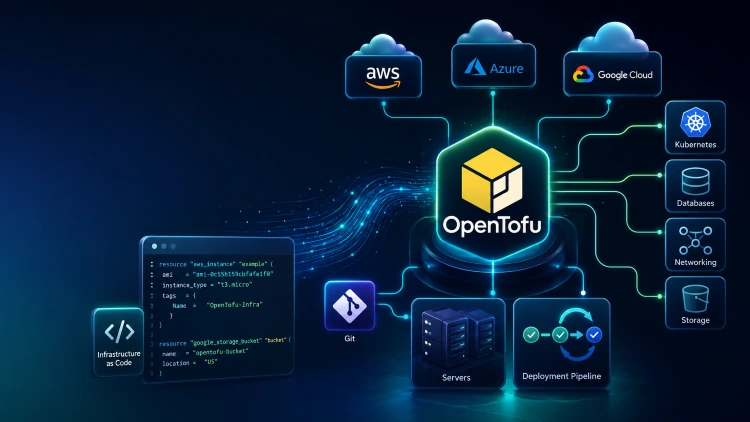
Managing cloud infrastructure manually becomes increasingly difficult as applications grow. Modern environments often include virtual machines, Kubernetes clusters, databases, storage services, networking components, and security configurations spread across multiple cloud providers.
Traditionally, infrastructure teams used manual scripts or cloud consoles to provision resources. While this approach works for small environments, it quickly becomes difficult to maintain, audit, and scale.
This challenge led to the rise of Infrastructure as Code (IaC), a practice that allows infrastructure to be defined, versioned, and deployed using code.
Terraform became one of the most widely adopted IaC tools in the industry. However, the emergence of OpenTofu has given organizations a fully open-source alternative that maintains compatibility with existing Terraform workflows while being governed by the community.
In this article, we'll explore what OpenTofu is, how it works, and why it is becoming an important tool for cloud infrastructure management.
What Is OpenTofu?
OpenTofu is an open-source Infrastructure as Code platform that enables teams to define, provision, and manage cloud resources using declarative configuration files.
The project was created by the Linux Foundation and the broader open-source community to provide a vendor-neutral IaC solution.
OpenTofu allows developers and operations teams to manage:
Virtual machines
Kubernetes clusters
Databases
Networking resources
Cloud storage
DNS configurations
Security policies
Instead of manually creating resources through cloud dashboards, teams define infrastructure in code and deploy it consistently across environments.
Why Infrastructure as Code Matters
Consider a typical cloud application.
Infrastructure requirements might include:
Load Balancer
Application Servers
Database
Object Storage
Virtual Network
Security Groups
Creating these resources manually introduces several challenges:
Configuration drift
Human error
Inconsistent environments
Slow deployments
Difficult disaster recovery
Infrastructure as Code solves these problems by treating infrastructure the same way developers treat application code.
Benefits include:
Version control
Repeatable deployments
Automated provisioning
Faster recovery
Easier collaboration
Understanding OpenTofu Architecture
A simplified OpenTofu workflow looks like this:
Configuration Files
         |
         v
      OpenTofu
         |
         v
Cloud Provider APIs
         |
         v
Infrastructure Resources
OpenTofu reads configuration files, determines the desired infrastructure state, and communicates with cloud provider APIs to create or update resources.
This process makes deployments predictable and reproducible.
Core Concepts in OpenTofu
Providers
Providers enable OpenTofu to interact with external platforms.
Examples include:
AWS
Azure
Google Cloud
Kubernetes
GitHub
Cloudflare
Example:
provider "aws" {
  region = "us-east-1"
}
The provider acts as a bridge between OpenTofu and the target platform.
Resources
Resources represent infrastructure components.
Example:
resource "aws_s3_bucket" "app_storage" {
  bucket = "my-application-storage"
}
This configuration creates an S3 bucket in AWS.
Resources are the building blocks of infrastructure definitions.
Variables
Variables make configurations reusable.
Example:
variable "environment" {
  type = string
}
Usage:
tags = {
  Environment = var.environment
}
This allows the same configuration to be deployed across development, testing, and production environments.
Creating Your First Infrastructure Configuration
Suppose you want to provision a virtual machine in AWS.
Example:
provider "aws" {
  region = "us-east-1"
}

resource "aws_instance" "web_server" {
  ami           = "ami-12345678"
  instance_type = "t3.micro"

  tags = {
    Name = "WebServer"
  }
}
This configuration defines a virtual machine and its properties.
OpenTofu automatically manages the provisioning process.
Initializing a Project
Before deploying infrastructure, initialize the project:
tofu init
This command:
Downloads providers
Initializes the working directory
Prepares dependencies
Initialization only needs to be performed once per project.
Planning Infrastructure Changes
One of OpenTofu's most valuable features is the ability to preview changes.
Example:
tofu plan
Output may indicate:
+ Create AWS Instance
+ Create Security Group
This preview helps teams validate changes before deployment.
Applying Infrastructure
Once the plan is reviewed, deploy the infrastructure:
tofu apply
OpenTofu provisions the required resources automatically.
Benefits include:
Reduced manual effort
Consistent deployments
Improved reliability
State Management
OpenTofu maintains a state file that tracks deployed resources.
Example:
Infrastructure State
       |
       +-- Virtual Machines
       +-- Databases
       +-- Networks
The state file enables OpenTofu to determine what changes are required during future deployments.
Proper state management is essential for production environments.
Multi-Cloud Deployments
Many organizations operate across multiple cloud providers.
OpenTofu supports multi-cloud deployments through providers.
Example architecture:
OpenTofu
    |
    +-- AWS
    +-- Azure
    +-- Google Cloud
This enables teams to manage diverse infrastructure using a single workflow.
Common Use Cases
Cloud Infrastructure Provisioning
Automate deployment of compute, networking, and storage resources.
Kubernetes Management
Deploy and configure Kubernetes clusters consistently.
Disaster Recovery
Recreate infrastructure quickly from version-controlled configurations.
Environment Replication
Create identical development, staging, and production environments.
Compliance and Governance
Maintain auditable infrastructure definitions.
Best Practices
Store Configurations in Version Control
Keep infrastructure definitions in Git repositories for tracking and collaboration.
Use Remote State Storage
Avoid storing production state files locally.
Modularize Configurations
Break large infrastructure definitions into reusable modules.
Review Plans Before Deployment
Always execute tofu plan before applying changes.
Protect Sensitive Information
Store secrets in dedicated secret-management solutions rather than configuration files.
OpenTofu vs Manual Cloud Management
| Feature | Manual Management | OpenTofu |
|---|---|---|
| Automation | No | Yes |
| Version Control | No | Yes |
| Repeatable Deployments | Limited | Yes |
| Multi-Cloud Support | Difficult | Yes |
| Change Tracking | Limited | Yes |
| Scalability | Moderate | Excellent |
OpenTofu provides a significantly more structured and scalable approach to cloud infrastructure management.
Conclusion
OpenTofu brings the benefits of Infrastructure as Code to modern cloud environments through a fully open-source and community-driven platform. By allowing teams to define infrastructure declaratively, automate deployments, and manage resources consistently, it reduces operational complexity while improving reliability.
Whether you're provisioning cloud resources, managing Kubernetes clusters, implementing multi-cloud strategies, or building automated deployment pipelines, OpenTofu provides a powerful foundation for infrastructure management. As organizations continue to embrace automation and cloud-native architectures, tools like OpenTofu are becoming essential components of modern DevOps and cloud operations workflows.
Comments
Join the conversation! Your thoughts help the community grow.